
Indeed, the fundamental difference between protective earthing, functional grounding, and the neutral wire lies in their role. Protective earthing is there to protect people from electric shocks in the event of a fault. Functional grounding stabilizes the system by providing a reference voltage. As for the neutral wire, it is simply the return path for the current during normal operation. Even though they are sometimes connected, their functions are quite distinct and absolutely not interchangeable.
The fundamentals of electrical safety
Therefore, delving into electrical safety concepts is crucial to ensuring the reliability of any installation. Confusing the terms "earthing," "grounding," and "neutral" is a common mirod, but one that can have serious consequences for engineers, technicians, and site managers. The aim here is to clarify their specific, though often interconnected, roles from the outset.
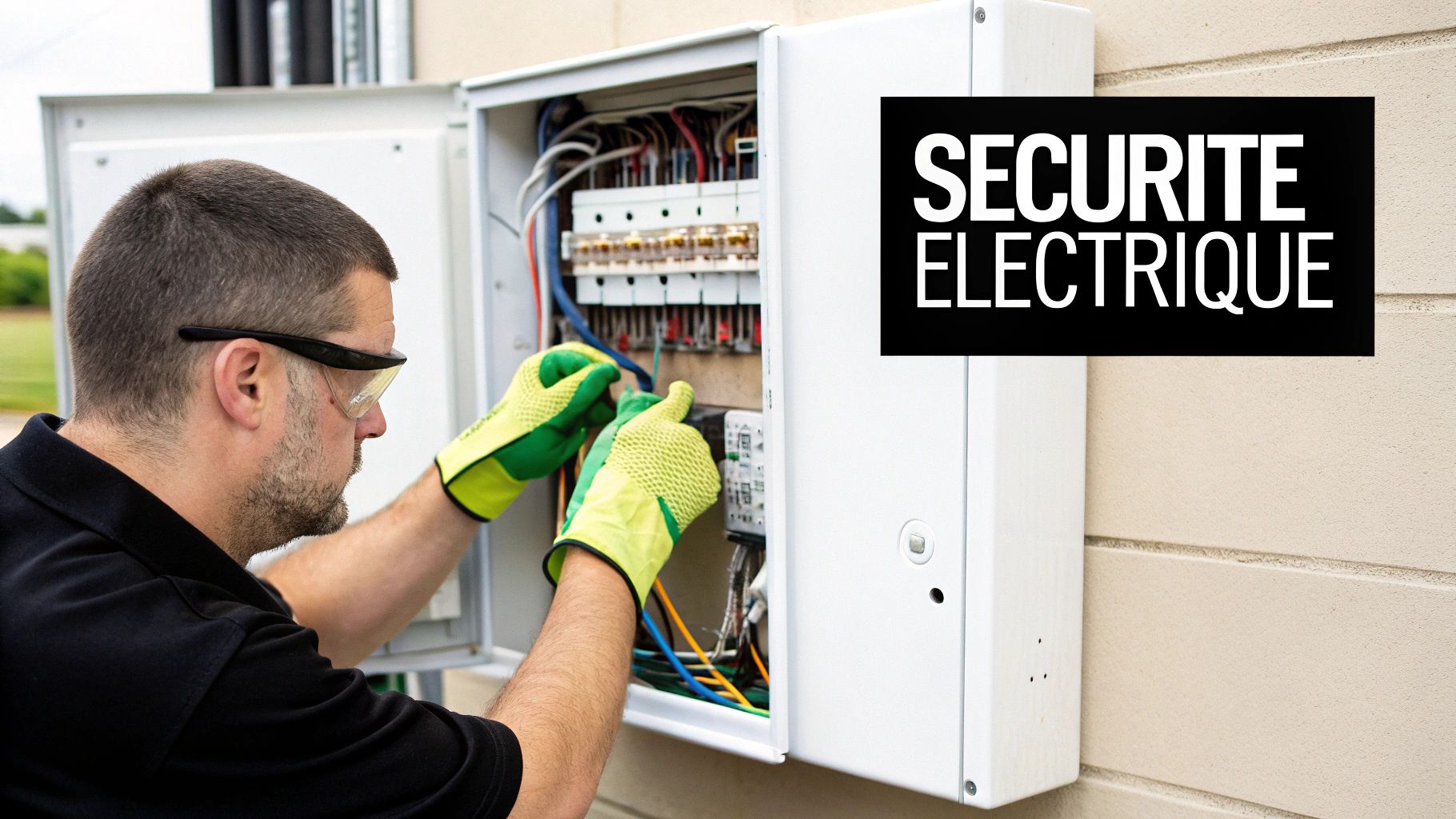
Furthermore, understanding these distinctions goes far beyond mere theory; it's a practical necessity in the field. Misinterpretation can lead to non-compliant installations, risks of electrocution, and costly equipment failures. The goal is simple: to give you the tools to accurately identify the function of each conductor.
Furthermore, this foundation is essential before tackling earthing schemes (SLT) or lightning protection strategies, all while respecting reference standards such as NF C 15-100 in France or the IEC 62305 internationally.
Quick distinction of concepts
To get off to a good start, let's recap the primary function of each term. This table provides a clear and quick overview, a good starting point before going into the details.
| Concept | Main role | Immediate objective |
|---|---|---|
| Earthing | Protection of people | Provide a low impedance path for the fault current to trip the protections. |
| Grounding | System stability | Create a stable voltage reference (the famous 0 Volt ) so that the devices function correctly. |
| Neutral | Return of the current | Allow the current to complete its circuit and return to the source under normal conditions. |
Furthermore, electrical safety is based on a golden rule: each conductor has a specific role and should never be used for anything else. Swapping the neutral and ground wires, for example, is a bit like disconnecting an airbag before driving.
Note that this distinction becomes absolutely critical when designing lightning protection systems. A good earthing system is designed to handle lightning currents of tens of thousands of amps. A faulty connection could inject this destructive energy directly into your internal wiring, frying sensitive equipment and endangering the lives of the occupants.
Roles and functions: earth, mass, and neutral
To properly distinguish between protective earthing, functional grounding, and the neutral conductor , it's essential to first understand the purpose of each. While they all work together to ensure the safety and performance of an electrical installation, their roles are neither the same nor interchangeable. Each conductor has a specific function, whether during normal operation or in the event of a problem.
In general, mixing their functions can have serious consequences, ranging from simple equipment failure to the risk of electrocution. Therefore, having a clear understanding of these concepts is the foundation of any safe and standards-compliant electrical design.
Earthing (protective grounding): the lifeline
In practice, earthing , more commonly known as protective earthing (PE conductor, for Protective Earth ), is there for one single reason: the safety of people. Its purpose is to protect against electric shocks if an insulation fault occurs.
To illustrate, consider the example of a washing machine: if a wire becomes disconnected inside and touches the metal casing, it becomes live. Without proper grounding, anyone touching it risks electrocution. This is where the grounding conductor comes in, providing a path of very low resistance so that this leakage current flows directly to the ground.
Remember that this sudden and intense current spike is immediately detected by the residual current circuit breaker. It then cuts off the power supply in milliseconds, well before an accident can occur.
It's important to note that the protective earthing is a backup system, designed for emergency use only. Under normal circumstances, no current should flow through it. It's your electrical safety net.
Grounding (functional earthing): the reference point
In reality, grounding , or functional earthing, plays a completely different role. It guarantees the stability and proper functioning of the electrical system. Its purpose is to create a common and stable voltage reference point, generally set at 0 volts , against which all other voltages in the circuit are measured.
Indeed, this reference is absolutely critical for sensitive electronic equipment, which requires very precise voltage signals to operate correctly. Without a reliable grounding point, the system would be subject to voltage fluctuations, electrical noise, and interference, potentially leading to malfunctions or even hardware failures.
However, System stability : It sets a reference potential for the entire network.
However, Equipment Protection : It helps to dissipate static charges and transient overvoltages.
On the other hand, Reliability of operations : It ensures that electronic devices communicate and operate on a common voltage basis.
However, in many installations, particularly at the electricity supplier's transformer, the neutral point is connected to earth (it is said to be grounded ) to establish this reference. To delve deeper into the subject, please consult our article on the fundamentals of grounding , which details these essential principles.
The neutral: the return path of the current
Finally, the neutral (conductor N) is an active part of the electrical circuit during normal operation. Its job is to provide a return path for the current so that it can flow back to its source and thus complete the circuit. It's quite simple.
For example, unlike the protective earth wire, the neutral wire is designed to carry current continuously. While the live wire carries energy to the appliance, the neutral wire carries it back to its point of origin. It's a veritable highway where the traffic never stops. This is precisely why the NF C 15-100 using the neutral conductor as a protective conductor.
To make things clearer, the table below summarizes these fundamental differences.
Comparison of key functions
In particular, this table highlights the fundamental differences between earthing, grounding and neutral under normal conditions and in the event of an electrical fault.
| Concept | Main function | Objective | Behavior in case of fault |
|---|---|---|---|
| Earthing | Human security | Protecting people from electric shocks. | It becomes the main path for fault current, activating the protections. |
| Grounding (Mass) | System stability | Provide a stable voltage reference ( 0V ). | Helps stabilize system voltages in the face of disturbances. |
| Neutral | Normal operation | Ensure the return of current to the source. | Can become dangerously energized if the connection to the source is broken. |
In short, the earth protects people, the ground protects equipment and ensures stability, and the neutral simply makes the circuit work. Three distinct roles, but all essential.
Comparison of earthing systems: TT, TN and IT
Now that we have clearly distinguished between protective earthing , functional grounding , and the role of the neutral, let's see how all of this is orchestrated in practice. In France, the NF C 15-100 the neutral of the EDF transformer and the metallic parts of your installation are connected to the earth.
In this respect, the choice of a grounding system is far from a minor detail. It directly impacts personal safety, service continuity, and the type of protective devices to install. Each system—TT, TN, and IT—has its specific purpose, whether for a house, a workshop, or a hospital. Understanding the difference between earthing, grounding, and neutral in each configuration is therefore a prerequisite for any serious electrician.
The TT scheme: the benchmark for residential security
In this context, the TT system is the classic choice for domestic installations in France. Its logic relies on a distinct double grounding system. On one side, the neutral of the supplier's transformer is grounded (the first T). On the other side, in your home, all metallic parts (the refrigerator casing, metal window frames) are connected to your own grounding rod (the second T).
In other words, the crucial point is that there is no direct connection between neutral and earth in your electrical panel. This separation is the cornerstone of the system.
In other words, imagine an insulation fault, a wire touching the casing of your washing machine. The leakage current cannot simply return to its source through a cable. It is forced to take a detour through the ground to complete the circuit. This path through the ground offers significant resistance, which, fortunately, limits the intensity of the fault current.
First, this low current is good news for safety, but bad news for conventional circuit breakers. They simply don't "see" it. This is where the savior of the TT system comes in: the high-sensitivity residual current device (the famous 30 mA). It is the only one capable of detecting this tiny leak and cutting off the power in a fraction of a second, before you even feel anything.
Furthermore, the strength of the TT system lies in its simplicity and very high level of safety for people, as long as the residual current device (RCD) is functioning correctly. It is the default, and most logical, choice for residential and small commercial buildings.
The TN system: the solution designed for industry
Finally, the TN system completely changes the game. Here, everything is directly connected. The transformer neutral is indeed grounded at the source (T), but the exposed conductor parts of the installation are connected directly to this neutral via a protective conductor (PE). The N therefore signifies that the earth and neutral are interconnected. Only one earth connection is used: that of the distribution network operator.
It is important to note that this direct connection creates a very low-impedance pathway for fault currents. If a phase touches ground, it is no longer a small leakage current, but a complete and significant short circuit. The fault current becomes very high, allowing conventional protective devices (magnetic circuit breakers, fuses) to detect it and react instantly.
Note that this scheme comes in three variations:
Indeed, TN-C : The neutral (N) and the protective conductor (PE) are combined into a single conductor called PEN. This is a somewhat outdated system, now prohibited in final circuits for safety reasons.
Thus, TN-S : The neutral and protective conductors are two separate conductors (S) throughout the installation. This is the safest and most modern version of the TN system.
Furthermore, TN-CS : A mix of the two. We start in TN-C with a PEN conductor, then at a certain point in the installation, we separate it into two distinct conductors (PE and N) for the rest of the circuit.
Furthermore, in France, the TT system is dominant in residential buildings and represents approximately 85% of single-family homes, according to RTE data. This approach, enshrined in the NF C 15-100 standard since 1991, reduces the risk of electrocution by 40% compared to poorly implemented TN systems, according to a 2019 UTE study. For those who wish to delve deeper into the subject, the article on types of grounding systems on Easi-Spare is a valuable resource.
The IT plan: absolute priority on service continuity
Furthermore, the IT scheme is the most sophisticated of the three. It is only found where a power outage is simply unthinkable: operating rooms, data centers, critical production lines.
Note that its principle is radical: the transformer's neutral is either completely isolated from earth (I), or connected via a very high impedance. The installation's exposed conductor parts, however, are properly connected to a local earth connection, much like in a TT system.
In general, the advantage is enormous. At the first insulation fault (a phase touching a ground), nothing happens. The fault current cannot close because the neutral is suspended. It is so weak that it is harmless and, above all, it does not trigger any protection. The factory continues to run, the surgeon continues to operate.
In practice, of course, we can't leave it like that. The fault is immediately signaled by an alarm (visual and audible), and the maintenance team must intervene to locate and repair it. Because if a second fault appears on another phase, we end up with a direct short circuit between two phases, and that trips the power. Insulation monitoring is handled by a dedicated device, the Permanent Insulation Controller (PIC) .
In concrete terms, this mind map summarizes well how each diagram prioritizes protection, stability and the return path of the current.
Let us remember that it is clear that while all schemes aim for security, IT places continuity of service at the same level of importance, which changes the whole philosophy of fault management.
The impact on protection against lightning and surges
It's crucial to understand that when discussing lightning protection, clearly distinguishing between earthing, grounding, and neutral becomes absolutely vital. A minor connection or misinterpretation isn't just a simple glitch; it can transform a lightning strike into a disaster for your equipment and the safety of the entire site. The robustness of your lightning protection system depends entirely on the correct application of these fundamental concepts.
In reality, a reliable protection system, compliant with standards such as NFC 17-102 IEC 62305 series , relies on a very clear separation of roles. The goal is simple: to intercept the phenomenal energy of a lightning strike and guide it to the ground as quickly and safely as possible, without it causing chaos in the building's electrical system.
Grounding, the first line of defense against lightning
Indeed, the protective grounding ( earthing ) of a surge protection system is not an ordinary grounding system. It is designed for an extreme mission: to dissipate impulse currents that can reach up to 200,000 amps in a matter of microseconds. To achieve this feat, the path to the ground must be as short and direct as possible, with minimal resistance.
However, this is why a dedicated ground connection for lightning protection is non-negotiable. Its resistance must be as low as possible, ideally less than 10 Ω . This value guarantees that the lightning's energy will dissipate through this preferred path, instead of venturing down circuitous routes such as the internal electrical network.
However, think of the lightning ground connection as a one-way highway, reserved exclusively for the dissipation of lightning currents. Attempting to combine it with other functions will create the conditions for a major incident on your network.
Mistaking the ground connection for the neutral, or creating an incorrect equipotential bonding, can have devastating consequences. If lightning finds a path to the installation's neutral, it injects massive overvoltages that propagate instantly to all connected equipment, causing irreparable damage.
The strategic role of surge protectors
Even with a perfect ground connection, the flow of such a violent lightning current causes a considerable rise in potential at ground level. This voltage can then travel back up through conduction into the building. This is precisely where surge protective devices ) come into play, acting as sentinels for your electrical system.
Their mission is to detect an abnormal power surge and immediately create a short circuit to ground, thus protecting all sensitive equipment downstream. The positioning of these guardians is therefore purely strategic:
Head surge arrester (Type 1) : Installed at the level of the main low voltage switchboard (TGBT), it absorbs the main shock and diverts most of the energy.
Secondary Surge Arrester (Type 2) : Placed in distribution boards, it refines the protection for circuits that are further away or more fragile.
Thin surge arrester (Type 3) : Installed as close as possible to critical equipment (servers, automation systems, medical equipment), it skims the smallest residual overvoltages.
An installation without surge protectors, or with poorly coordinated devices, is like leaving the front door wide open in the middle of a storm. The key is to ensure a proper grounding system and a well-designed surge protection network. For more information, our article on the purpose of a grounding system for lightning rods will provide further details.
The influence of earthing schemes
The way surges are managed also depends on the earthing system (ESS) of your installation. The TN system, and more specifically its TN-CS variant, is used in approximately 65% of industrial installations in France. For a site manager, this information is vital: an abnormal voltage between neutral and earth exceeding 2 V is often a sign of a fault. Given that there are approximately 50,000 thunderstorms per year in France, Météo-France estimates that 30% of lightning-related damage affects TN systems that are poorly protected by surge arresters or have faulty earthing.
Finally, Equipotential Spark Gap is the true cornerstone of any effective protection. It consists of interconnecting all the metallic masses of the building (framework, pipes, cable trays) to the main grounding system. This practice ensures that in the event of a lightning strike, all these conductor elements rise to the same potential, preventing the development of dangerous voltage differences between two points that could be touched. Neglecting Equipotential Spark Gap risks the formation of destructive electrical arcs within the building itself.
Verification and maintenance: the essential link in safety
A protection system, however well-designed, is only reliable if it is regularly checked. Effective grounding is not a "set it and forget it" installation. Its performance can degrade over time due to corrosion, ground movement, or even subsequent work that disrupts the network. For maintenance managers, a clear understanding of the difference between earthing, grounding, and neutral is the starting point for a rigorous verification strategy.
This preventive maintenance is the only guarantee that fault current discharge paths remain fully operational. It ensures the safety of personnel and the longevity of equipment. In practice, it relies on a series of measurements and visual inspections to be carried out at regular intervals, in accordance with applicable standards.
Measuring the resistance of the grounding electrode
The key indicator, the true health report of your grounding system, is its resistance. For it to effectively dissipate dangerous currents, this value must be as low as possible, typically less than 10 Ω for lightning protection systems.
To measure it, a tellurometer . This specialized device injects a current into the ground via auxiliary rods to calculate the resistance. The "62% method" is the most reliable and widely used. It involves placing the measuring rods far enough apart to be outside the influence zones of the grounding system being tested and other buried conductive masses.
Taking these measurements regularly makes it possible to detect progressive degradation and to act before it is too late, for example by adding earthing rods or improving the conductivity of the soil.
Continuity and voltage check
The ground connection is only one element of the circuit. The integrity of the entire protection chain must be ensured.
Continuity check : This is a non-negotiable step. It is essential to verify that all protective earth (PE) conductors are properly connected, from the equipment casing to the main earthing bar. A simple ohmmeter in continuity mode is sufficient to detect a loose connection or a damaged cable.
Neutral-to-earth voltage check : Under normal operating conditions, a very low voltage (generally < 2 V ) is often observed between neutral and earth. If this value rises abnormally, it is a warning sign: this may indicate a load imbalance, a fault in the neutral conductor, or a poor earth connection. An investigation is required immediately.
These checks are particularly critical in IT earthing systems. In France, this system is used in 12% of sensitive industrial sites, such as hospitals, where it reduces downtime by 70% compared to TT/TN systems during a lightning strike. The IEC 62305 standard goes further and requires, for these sites, an earthing system specifically dedicated to lightning protection, capable of dissipating up to 100 kA per pulse, and which must be completely independent of the IT neutral. For further information on these aspects, the technical resources on earthing systems from Eduscol are an excellent reference.
Unverified protection is nonexistent protection. Periodic maintenance is not a mere regulatory formality; it is the active assurance that your security shield is always up.
The contribution of connected monitoring
Traditional maintenance, however essential, remains sporadic. For major risks such as lightning, real-time monitoring offers an unparalleled level of safety.
Innovative solutions, such as our Contact@ir system , enable remote and continuous monitoring of the status of lightning protection installations. This tool immediately detects the slightest anomaly, whether it's a lightning strike on a lightning rod or a break in the continuity of the down conductor.
This approach transforms maintenance from a reactive mode, where intervention occurs after an incident, to a truly proactive risk management strategy. You are alerted in real time and can intervene before a failure compromises the security of your site. This guarantees that your system is 100% operational, 24/7 .
Summary and recommendations for professionals
For any building or industrial professional, a thorough understanding of protective earthing, functional grounding, and neutral is not optional, it's essential. These three pillars, together, ensure the safety and reliability of an electrical installation. Let's review their roles to guide your decisions in the field.
In short, earthing is your life insurance: its sole purpose is to dissipate dangerous fault currents to protect people. Grounding ensures system stability by creating a reliable 0-volt , essential for the proper functioning of appliances. The neutral wire , meanwhile, is simply the return path for current during normal operation.
Best practices for a flawless installation
Ensuring the safety and compliance of an installation requires a rigorous and methodical approach. Here are the essential points of vigilance for any electrician or technician.
Strictly adhere to the standards : Compliance with French standards, such as NF C 15-100 for low-voltage installations or NFC 17-102 for lightning protection, is non-negotiable. It is the foundation of any safe design.
Aim for perfect equipotentiality : It is crucial to ensure that all metallic parts of the building (structure, pipes, cable trays) are properly interconnected and connected to the main earthing system. This connection prevents the occurrence of dangerous potential differences, whether due to an insulation fault or a lightning strike.
Never mix up functions : A golden rule: never use the neutral conductor (N) as a protective conductor (PE). Their roles are fundamentally different, and confusing them renders the safety devices inoperable.
For complex projects, and especially those involving lightning protection, consulting experts is essential. A thorough risk analysis is always the first step towards a reliable and long-lasting solution.
Given these challenges, we strongly encourage you to contact our teams for a complete risk audit of your facilities.
Frequently asked questions about grounding and neutral
In practice, certain questions keep coming up. Let's clarify things by directly answering the most common questions, based on the standards and principles we have just seen.
Can the neutral and ground be connected together?
The answer is a no for a final electrical installation in France. The NF C 15-100 explicitly prohibits it. The neutral conductor (N) and the protective conductor (PE) must remain separate.
The only point where they are connected is well upstream, at the electricity supplier's transformer. If you create an additional connection in your installation, you will bypass the residual current device (RCD). Worse, you will transform all your metal parts into potential pathways for current, which is extremely dangerous.
What is the ideal earth resistance for a lightning rod?
When it comes to lightning protection, the rule is simple: the lower the better. Reference standards, such as NF C 17-102 , are very clear on this point. They mandate an earth resistance of less than 10 ohms (Ω) .
Never forget that low resistance is the only way to ensure that the enormous lightning current is dissipated to the ground as quickly and efficiently as possible. This prevents power surges that can be destructive to the building, its equipment, and, of course, the people inside.
Why do we measure a voltage between neutral and ground?
It is perfectly normal to find a small voltage between neutral and ground, often between 0 and 2 volts. This is not a fault; it is simply the physical consequence of the current flowing through the neutral conductor. Like any wire, it has resistance, and the flow of current creates this small voltage drop.
However, if your multimeter displays a reading that climbs, say above 5V , it's a warning sign. Such a reading indicates a potential problem: poor phase balance, a break or loose connection on the neutral wire, or even a faulty ground connection. In this case, you must investigate immediately to ensure safety.
To protect your most critical installations against lightning and power surges, trust the expertise of LPS France . Discover our comprehensive solutions, from risk assessment to connected monitoring, on our official website .