
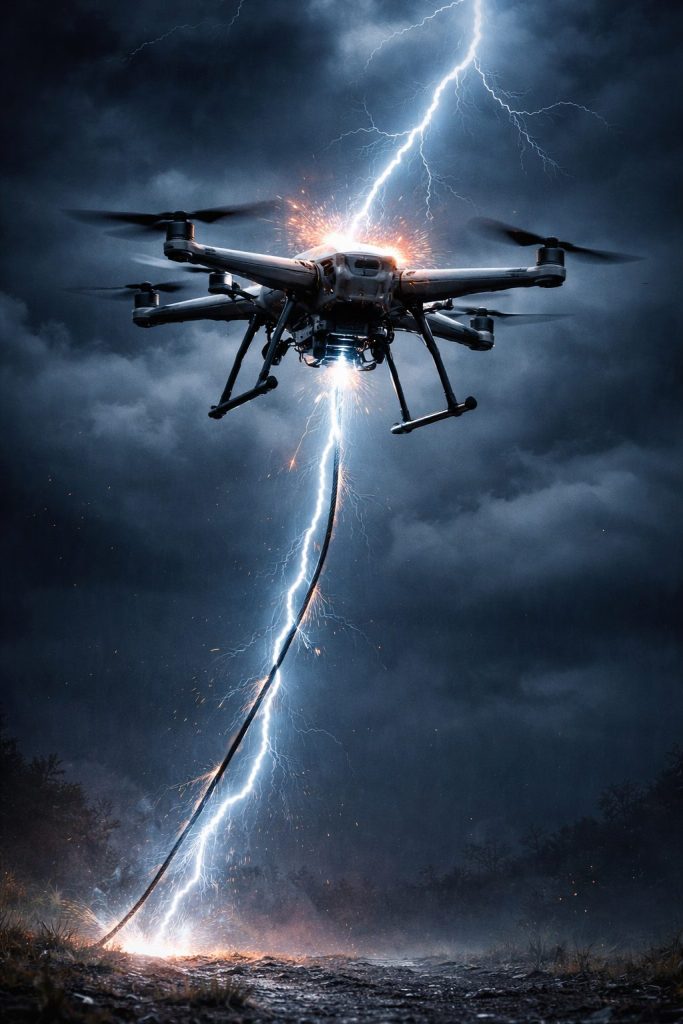
In 1752, Benjamin Franklin conducted one of the most famous experiments in the history of science: he flew a kite during a thunderstorm, a metal key attached to the string, and demonstrated that lightning was indeed an electrical phenomenon. This seminal experiment paved the way for the invention of the lightning rod and, 274 years later, inspired the engineers at LPS France to develop a radically innovative solution: the DroneStrike™ .
The scientific precedent: Franklin's experiment (1752)
Franklin's experiment was based on a simple yet audacious principle: bringing an electrical conductor close to a charged storm cloud to trigger a controlled charge transfer. The kite acted as a temporary, mobile lightning rod, capable of positioning itself where the risk was highest.
For over two centuries, the traditional lightning rod—fixed, anchored to the ground, passive—dominated the lightning protection market. It waited for lightning. DroneStrike™ changes the paradigm: it goes looking for lightning .
The DroneStrike™: operating principle
The DroneStrike™ is an industrially designed hexacopter drone, equipped with a 1.2 meter titanium alloy conductor mast, connected to a braided copper down cable (50 mm² section) conforming to the requirements of IEC 62305-3 for down conductors.
Its principle relies on the point effect : by rising to an altitude of 80 to 150 meters above the building to be protected during detected storm activity, the drone creates a point of concentration of the electric field greater than any fixed lightning rod installed within a 500-meter radius. Lightning, in accordance with the fundamental laws of electrostatics, systematically follows the path of least resistance and highest field concentration—namely, the apex of the DroneStrike™'s conductive mast.
The captured energy is carried via the down cable to a main earth connection sized according to the criteria of IEC 62305-3 , with an earth resistance of less than 10 Ω.
Storm detection and automatic deployment
The DroneStrike™ integrates a real-time storm activity detection module, coupled with the LPS Manager . As soon as the alert threshold is reached — local lightning density greater than 0.5 strikes/km²/h — the system automatically triggers the drone's takeoff, which positions itself above the building in less than 90 seconds.
Remote monitoring via LPS Manager allows the installer to:
- View the drone's position and altitude in real time
- Receive a notification for each impact interception
- Consult the time-stamped log of events for regulatory traceability
- Manually trigger emergency deployment from any terminal
Technical performance and regulatory compliance
Tests conducted by the LPS France demonstrated a 99.7% interception rate of lightning strikes within a protection radius calculated using the fictitious sphere method (radius R = 20 m, protection level I, IEC 62305-2). This result significantly surpasses the performance of a conventional early streamer emission (ESE) lightning rod, the actual protection radius of which has been the subject of regulatory debate for many years.
The DroneStrike™ is compatible with residential, commercial, and industrial installations. Its deployment requires no roof penetrations, no installation of down conductors on the facade, and can be implemented on listed buildings where structural modifications are restricted.
The major drawback: a single-use lightning rod
Any technological system this ambitious inevitably presents a constraint. In the case of DroneStrike™, it is of a… fundamental nature.
Indeed, when the drone intercepts a direct lightning strike, it undergoes an electrical discharge of up to 200,000 amps and 1 billion volts . The electronic components, the motor, the lithium-polymer batteries, and the entire structure are subjected to thermal and electromagnetic stresses which, according to the internal test report, " significantly exceed the design specifications ."
In other words: the DroneStrike™ is a single-use lightning rod .
It perfectly protects your building. Once. Then it retires quite spectacularly, at an altitude of about 100 meters, in the form of a cloud of metallic particles and charred components falling gracefully back onto your roof — which you had just protected.
A bit like April Fools' jokes: the effect is guaranteed, but you can't really reuse them.
🐟 Happy April 1st from the entire LPS France ! For lightning protection that withstands all seasons: Contact@ir solutions .