
Each lightning bolt that streaks across the sky releases phenomenal energy, capable of obliterating anything it touches. Faced with this raw force of nature, a lightning rod should be seen not as a shield that repels the onslaught, but rather as an agile and strategic guide. Moreover, its true role is to provide a path of least resistance, a kind of safe highway so that the devastating energy of lightning can be channeled and dispersed safely into the ground. This is what protects the building, its equipment, and of course, the people inside.
What is the real purpose of a lightning rod?
Furthermore, the lightning rod is just the tip of the iceberg, the visible part of a much more complex lightning protection system (LPS). Indeed, a common misconception needs to be dispelled: it doesn't prevent lightning from striking, nor does it "repel" it. On the contrary, its job is to attract it, to intercept it in a controlled manner before it strikes a vulnerable point in the building.
Furthermore, to grasp the scale of the problem, the figures speak for themselves. In 2022, the Météorage network recorded no fewer than 566,706 lightning strikes in France alone. Every year, lightning causes around a hundred injuries and ten deaths. And that's not all: without adequate protection, around a hundred single-family homes were directly struck in 2022, and ten church steeples were destroyed—a significant loss for our heritage. To delve deeper into the subject, the statistics on lightning risks in France are quite revealing.
Why protecting oneself has become non-negotiable
Indeed, far from being a mere gadget, a lightning protection system is a lifeline for many buildings. Ultimately, an uncontrolled direct strike opens the door to catastrophic scenarios.
- Fire risk: The electrical current from a lightning strike is so intense that it can instantly ignite building materials, triggering flash fires.
- Structural damage: The shock wave can literally shatter concrete, brick or wood, threatening the very stability of the structure.
- Damaged equipment: Overvoltages that propagate through electrical and communication networks can destroy all connected electronic devices in a fraction of a second.
First, a well-designed and properly installed lightning protection system, like those we design at LPS France, is currently the only reliable response to this risk. Finally, it transforms an unpredictable threat into a manageable event, guaranteeing the safety of people and the continuity of operations.
Note that in the following sections, we will break down how these systems work, starting with basic physical principles and moving towards cutting-edge technologies. The goal: to give you all the tools you need to understand and implement truly effective protection.
The science behind lightning capture
To truly understand how a lightning rod works, imagine a real race against time unfolding in a stormy sky. It's important to note that the lightning rod doesn't passively wait for the strike; it actively intercepts lightning based on very specific principles of physics. It all starts in the cloud, where a massive electrical charge accumulates.
When this tension reaches a breaking point, the cloud releases what is called a "downward leader." Imagine a channel of ionized air, almost invisible, descending in spurts toward the ground. Remember that it instinctively seeks the shortest and most conductor path to release its energy. It is the first participant in the race.
Meanwhile, on the ground, the intense electric field triggers a chain reaction. For example, the most prominent and conductor objects—a tree, the corner of a roof, or, in the best-case scenario, a lightning rod—begin to emit their own channels of ionized air upwards. These are called "upward leaders.
Win the race to the sky
Furthermore, the lightning rod is specifically designed to be the clear favorite in this race. Its secret? Its strategic location on the highest point of the building and its construction from highly conductor materials. These advantages allow it to concentrate the electric field at its tip, thus launching its upward leader much earlier and with greater force than any other point in the vicinity.
This is the crucial moment. The descending leader from the cloud meets the ascending leader emitted by the lightning rod. A perfect conducting bridge is then created between the sky and the earth.
This moment of connection is crucial. By creating this bridge before anyone else, the lightning rod designates itself as the deliberate and controlled point of impact. It dictates the lightning's trajectory, diverting it away from vulnerable parts of the structure.
Furthermore, once this channel is established, the main lightning discharge—a phenomenal electrical current that can exceed hundreds of thousands of amperes —flows through it like a highway. The energy is safely intercepted, but the system's mission is only just beginning.
Note that the process takes place in three stages: interception, channeling and dispersion of energy in the ground.
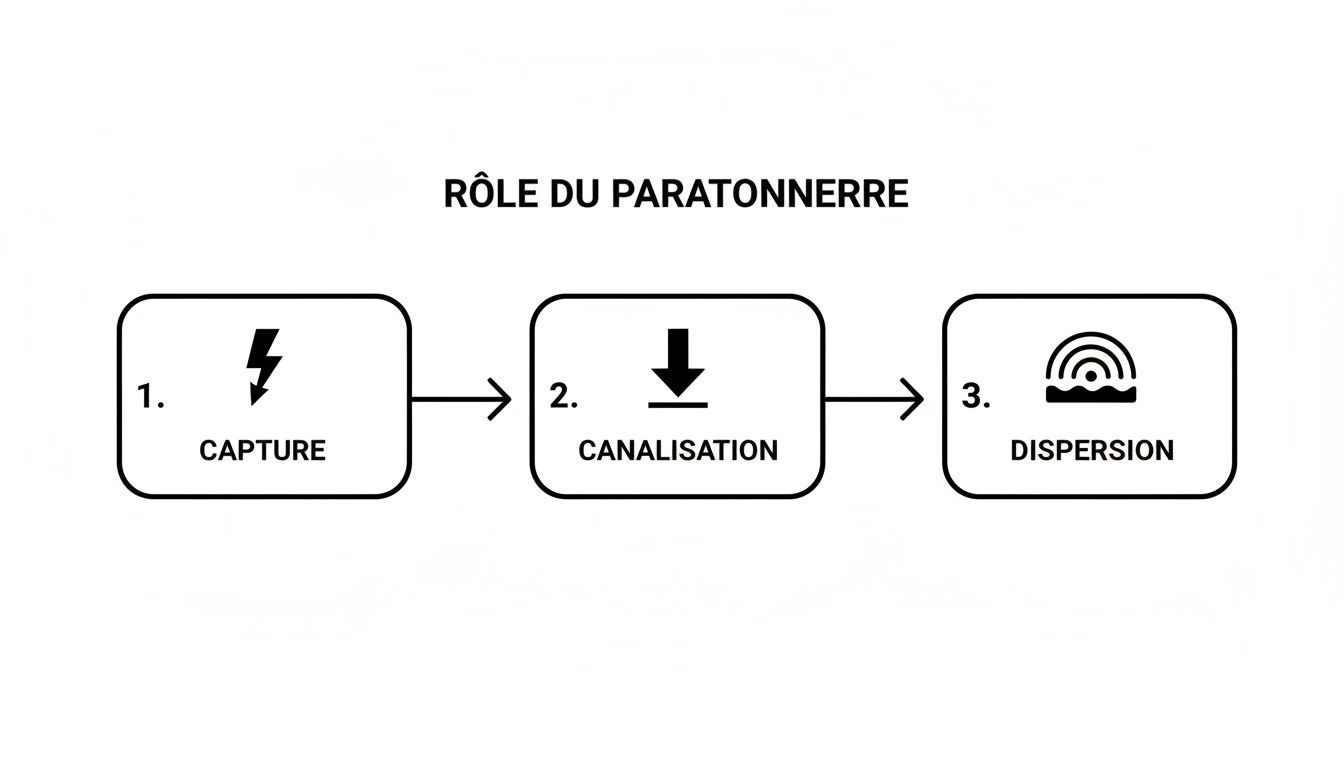
It is worth noting that this diagram perfectly illustrates how the lightning rod provides end-to-end protection, from capturing the lightning strike to neutralizing it in the ground. A vital path for safety.
From the point of impact to grounding
Attracting lightning is only the first part of the job. It's important to remember that this enormous energy must then be channeled to the ground without damaging anything along the way. This is where the down conductors and the grounding system come in, acting somewhat like the circulatory system of the installation.
The entire system ensures that the electrical current never deviates from its path, never penetrating the building's structure. It remains confined within this external conductor network, from the lightning strike point to its final dissipation in the ground. This complete control of the lightning's path protects the building and its occupants. For example, the lightning rod is much more than a simple rod: it is the conductor of a comprehensive and intelligent protection system.
How does a lightning protection system work?
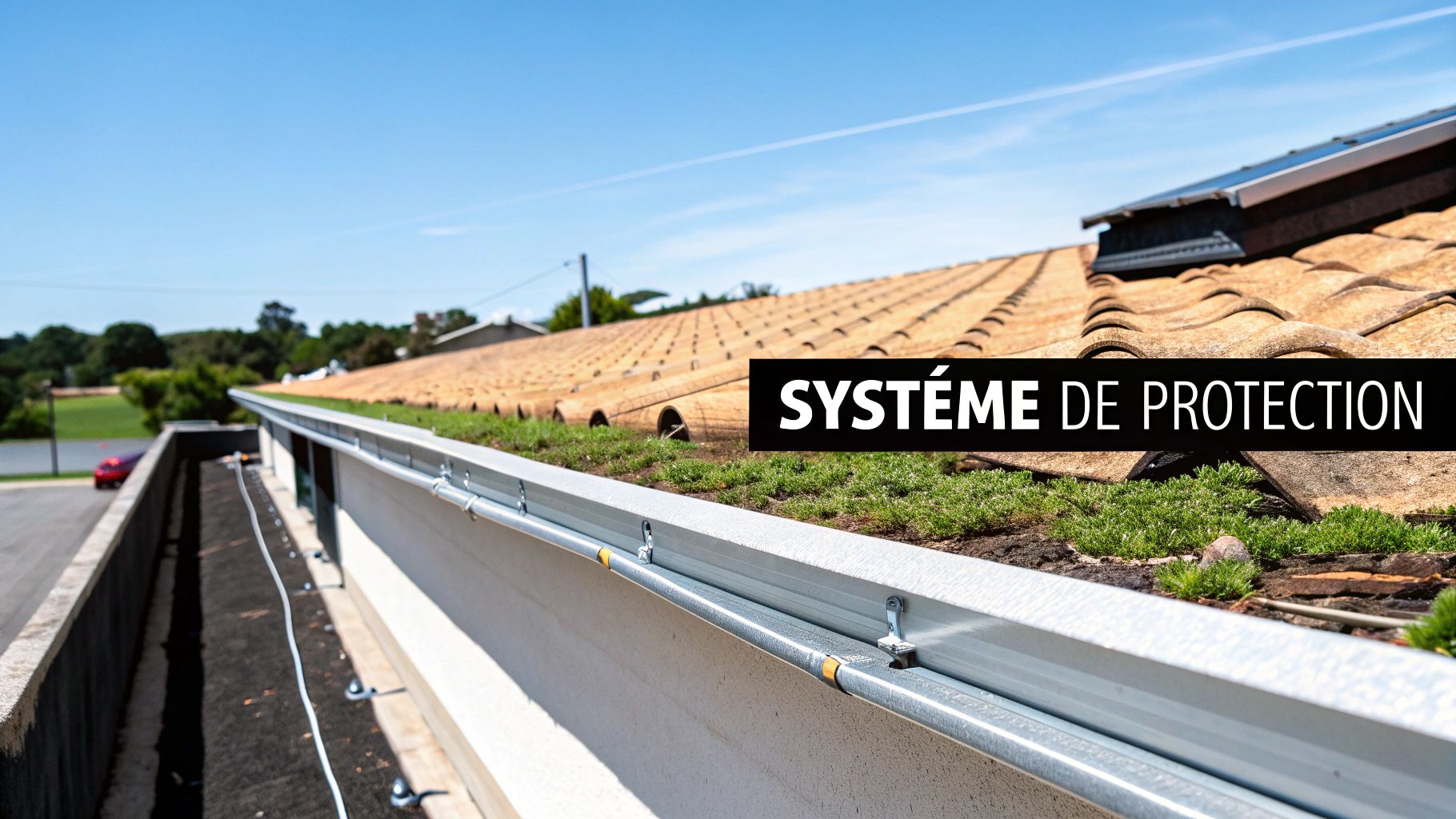
Furthermore, the lightning rod, that metallic spike proudly displayed on rooftops, is actually only the visible part of a much more complex system. It is the conductor of a complete and interdependent ecosystem: the Lightning Protection System (LPS).
Furthermore, thinking that a simple lightning rod is enough is a bit like believing that a single firefighter can extinguish a forest fire. To be effective, it must be part of a perfectly coordinated chain. Omitting a single link leaves the door wide open to the destructive energy of lightning.
In addition, this system is designed to provide a controlled and secure path for lightning, from its point of impact in the sky to its harmless dispersion in the ground.
The 3 pillars of a lightning protection system
Note that to visualize how all this works, the system must be broken down into its three vital components. Each has a very specific role, and it is their synergy that ensures the safety of a building.
The lightning arrester: This is the famous lightning rod. Its mission is simple but crucial: to serve as a preferential point of impact. It intercepts lightning before it strikes another part of the structure, acting as a strategic bait.
Down conductors: Once lightning is captured, its colossal current—which can reach hundreds of thousands of amps —must be carried away. Down conductors are the arteries of the system. They guide this energy along exterior walls, away from sensitive parts of the building.
The grounding system: This is the end of the line. This network of conductors buried deep in the ground disperses the enormous electrical charge over a wide area, thus safely neutralizing it. A poorly designed grounding system is the worst flaw in any electrical system: the current could back up and cause immense damage.
Note that for an overview, here is a summary of the role of each component.
The 3 pillars of a lightning protection system
Remember that this table summarizes the role of each key element of a lightning protection system for quick understanding.
For example, each pillar is therefore essential to ensure that the path of lightning remains under control.
A lightning protection system doesn't block energy; it guides it. If the path is broken at a single point—a loose down conductor or a faulty ground connection—the current will seek another route. Often, this will be through the building's structure itself, with disastrous consequences.
The effectiveness of these systems is the result of decades of research, particularly at experimental sites such as Saint-Privat-d'Allier in Haute-Loire. Furthermore, this work has allowed for the refinement of models to better channel energy towards optimized grounding points, an expertise that LPS France rigorously applies on a daily basis.
The invisible threat: power surges
Furthermore, protection doesn't stop at the direct impact. Lightning striking even several hundred meters away generates a devastating electromagnetic pulse (EMP). This shock wave propagates through the ground and networks, inducing voltage surges in all conductor lines: electrical cables, telephone lines, antennas, etc.
Furthermore, these voltage spikes, as brief as they are violent, are the number one cause of damage to electronic equipment. They act like an electrical tsunami that instantly fries circuits. For a business, this can mean data loss, production downtime, and exorbitant replacement costs.
Note that to counter this indirect threat, a complete SPF must absolutely include surge arresters.
It's worth noting that a surge protector is like a bodyguard for your electrical installations. Installed on your electrical panel, it remains dormant under normal conditions. But as soon as it detects a power surge, it reacts in a nanosecond to divert this excess energy to ground, protecting everything connected downstream. To learn more, feel free to consult our guide on the components of a lightning protection system.
To recap, lightning protection is a two-tiered strategy: the external system handles the direct impact, while internal surge protectors neutralize indirect effects. Both systems work together for truly comprehensive protection.
Choosing between Franklin lightning rod and ESE lightning rod
For example, when it comes to choosing the right lightning protection device for a lightning protection system (LPS), two main philosophies emerge. Each has its own strengths and addresses specific needs. On the one hand, there is the traditional approach, proven over centuries. On the other, a newer, more dynamic technology that seeks to anticipate lightning strikes in order to better control them.
Furthermore, this is not a choice to be taken lightly. The decision depends on the size of your site, the complexity of the building, the required level of security, and even installation constraints. Understanding what differentiates them is therefore the first step in designing truly effective protection.
The passive principle of the Franklin lightning rod
The Franklin lightning rod, also known as a simple rod, is the direct descendant of Benjamin Franklin's brilliant insights from the 18th century. Its operation is what is described as "passive." In practical terms, it remains inert until the very last moment, when the storm's electric field reaches its peak just before impact.
It is at this critical moment that its pointed shape and elevated position play their role. Furthermore, it concentrates electrical charges and eventually emits a leader that rises to meet the lightning. It thus becomes a preferential point of impact, but never initiates it. Its protective radius is therefore quite limited, following a simple geometric model often visualized as a cone radiating from its tip.
Furthermore, to protect large areas, such as a warehouse or a large public building, it is therefore necessary to multiply the number of capture points. This is known as the meshed cage, which consists of covering the roof with conductors, all connected to several grounding lines.
The great strength of the Franklin lightning rod is its simplicity. No electronics, no moving parts, just fundamental physical principles. It's an incredibly robust and durable solution, perfect for simple structures like a church steeple or a small house where very localized protection is sufficient.
It should be noted that despite its reliability, this method can quickly become complex and expensive on modern buildings or industrial sites. Installing multiple downpipes along the facades can also pose problems, both aesthetically and technically.
The active approach of the Early Streamer Emission (ESE) Lightning Rod
Conversely, there is the Early Streamer Emission ( LPS France, takes an "active" approach. The ESE doesn't passively wait for lightning to decide its path. ESE ) lightning rod . It's worth noting that this technology, which is central to our business at
As a reminder, its system is designed to detect the approach of the descending leader coming from the cloud. Long before any other high point in the building can react, the ESE uses the energy of the ambient electric field to generate its own powerful, early ascending leader. In a way, it gains a decisive head start in the race to the sky.
For example, this anticipation allows it to establish a preferred point of impact with formidable efficiency, resulting in a much larger protection radius than that of a simple rod. This operation is strictly governed by standards, notably the French standard NF C 17-102 in its 2011 version . The ESEs we design and manufacture are precisely calibrated to generate this early ignition and thus extend the safety zone.
Technical comparison between Franklin and ESE
Furthermore, the final choice between these two technologies should always be based on a thorough lightning risk analysis tailored to your site. To help you understand the differences, here is a table summarizing them.
Furthermore, this table compares the characteristics, advantages, and typical applications of the two main lightning rod technologies.
In conclusion, while the Franklin lightning rod remains a proven and relevant solution for specific needs, the Early Streamer Emission (ESE) lightning rod stands out as the optimal protection for the vast majority of modern infrastructure. Furthermore, its ability to cover large areas with a lighter installation often makes it a more pragmatic and economical solution for industrial sites, commercial buildings, or complex built heritage. You can explore the advantages of Early Streamer Emission (ESE) lightning rods in our dedicated article.
Standards and maintenance: the keys to lasting protection
It's worth noting that installing a lightning protection system is a good start. Ensuring its continued effectiveness year after year is even better. In reality, installation is only the first step. For a lightning rod and its entire protection network to perform flawlessly, two pillars are absolutely essential: strict adherence to standards and rigorous maintenance. Without these, even the best system ends up being nothing more than a decorative piece of metal on a roof.
It's important to emphasize that compliance with standards isn't just a matter of paperwork. It's the foundation that guarantees a system's reliability. Every element, from the tip of the lightning rod to the last connection in the ground, has been designed, tested, and installed according to best practices, the result of decades of field experience.
The crucial importance of protection standards
For Early Streamer Emission (ESE) lightning rods, the industry standard is NF C 17-102, particularly its 2011 version. This standard defines everything: the design, the calculations of the protection radius, and the installation rules. This is what ensures the actual effectiveness of these active systems. It mandates a very precise methodology that begins well before any tools are even brought out.
Indeed, any serious project must begin with a Lightning Risk Analysis (LRA). This is a thorough technical study that meticulously examines the site:
- Where is the building located and what is the lightning strike risk level in the area?
- What are its characteristics (height, materials, use)?
- What are we protecting inside (servers, expensive machines, flammable materials)?
- What would be the consequences of a direct impact (human risks, financial losses, business interruption)?
For example, it is only after this analysis that we can define the necessary level of protection and design a tailor-made system that perfectly matches the threat, without spending a single euro too much or leaving a flaw in the armor.
Maintenance: much more than a recommendation, an obligation
Furthermore, once installed, a lightning protection system is a living system. It is subjected to the ravages of time: corrosion, wind, freeze-thaw cycles, and of course, the lightning strikes for which it was designed. Every lightning strike, even a perfectly controlled one, puts the components under considerable stress and can, in the long run, weaken them.
Let's not be mirodn: periodic maintenance is not simply an option. It is a regulatory obligation and a technical necessity. A system that is not regularly checked is a system whose effectiveness can no longer be guaranteed.
During an inspection, a quick glance isn't enough. Electrical continuity is checked, the grounding resistance is measured, and the connections are made sure they haven't shifted. Furthermore, the grounding system is crucial: if its resistance degrades, it's a ticking time bomb. Lightning energy could no longer flow properly to the ground, with potentially disastrous consequences.
From passive maintenance to proactive security management
Furthermore, the traditional method is to schedule maintenance visits at regular intervals. However, this approach has its limitations. A defect could very well appear the day after an inspection, leaving the building exposed until the next check. This is where today's technologies change the game.
It's worth noting that innovations like the Contact@irconnected lightning strike counter from LPS France are ushering in a new era. It's not just a simple counter; it's a true monitoring device that continuously tracks the system's health and sends real-time information. Thanks to this 24/7 monitoring, we move from reactive maintenance to proactive management.
As a reminder, rather than waiting for the annual inspection, the site manager is alerted instantly if a lightning strike occurs or an anomaly is detected. A targeted check can then be triggered precisely when it's needed. The result? Continuous protection and complete peace of mind. To see how it works in practice, check out the video on the LPS CEMASO YouTube channel.
Implement your lightning protection solution
For example, protecting a site against lightning isn't simply a matter of installing a lightning rod and hoping for the best. It's a logical and comprehensive approach, designed for long-term use. Every step, from the initial analysis to regular maintenance, is crucial to ensuring complete safety. The goal is to build a customized solution that perfectly matches the specific risks of your site, whether it's an industrial complex or a simple office building.
It all starts with a non-negotiable step:Lightning Risk Analysis (LRA). Think of it as a complete diagnostic of your installation. Furthermore, this in-depth technical study will assess your site's exposure to risk, the nature of your activities, the sensitivity of your critical equipment, and more. It will determine the necessary level of protection and serve as the foundation for your entire strategy.
Defining the technology and design
Furthermore, once the ARF (Augment Reduction Factor) is in place and your needs are clearly defined, you must choose the right capture technology. You have the choice between a passive system, such as traditional Franklin rods or a meshed cage, ideal for very precise areas. Alternatively, you can opt for an active solution, such as the Early Streamer Emission (ESE) Lightning Rod, perfect for optimally covering a large area. This choice will determine the entire architecture of your protection system.
Furthermore, this is where the design phase comes in, a key moment where the following will be defined in concrete terms:
- The exact location of the lightning rod(s) for total coverage without blind spots.
- The shortest and safest route for downhill conductors who will carry the current.
- The structure of the grounding network is essential for efficiently dispersing energy into the ground.
Design isn't just a plan on paper. It's the concrete translation of your security requirements into a functional installation. Only an installation designed and carried out by qualified professionals, in compliance with standards, can guarantee effective, long-term protection.
Choose a partner, not just a supplier
It's important to note that lightning protection is much more than a simple commercial transaction. It's a long-term commitment. That's why at LPS France, we see ourselves not as mere suppliers, but as true partners. We're by your side every step of the way: from the initial risk assessment to the predictive maintenance of your installations. The goal is simple: to build a comprehensive strategy together to manage this risk.
As a reminder, to achieve this, we have developed a range of solutions and services designed to protect your infrastructure and ensure peace of mind for your teams.
- Powerful management tools: Our LPS Manager offers you a centralized view to manage and monitor your entire fleet of lightning protection devices.
- Accessible expertise: With LPS Academy training , your teams can gain autonomy and better understand the issues related to lightning.
- Human support: Our technical and sales teams are there to listen to you, analyze your challenges and find, with you, the solution that makes sense.
For example, protecting your website is a responsibility we share. Don't wait until it's too late: contact our experts today for a diagnostic assessment and to build a protection plan together that meets your needs.
Questions everyone asks about lightning rods
Furthermore, even with all the technical explanations, very practical questions and some persistent misconceptions often remain. This is perfectly normal. At LPS France, we answer these questions every day, so let's take this opportunity to set the record straight.
Will the lightning rod attract lightning to my house?
This is the most common myth! And the answer is a no . Furthermore, a lightning rod does not create lightning, nor does it cause a passing lightning bolt to change direction and strike your roof. It simply doesn't have that power.
Furthermore, its role is far more ingenious: if lightning strikes and its trajectory is already heading towards your area, the lightning rod presents itself as the easiest and most direct path to the ground. In a way, it tells the lightning, "Go this way, it's simpler and safer." It intercepts and channels a discharge that, without it, could have struck anywhere—the chimney, an antenna, or a nearby tree—with potentially catastrophic results.
How can I tell if my building is really a target?
Note that zero risk does not exist, but certain factors clearly increase the probability of an impact. Your building is more exposed if:
- It is isolated or elevated : a house on top of a hill, a lone warehouse in the open countryside… these are natural targets.
- There are large trees nearby : a tall tree can attract lightning, and secondary electrical arcs (side flashes) can easily jump to neighboring buildings.
- The equipment inside is valuable or sensitive : think of your computer servers, an automated production line, or even your home automation system. Even an indirect impact can cost a fortune in repairs and lost business.
To be absolutely certain, there is only one reliable method:Lightning Risk Analysis (LRA). This is a thorough technical study that evaluates all parameters to objectively determine your risk level and the appropriate type of protection, if any.
Will an installation ruin the aesthetics of my building?
This is a perfectly legitimate concern, especially when it comes to a historical monument, an architect-designed house, or simply a facade that's dear to you. Rest assured, today's systems are designed for discretion. It's worth noting that the conductors can follow the building's lines, such as roof edges or downspouts. They are even available in several shades to blend in with the surrounding color.
It's worth remembering that early streamer emission (ESE) lightning rod technology is a major advantage in this regard. Since a single lightning rod can protect a very large area, the number of visible down cables is drastically reduced, unlike with a traditional meshed cage. The goal is simple: maximum protection with minimal visual impact. To see what real-world installations look like, the LPS CEMASO YouTube channel is a treasure trove of examples.
For example, lightning protection is a matter for specialists where chance plays no part. Every building is unique, every environment has its own specific characteristics. For a thorough assessment of your needs and the design of a system that will protect you effectively and sustainably, LPS France is at your service. Visit our website to discover our solutions and contact our specialists.