
Furthermore, the components of a lightning protection system, also known as a lightning protection system (LPS), form a coordinated defense against both direct and indirect lightning strikes. Think of it as a coherent system that includes lightning rods , down conductors , grounding , and surge arresters . Each element is crucial for safely intercepting, channeling, and dissipating the immense energy of a lightning strike .
Understanding the role of each lightning protection component
First, think of your installation as a fortress. Furthermore, the lightning protection system is its complete armor, where every component, from the most visible to the most discreet, is vital to repelling an attack. Ultimately, if even one of these components is missing, the entire structure becomes vulnerable.
However, effective protection never relies on a single piece of equipment, but rather on the synergy of several elements working together.
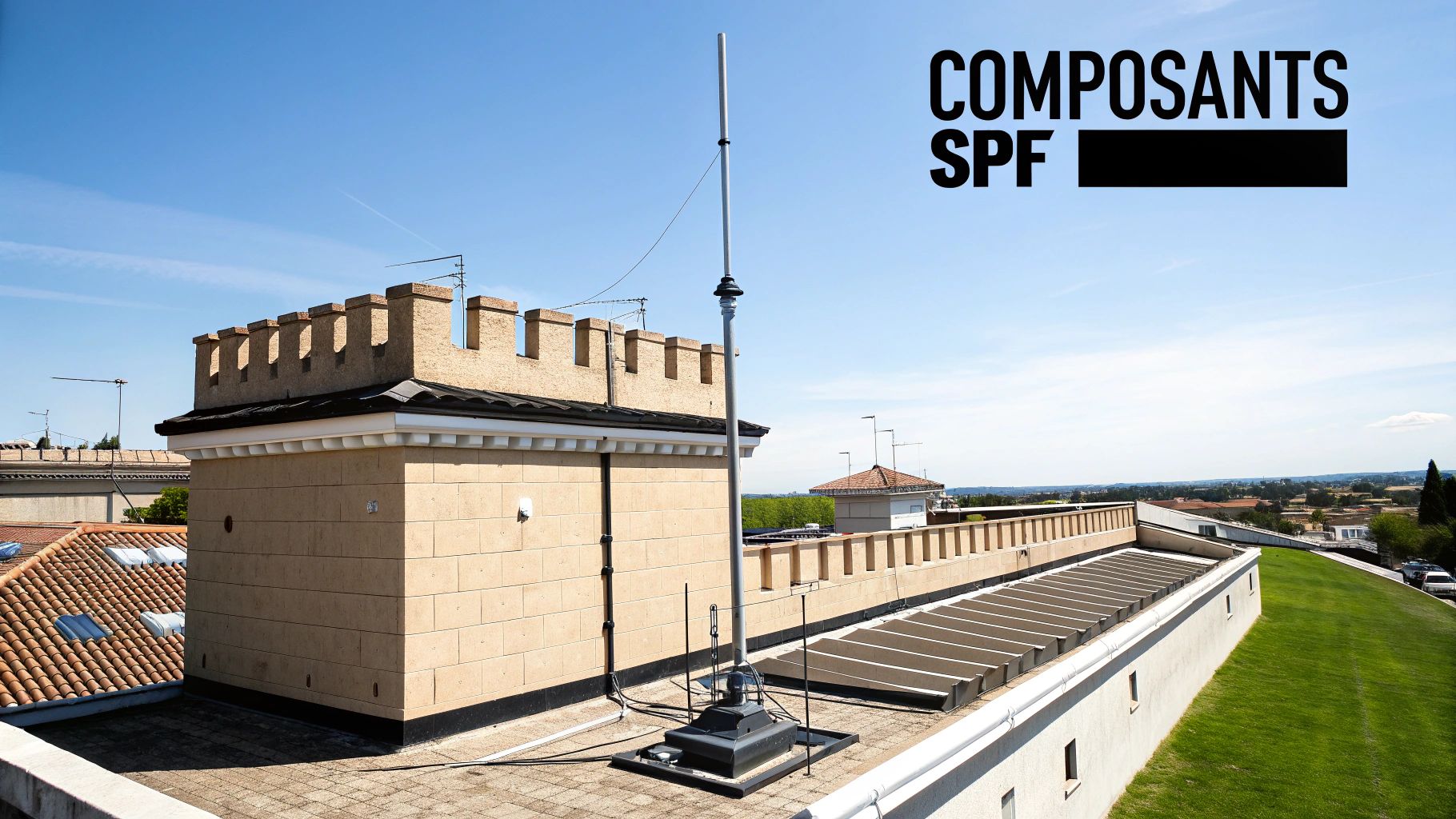
Furthermore, this integrated approach is designed to harness a natural phenomenon of unimaginable power. A single lightning strike can carry up to 100 million volts and currents exceeding 30,000 amps. Without a controlled and secure path, this energy would seek the path of least resistance, passing through the building's structure, electrical wiring, or computer networks. The consequences? Fires, explosions, and destruction.
The defense chain of a FPS
Furthermore, to better visualize how all this works, let's break down this chain of protection into several links. Ultimately, each link has a very specific role in ensuring overall security:
- The capture device : This is the lookout on the ramparts. Positioned at the highest point, its role is to intercept the lightning before it even hits the structure.
- Down conductors : They act like a safe highway. These very robust cables guide the lightning current from the lightning rod to the ground, preventing it from straying into the building.
- The grounding system : This is the endpoint of the system. Its purpose is to disperse this phenomenal electrical charge into the ground to neutralize it safely and effectively.
- Surge protectors (SPDs) : These are the bodyguards of your electronic equipment. They protect against indirect power surges that propagate through electrical and communication networks, often kilometers from the point of impact.
The importance of an accurate risk analysis
Indeed, the design of such a system cannot be improvised. It stems from a rigorous lightning risk analysis, which takes into account factors such as the site's geographical location. Finally, in France, the average density of ground strikes is a fundamental piece of data.
In France, according to statistics from Météorage, the national lightning detection operator since 1987, the average ground strike density (NSG) is approximately 0.90 strikes per year per km². This data is essential for correctly sizing the components of a protection system. For further information on risk analysis, you can consult the data from the Eure prefecture's lightning study.
It should be noted that adherence to strict standards, such as NF C 17-102 or IEC 62305:2024, ensures that each component is properly sized, correctly installed, and integrated. This compliance is not a mere administrative formality; it is the only true guarantee of reliable protection against such an unpredictable and powerful threat.
Choosing the right capture device for optimal defense
First, the lightning capture device is the sentinel of your lightning protection system. Furthermore, perched at the highest points of your structure, it forms the very first line of defense. Its purpose? To intercept lightning before it strikes a vulnerable area. Think of it as the lookout on the ramparts: it spots the threat and neutralizes it at its source.
Indeed, the choice of this component is far from trivial. It determines not only the effectiveness of lightning protection but also the area that will actually be protected and the visual impact on your building. Ultimately, two main technologies stand out on the market, each with its own approach to accomplishing this vital task.
The simple point, or Franklin lightning rod
It's worth noting that the simple point, also known as a Franklin lightning rod, is a historical technology, a completely passive. Imagine a lighthouse on the coast: it doesn't search for ships, but its position and height make it an essential landmark. The Franklin point works in the same way.
Furthermore, it does not generate any ionization and simply provides an easier path for the lightning's descending leader as it is about to strike. Indeed, its protective radius is quite limited and directly dependent on its height. Therefore, to cover large areas, it is often necessary to install a whole network of interconnected spikes, known as a meshed cage.
- Ideal for : Structures where aesthetics are paramount, such as historical monuments, or for buildings of modest size.
- Principle : To offer a passive point of impact, favored by lightning.
- Limitation : Multiple spikes are needed to protect large areas, which can increase the weight of the installation.
Early streamer emission (ESE) lightning rod
It's worth remembering that the early streamer emission (ESE) lightning rod takes a proactive. While the Franklin point is a passive beacon, the ESE is an air traffic controller that anticipates traffic. It doesn't wait for lightning; it goes to meet it.
Thanks to an integrated electronic device, the ESE senses the approach of the lightning's downward leader and generates its own upward leader with a head start. For example, this anticipation allows it to detect lightning much higher and farther away than a simple pointer of the same height.
Theignition advance, measured in microseconds (µs), is the key characteristic of a ESE. The greater this advance, the larger the protection radius. A single device can then secure a much larger area, such as an industrial site or a large warehouse.
Furthermore, this greater protection radius often makes ESE a more economical and simpler solution to install in large buildings. The NF C 17-102:2011 strictly regulates the design, testing, and installation of these lightning protection system components to guarantee their reliability.
Make the right choice with the expertise LPS France
So, simple spike or ESE? The answer depends on many factors: the size of the building, the level of protection required by the lightning risk analysis, the budget, and also aesthetics. Protecting a church listed as a historical monument is nothing like securing a data center or a chemical plant.
This is where LPS France 's expertise comes in: analyzing all these parameters to recommend the most suitable solution. Furthermore, strategic positioning of the lightning protection system is absolutely essential. If poorly placed, even the best lightning rod becomes useless. Our technical teams therefore ensure that each installation maximizes coverage and guarantees flawless protection, making this first link the true cornerstone of your security.
The path of lightning: guiding energy safely
Note that capturing lightning with a lightning rod is good. But it's only the first step. The enormous amount of energy intercepted must then be channeled to the ground in a perfectly controlled manner. This is where down conductors and grounding come into play.
Think of the down conductors as an armored highway, specially designed for an ultra-powerful convoy. Note that the grounding system is the terminus: a space designed to neutralize this charge without causing any damage. A fault along this path, and disaster is guaranteed. Energy would flow uncontrollably through the structure, causing electrical arcs, fires, and irreversible damage.
As a reminder, the diagram below illustrates this essential process. Whether it's a simple Franklin point or an Early Streamer Emission (ESE) lightning rod, the objective remains the same: to create a preferential and safe path for lightning energy.
Downhill drivers: the lightning highway
For example, down conductors are the lifeblood of any protection system. Their role? To provide a very low impedance path so that the lightning current travels along them without even "thinking" about passing through the building's metal structure or wiring.
Furthermore, the choice of material is crucial. Copper or aluminumare, known for their excellent conductivity. Their cross-section is rigorously defined by standards such as NF C 17-102:2011 to ensure they can withstand currents exceeding 100,000 amps.
Furthermore, their installation must follow very strict rules:
- As direct as possible : The path between the lightning rod and the grounding rod should be as short and straight as possible.
- No sharp bends : Too tight an angle would create a "springboard effect", risking projecting an electric arc towards nearby conductor elements.
- Secure fixings : The conductors must be securely fastened to the structure to withstand the violent electrodynamic forces generated by the passage of current.
Grounding: the final point of protection
If conductors are the highway, then the grounding system is the terminus. Furthermore, its purpose is to disperse the thousands of amps of lightning current into the ground, where they will be neutralized. It is the ultimate point of contact between your installation and the planet.
A poor grounding system is an invitation to disaster. If energy cannot dissipate quickly enough into the ground, it can literally "rise back up" into the building via the grounding system, frying equipment and endangering people.
Achieving low earth resistance is not optional, it's mandatory. Note that the NF C 17-102 standard requires a value below 10 ohms. In challenging soils (rocky, sandy), reaching this target requires engineering expertise. For more information, our guide on earthing systems details the various techniques.
Note that to help you visualize the options, here is a comparison of the most common grounding configurations.
Comparison of grounding systems
As a reminder, this table compares the main grounding configurations to help engineers and managers choose the most suitable solution for their site.
In conclusion, creating a safe lightning path is a precise task. For example, it relies on the right choice of materials, intelligent conductor routing, and a perfectly sized and installed grounding system. Less visible than the lightning rod, these elements are nonetheless just as crucial to the overall effectiveness of your protection.
Protect your sensitive equipment with surge protectors
Furthermore, the threat of lightning isn't limited to a direct strike. A lightning strike several kilometers away can actually trigger an electrical shock wave that propagates through electrical or communication networks. Invisible and devastating, this surge is enough to fry the electronic components that power your business.
This is where surge protectors, also known as SPDs (Surge Protective Devices), come into play. They act like silent guardians, constantly on the lookout to intercept these voltage spikes before they reach your servers, industrial automation systems, or security systems.
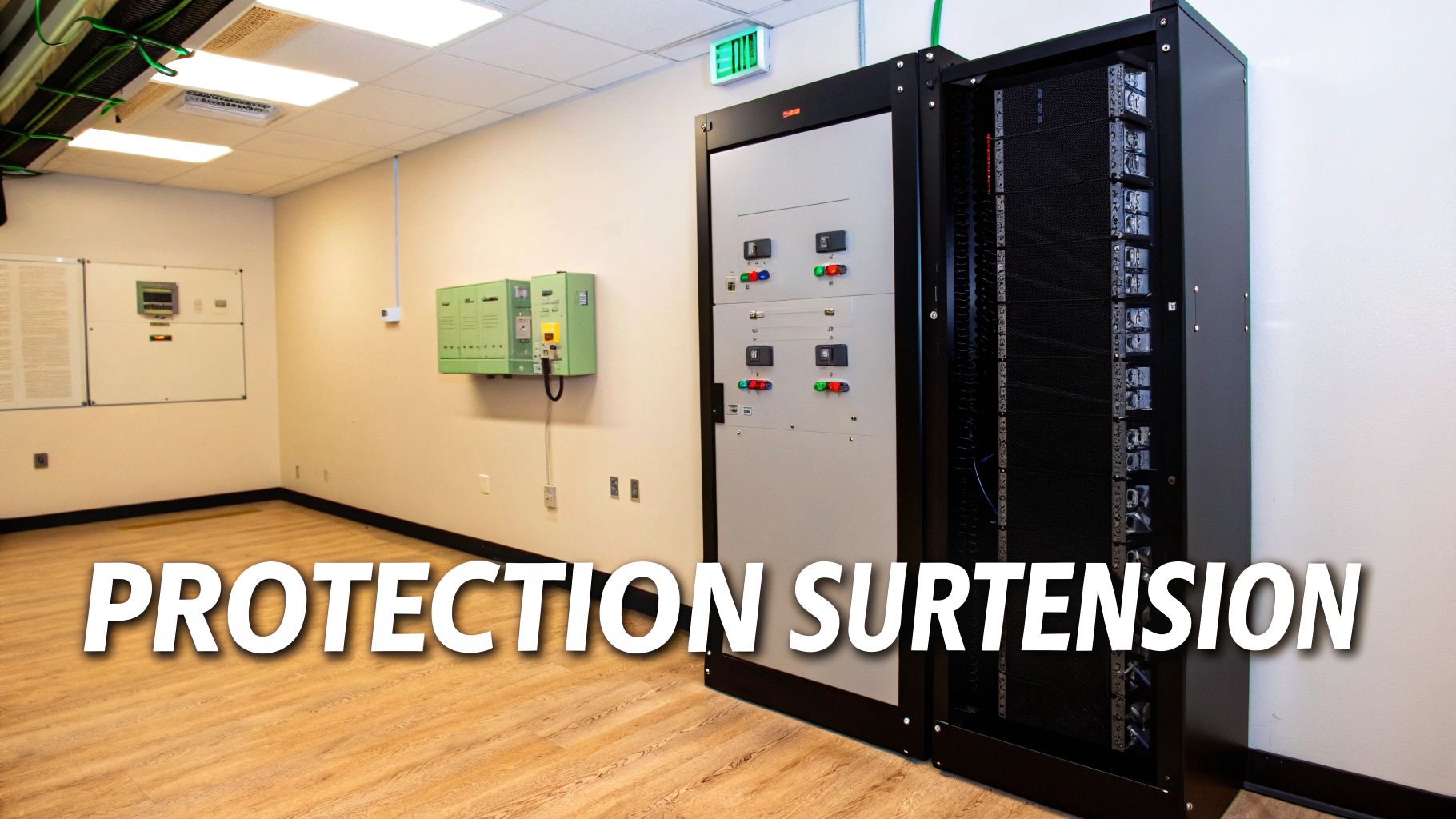
How does a surge protector work?
Imagine a surge protector as a high-speed switch on a railway track. Under normal conditions, the electrical current flows smoothly to your equipment. But as soon as an abnormal surge is detected, the surge protector switches in a matter of nanoseconds. Furthermore, it diverts this excess energy directly to the ground, neutralizing it before it can cause any damage.
This protection is absolutely vital. Why? Because the majority of lightning damage doesn't come from direct strikes on buildings, but rather from these induced surges. It's worth noting that an external protection system (lightning rod) without surge protectors is like locking the front door while leaving all the windows wide open.
A lightning rod protects the building's structure from fire and physical damage. A surge protector, on the other hand, protects the electronic core of your business from power surges. Both are components of a lightning protection system, providing complete security.
The different types of surge protectors
Not all surge protectors are created equal. They are classified by "Type" according to their location within the installation and their ability to withstand the surge. It's worth noting that a truly effective protection strategy relies on a cascade approach, which combines several types of surge protectors at key locations.
- Type 1 : This is the main shield. Installed at the main low voltage switchboard (TGBT), it is designed to divert most of the energy away from a direct impact on the building or the power line.
- Type 2 : It is placed in the sub-distribution boards. Its role is to manage residual overvoltages that may have passed through the Type 1 surge arrester, but also those that may be generated inside the building itself.
- Type 3 : This is proximity protection, the last line of defense. Installed as close as possible to highly sensitive equipment (computers, servers, medical equipment), it provides precise and comprehensive protection.
Remember that this multi-level defense ensures that the voltage is gradually reduced to a completely harmless level before it reaches your most valuable devices.
The importance of a coordinated protection strategy
Thinking that a single surge protector at the building's entrance is sufficient is a common and costly mirod. For example, a power surge can penetrate any conductor network: the electrical supply, of course, but also the telephone line, network cable, or even an antenna. Protection must therefore be considered holistically.
Let's take the example of a data center. We'll install Type 1 and Type 2 surge protectors on the main power lines. Then, we'll protect the server racks with surge protectors specifically designed for data networks, and finally, we'll add surge-protected power strips for each critical piece of equipment. This coordinated approach creates a true protective bubble.
Furthermore, lightning risk analyses conducted in France confirm this necessity. They show that the most effective systems combine different levels of protection for maximum efficiency. In French lightning risk analyses, such as the one for Finistère in 2020, level I or III installations incorporate reinforced level II Equipotential Spark Gap surge arresters, thus protecting against 98% or 92% of strikes according to standard NF C 17-102:2011. For more information, you can consult the detailed lightning risk analysis for the Finistère prefecture.
Furthermore, the correct selection and positioning of surge protectors are technical steps that cannot be improvised. A poorly planned installation can render protection completely ineffective, or even dangerous. This is why calling on a specialist like LPS France is a direct investment in the continuity and security of your business.
In addition, here is the rewritten section, designed for a human, expert and natural tone, while respecting all the specified requirements.
Going further: connected monitoring and Equipotential Spark Gap
It's important to note that truly comprehensive lightning protection doesn't stop at the components that capture and dissipate current to ground. Modern installations incorporate two essential pillars that guarantee overall safety and enable much smarter maintenance: Equipotential Spark Gap and connected monitoring.
During a lightning strike, the danger doesn't just come from the main current. It's important to emphasize that it also, and perhaps even more so, stems from the potential differences that can suddenly arise between the various metallic parts of a building. This is where Equipotential Spark Gap becomes an absolutely fundamental concept for the safety of people and equipment.
The principle of equipotentiality
To better understand, imagine a large ship in the middle of a storm. To prevent the formation of devastating electrical arcs between the mast, the hull, and the onboard equipment, everything is electrically interconnected. Remember that this connection ensures that in the event of a lightning strike, the entire ship rises to the same electrical potential, thus canceling out lethal contact voltages.
In a building, Equipotential Spark Gap applies this same principle. For example, it consists of connecting all metallic masses and conductor networks together:
- Metal frameworks
- Water, gas or heating pipes
- Cable trays
- The main grounding point of the lightning protection system
Furthermore, by creating this "surface" where the potential is unique, we ensure that the lightning current will not seek a path through equipment or, worse, through a person. To delve deeper into this topic, feel free to read our article on the importance of Equipotential Spark Gap.
Equipotential Spark Gap is essential for safety within the building itself. Without it, even the best lightning rod cannot prevent the formation of internal electrical arcs, a frequent cause of fires and destruction of electronic equipment.
The future of maintenance: connected monitoring
Historically, verifying a lightning protection system involved regular, often complex and costly, physical inspections. Today, technology is a game-changer. We've moved from reactive maintenance, where damage is only observed, to predictive and intelligent monitoring that provides unparalleled peace of mind.
Furthermore, this true revolution is driven by connected systems that act as genuine health monitors for your installation. They continuously check the integrity of the lightning protection system components and alert you to the slightest anomaly.
Note that solutions like Contact@irtransform a passive installation into an active system that communicates with you. A small transmitter, placed on the lightning rod or surge protector, sends real-time information about its operating status. No more waiting for the annual inspection to find out if your protection is still working!
With dedicated applications like LPS Manager, managing your fleet becomes centralized and incredibly simple, directly from your smartphone or computer. It's worth noting that this 24/7 allows you to:
- Receive instant alerts in case of failure.
- Plan predictive maintenance, intervening before a problem becomes critical.
- Maintaining a complete history of events and interventions ensures full regulatory compliance.
Remember that by combining the fundamental security of equipotentiality with the intelligence of connected monitoring, you are not just protecting yourself against lightning: you are continuously controlling your security.
Of course, here is the section rewritten in a natural and expert style, following the guidelines and examples provided.
The questions that keep coming up on the ground
When embarking on a lightning protection project, you quickly encounter very practical questions. To help you gain a clearer understanding, we've compiled the most frequently asked questions from professionals. For example, the answers are straightforward, based on our experience and, of course, on industry standards.
What is the real difference between a ESE lightning rod and a simple Franklin spike?
Furthermore, the fundamental distinction between these two lightning protection components lies in their mode of operation and, logically, their protection radius. The simple point, also known as a Franklin lightning rod, is a passive. Think of it as a simple preferential point of impact: it waits until lightning is about to strike very close to offer it the shortest path to the ground. Its effectiveness depends directly on its height, which significantly limits its coverage area.
Furthermore, the early streamer emission (ESE) lightning rod is active. It doesn't wait passively for the lightning to arrive; it goes to meet it. Thanks to a specific device, it senses the approach of lightning and sends its own leader into the sky with a crucial head start.
It is this ability to "anticipate" that allows it to detect lightning much higher and farther than a conventional lightning rod. The result: a significantly greater protection radius. This is why the ESE is often the most relevant and economical solution for protecting large areas such as industrial sites, warehouses, or large public buildings.
Why is the resistance of the ground connection so important?
Furthermore, the resistance of the grounding system is a bit like the width of a highway exit. It determines how easily the lightning current can dissipate into the ground and dissipate. A low resistance, which must be less than 10 ohms according to the NF C 17-102 standard, guarantees that this enormous energy will be dissipated without obstruction.
If the resistance is too high (the outlet is too narrow), the current will reverse direction. It will then seek other, much less safe paths: the building's metal framework, electrical cables, pipes… This phenomenon can create devastating electrical arcs, fires, and fry all connected equipment. It's important to note that a good ground connection is therefore not optional; it's the foundation of the entire safety system.
If I have a lightning rod, can I do without surge protectors?
No, absolutely not. That's one of the most dangerous misconceptions in the industry. It's important to emphasize that lightning rods and surge arresters (SARs) play different, but entirely complementary, roles.
- The lightning rod : It protects the building's envelope from a direct strike. In other words, it prevents your roof from being destroyed or a fire from starting. It's the structure's physical shield.
- Surge protectors : These protect electronic equipment inside against power surges. These surges can come from a direct lightning strike, but also from lightning that strikes kilometers away and propagates through electrical or telecommunications networks.
Remember that thinking a lightning rod is enough is like protecting the walls of your house while leaving your electrical circuits and electronic devices completely unprotected. Without surge protectors, even if your building is intact, a power surge can destroy tens of thousands of euros worth of equipment in a millisecond and bring your business to a standstill.
Is it really necessary to check a lightning protection installation?
Yes, and it's even a regulatory requirement. For example, a lightning protection system, like any safety system, must be regularly inspected to ensure it's still functioning. Its components are subject to weathering, corrosion, and sometimes damage during work on the roof, for example.
Furthermore, the frequency of checks depends on your site's level of protection, but generally, a full audit by a qualified organization is required every one or two years. This audit includes:
- A visual inspection from A to Z.
- Measuring the electrical continuity of cables.
- The famous measurement of grounding resistance.
Furthermore, these checks are the only way to guarantee compliance and, above all, peace of mind. The day lightning strikes, your system will be ready.
Furthermore, for any risk assessment, design, or maintenance of your lightning protection components , LPS France 's expertise guarantees reliable protection that meets the strictest standards. Discover our comprehensive solutions at lpsfr.com.