
Estimating the cost of a lightning protection system isn't simply a matter of asking, "How much does a lightning rod cost?" In reality, this investment often represents only 1% to 2% of the total cost of a new building . This is a relatively modest sum compared to the potentially catastrophic consequences such a system prevents. Above all, it's a strategic decision for the safety of your teams, your equipment, and the continuity of your business.
Going beyond the simple price of the lightning rod
Furthermore, to fully understand the necessary budget, one must look beyond the visible equipment. Just as it is crucial to analyze in detail the cost of implementing a timekeeping system , the budget for lightning protection depends on a multitude of factors. One does not buy an off-the-shelf product; one deploys a complete technical solution, custom-designed for a specific site.
This comprehensive view is essential, because the effects of a lightning strike, whether direct or indirect, can be disastrous. Ultimately, effective protection is essentially an ecosystem designed to intercept lightning, channel it safely, and dissipate its phenomenal energy into the ground.
The key components of a well-assessed budget
Furthermore, the final cost of your installation depends on several elements that work together. In conclusion, each of them has a well-defined role to ensure the overall efficiency of the system.
- Lightning Risk Analysis (LRA): This is the non-negotiable starting point. Conducted by experts, such as those at LPS France , it precisely assesses the level of protection your site needs. It ensures that every euro invested is relevant and justified.
- Lightning capture devices: From early streamer emission (ESE) lightning rods to franklin simple rod rods, the choice depends directly on the geometry and complexity of your building.
- Surge protectors (SPDs): True shields, they are essential to protect your sensitive electronic equipment from overvoltages that can destroy them in a fraction of a second.
- Grounding: This is the foundation of the entire system. Without an excellent ground connection to dissipate the current, even the best lightning rod is completely ineffective.
Furthermore, ultimately, the highest cost is always that of doing nothing. It's worth noting that production downtime, loss of critical data, or fires represent a far greater financial threat than investing in preventative protection.
A very real economic risk
Globally, economic losses due to lightning strikes amount to billions of euros each year. In France, lightning strike frequency is not uniform across the country. Furthermore, these regional disparities directly influence the need for investment to ensure business continuity. To better understand the dangers and impact of lightning, consult our detailed analysis .
In short, questioning the cost of a lightning protection system means choosing between a controlled expense and a risk with uncontrollable consequences.
The anatomy of a lightning protection quote: a line-by-line analysis
First, to fully understand the cost of a lightning protection system, you must first be able to read between the lines of a quote. It's not simply a price list, but a concrete, quantified breakdown of the protection strategy designed specifically for your site. Ultimately, each item, each line item, represents a crucial link in your safety chain.
Think of your protection system as a shield. The lightning rod is its visible face, the one that intercepts the initial impact. But its true effectiveness relies on all the internal layers that support it. A clear and detailed quote allows you to see all these layers and assess the value of the investment.
Note that you should also remember that the choice of service contract (time and materials or fixed price) will have a direct impact on the cost structure and your final budget, particularly on the billing of labor and project management.
Capture devices: the first line of defense
It's important to note that the first major component is the lightning arrester, the element that literally "catches" the lightning strike. Its cost varies considerably depending on the technology you choose. The two main types are Early Streamer Emission (ESE) lightning rods and more traditional systems, such as mesh cages.
As a reminder, a ESE (Preferential Lightning Array), such as those we design at LPS France, works by creating a preferred point of impact for lightning, guiding it safely. While the initial purchase cost of a ESE is higher than that of a simple lightning rod, the overall project cost is very often more advantageous. Why? Because its installation is simpler, requires fewer down conductors, and therefore less excavation work. Ultimately, maintenance is also less demanding, generating substantial savings over the entire system lifecycle.
For example, this diagram gives you a clear idea of the cost breakdown in a typical project.
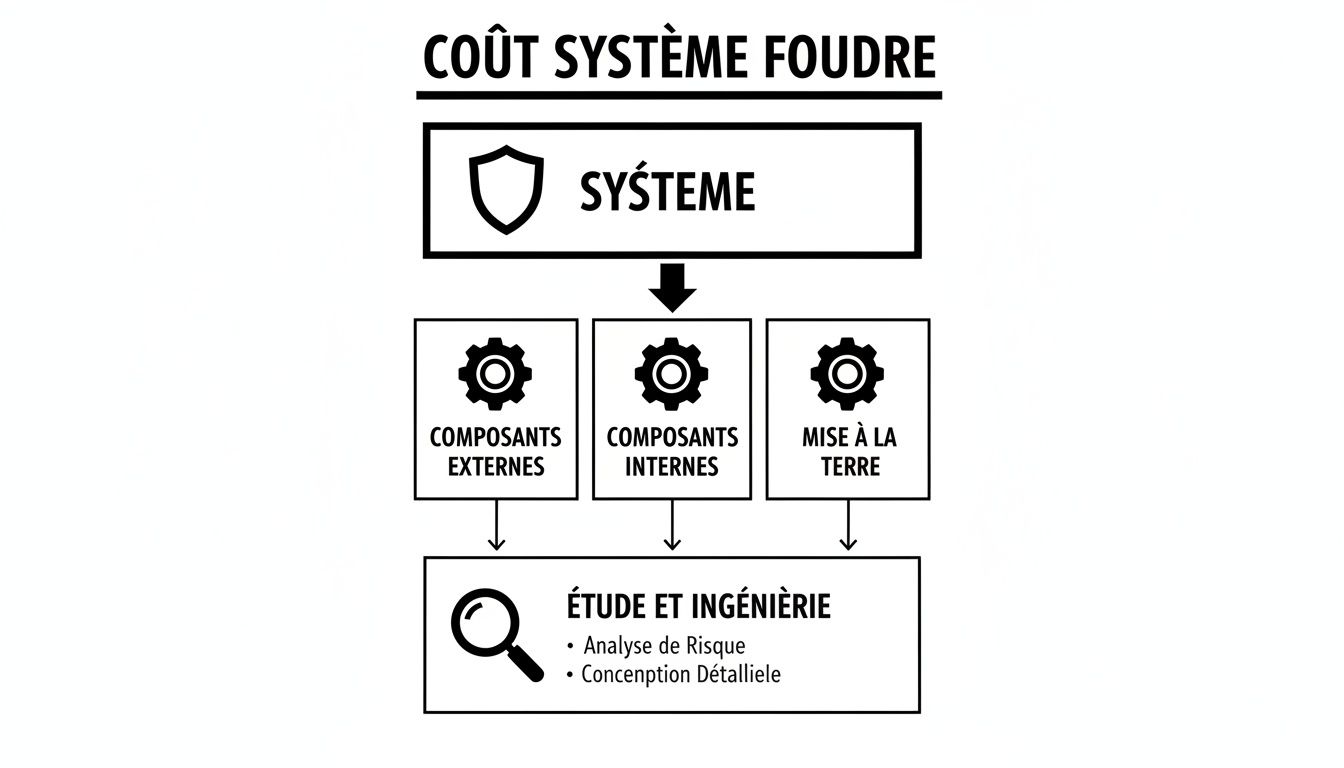
Moreover, it is clear that the engineering and preliminary study are not details, but a fundamental part of the budget which guarantees the efficiency of everything else.
Furthermore, to illustrate the difference in cost concretely, here is a comparative table.
Furthermore, a cost comparison between ESE lightning rods and meshed cages
Note that this table compares the main cost items for a typical installation using an Early Streamer Emission (ESE) Lightning Rod versus a traditional meshed cage, highlighting potential savings.
It should be noted that choosing a ESE therefore results in a smarter initial investment and reduced operating costs in the long term.
Surge protectors (SPD): the guardians of your equipment
Remember that once lightning is captured, its raw energy creates devastating power surges that can propagate throughout your electrical and data networks. This is where surge protectors, or Surge Protective Devices (SPDs) , come into play.
Think of them as ultra-fast, intelligent circuit breakers. Installed on your electrical panels, they detect these voltage spikes and instantly divert them to ground in nanoseconds. For example, they act before the surge has time to reach and fry your servers, industrial automation systems, or office equipment.
A serious quote should detail:
- The main surge arresters (Type 1) : Positioned at the main entrance to the building, they absorb the first, most violent shock.
- Secondary surge arresters (Type 2) : Placed on the distribution boards, they refine the protection closest to your sensitive equipment.
- Surge arresters for communication networks (Type 3) : Essential for protecting data lines, telephone lines or control systems.
Furthermore, the cost of these security guards is minimal compared to the value of the equipment they protect. A single production stoppage can cost tens of thousands of euros.
Grounding: the final, and most critical, link
Furthermore, grounding is the foundation of the entire system. It's simple: without proper grounding, lightning rods and surge protectors are useless. Its role is to disperse the immense current of lightning into the ground safely and effectively.
The cost of grounding should never be a variable to adjust. Trying to save money on this item compromises the entire installation and makes it potentially dangerous.
Furthermore, the budget for this item will depend on the nature of your soil (its "resistivity") and the complexity of the network to be created. It generally covers:
- Earthing rods or buried conductors (like a loop at the bottom of a trench).
- Connections and access points for future inspections.
- The conformity tests, which must prove that the earth resistance is well below the normative thresholds (generally less than 10 ohms ).
Skilled labor: the expertise that makes the difference
Finally, a significant portion of the quote is allocated to labor. Installing lightning protection systems is not something one can simply do overnight. It requires specialized skills and specific certifications. The installation cost therefore reflects the technicians' expertise, strict adherence to current standards (such as NFC 17-102 ), and the use of specialized tools.
Note that this service includes more than just equipment installation. It also covers commissioning tests and the preparation of the final compliance report. This document guarantees that the installation is fully functional and protects you, including with regard to your insurer.
What factors influence the final budget?
The cost of a lightning protection system is never just a line item on a price list. Remember—and this is a good thing!—that every site, every building has its own specific characteristics. Trying to apply a one-size-fits-all solution would be like using a single key for all locks: ineffective and potentially dangerous. Your final budget is therefore the result of a thorough technical analysis that takes into account a range of variables specific to your project.
For example, the goal isn't to complicate things, but rather to ensure that the investment is perfectly proportionate to the actual risk. A rigorous technical study, like those we conduct at LPS France, has precisely this objective: optimal protection without spending a single euro more than necessary. Understanding these key factors will help you better evaluate a quote and know exactly why you're paying.
The geometry and nature of your building
Furthermore, the first thing that stands out is the structure you wish to protect. The complexity of the installation and the amount of equipment required are directly related to the physical characteristics of the site.
Height and surface area: This is quite logical. A taller or larger building requires more coverage. In practical terms, this means longer conductors, more capture points, or a PDA lightning rod with a larger protection radius. Protecting a 5,000 m² will inevitably be more expensive than securing a 500 m² .
Construction materials: The nature of your structure also plays a role. A metal-framed building can sometimes make installing down conductors easier. Conversely, a concrete or wood structure will require specific fixings and techniques, which can affect installation time and therefore, labor costs.
The complexity of the roof: A flat, empty roof? That's the simplest case. But reality is often different. A roof with multiple levels, air conditioning equipment, antennas, or solar panels requires a much more detailed analysis and a more delicate installation to guarantee complete protection without creating interference.
The level of protection defined by the risk analysis
This is undoubtedly the most decisive factor for your budget. Furthermore, this level of protection is determined by the lightning risk analysis (LRA). This is not a mere administrative formality; it is the true cornerstone of your installation.
Lightning risk analysis is the roadmap for your project. It transforms an abstract risk into concrete technical requirements. It justifies every component of your system and ensures that nothing is left to chance.
The NFC 17-102 defines four levels of protection, from Level I (the strictest, for very high risk sites) to Level IV (the most common, for lower risks).
Note that the impact of the level of protection on the cost
It should be noted that this table illustrates very well how the level of protection influences the technical requirements, and consequently, the overall cost.
It's important to remember that the higher the level of protection, the denser the network of conductors will be, the greater the number of grounding points required, and the more stringent the safety distances that must be maintained. All of this logically impacts the material costs and the time spent on the job site.
The complexity and criticality of the site
Finally, the nature of the activities you host and the site's environment play a major role. Protecting a data center, where an hour of downtime can cost millions, is not approached in the same way as protecting an agricultural shed.
Specific environments: ATEX zones (explosive atmospheres) requires the use of specific materials and installation methods to eliminate any risk of sparks. Similarly, protecting a historical monument requires virtually invisible solutions to preserve the heritage, which demands specialized expertise.
Service continuity: For critical infrastructure such as hospitals, airports, or production plants, protection must be absolute. The system will often incorporate more numerous and higher-performance surge protectors to shield sensitive equipment. This component then represents a larger portion of the overall budget, but it is non-negotiable.
For example, each of these points is meticulously analyzed during the technical study to offer you a solution that does not just tick the boxes of a standard, but truly protects what matters to you: your business, your assets and your teams.
Lightning protection: what budget should you expect depending on your building?
Discussing the cost of a lightning protection system often remains vague without concrete examples. To help you gain a clearer understanding and anticipate the investment, let's look at some realistic price ranges for different types of buildings, breaking down the logic behind each estimate.
Furthermore, keep in mind that these figures are primarily orders of magnitude. Each site has its own specific characteristics, and only a complete lightning risk assessment will allow for a precise calculation of the technical solution you need.
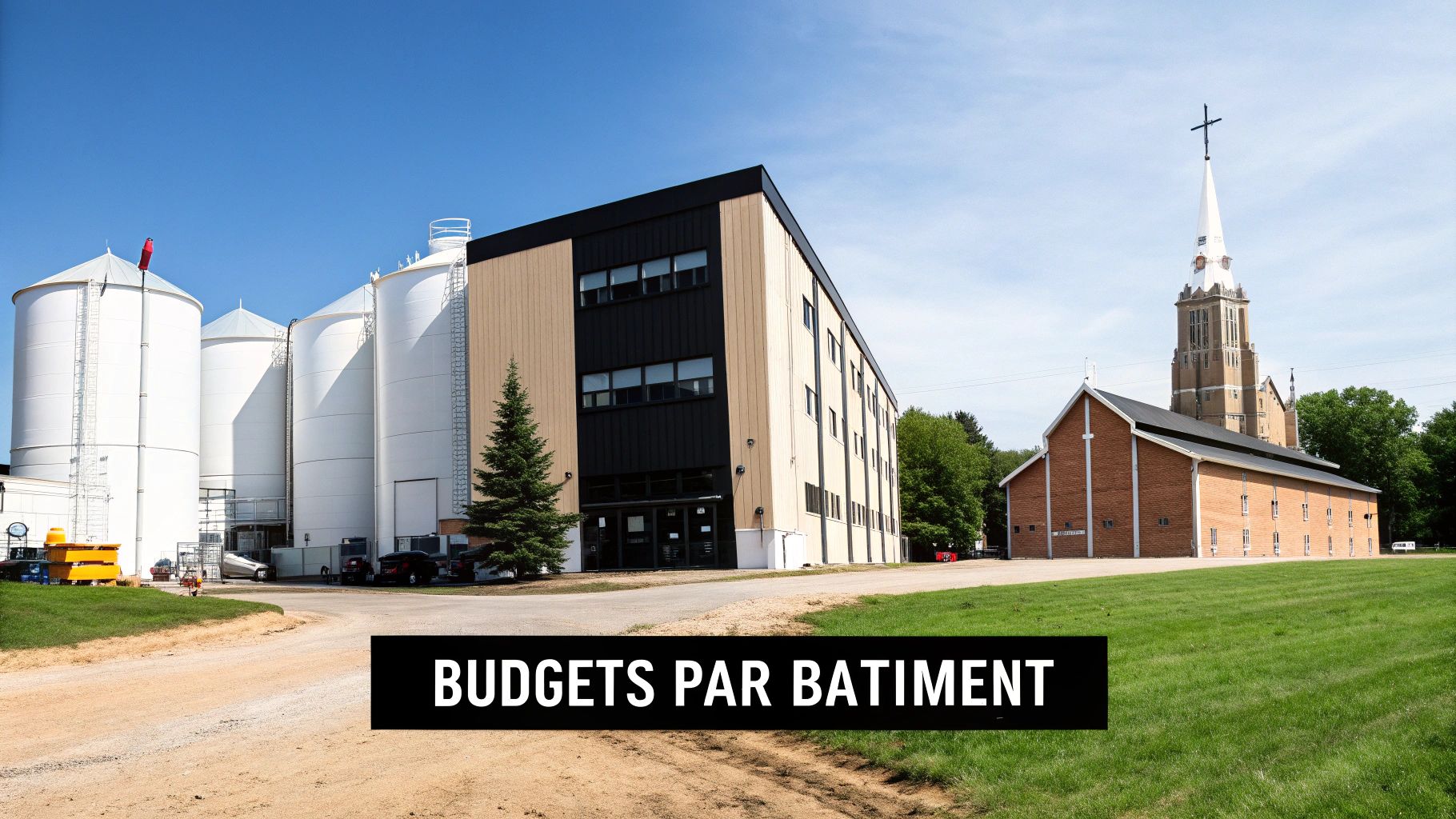
Furthermore, these few practical cases will clearly illustrate how the technology chosen and the constraints of the field directly impact the budget balance.
Scenario 1: A classic office building
5-story office building with a footprint of 1,000 m² . Note that it houses common equipment such as computer workstations, an air conditioning system, and an elevator. Here, the major challenge is to guarantee business continuity and protect data.
It should be noted that for this type of structure, a typical solution would look like this:
- Study and design: The risk analysis will probably result in a protection level III or IV, the most common for these buildings.
- Lightning capture: A single early streamer emission (ESE) lightning rod installed on the roof is usually sufficient to cover the entire area.
- Grounding: We will create a fairly simple grounding network, with two down conductors and ground rods to obtain the correct resistance.
- Surge protection: Type 1 surge arresters must be installed Type 2 surge arresters on the strategic secondary switchboards (server room, per floor).
Estimated budget range: between €8,000 and €15,000.
What will affect the quote? Primarily the ease of access to the roof and the number of electrical panels to be protected inside the building.
Scenario 2: An industrial site with hazardous areas
Let's change scenery to a 10,000 m² , which includes production areas and ATEX (Explosive Atmospheres) storage areas. It's worth remembering that the risk of fire or explosion becomes critical, as does the protection of the automated systems that control the production lines.
For example, here, no compromises are made: the required level of protection will be Level I , the highest. The approach is much more rigorous.
- ATEX engineering: A specific study is essential to eliminate any risk of sparks, which requires very strict materials and installation methods.
- Lightning capture: Depending on the configuration, you will either need several PDAs, or opt for a mesh cage with a very dense mesh for protection as close as possible to the structures.
- Equipotentiality: This is a crucial point. All metallic masses (tanks, pipes, structures) must be meticulously connected to the earth network to neutralize potential differences.
- Reinforced surge arresters: Surge arresters are installed wherever necessary: on power inputs, but also on each data and control line that enters or leaves risk areas.
Estimated budget range: between €40,000 and €90,000 , or even more.
The cost quickly escalates due to ATEX standard requirements, the site's size, and the criticality of the equipment.
Scenario 3: The bell tower of a church or a historical monument
Protecting a 40-meter-high is a completely different challenge. Furthermore, the absolute priority is to preserve the architectural integrity of the monument while ensuring effective protection against direct lightning strikes, which are very frequent at high points.
Furthermore, the solution must therefore be both efficient and discreet.
- Aesthetic integration: The choice of materials (copper conductors, sometimes tinned to better blend into the decor) and their routing are designed to be virtually invisible.
- Lightning capture: A simple Franklin point or a small PDA is installed at the top.
- Downpipe guides: They are carefully fixed along the edges, sometimes following the downpipes to be forgotten.
- Custom grounding: The soil around old foundations is often a challenge. The grounding system must be adapted to these specific constraints.
Estimated budget range: between €12,000 and €25,000.
In this case, the means of access at height (cherry picker, scaffolding) and the almost artisanal work required to preserve the building weigh most heavily on the budget.
Furthermore, as you can see, the cost of a lightning protection system is truly a customized matter. To delve deeper into the subject, feel free to consult another numerical example in our article dedicated to the cost of lightning rods . Each project is a new equation where risk, technology, and site specifics determine the final investment.
Beyond installation: calculate the true total cost of your protection
The cost of a lightning protection system isn't limited to the initial installer's bill. It's actually just the starting point of a long-term commitment to ensuring reliable protection. To get a true picture of your investment, you need to consider the total cost of ownership (TCO) , which takes into account all anticipated (and unforeseen) expenses throughout the system's lifespan.
It's important to note that these post-installation fees are not simply optional. They are essential to ensure your security system remains effective and that you remain compliant with the law.
Recurring costs that should never be overlooked
Remember that once your system is in place, several regular expenses will be necessary to keep it operational and reliable. Skipping these steps is a bit like never changing your car's oil: you risk rendering a vital investment useless precisely when you need it most.
Here are the main costs to anticipate:
- Mandatory periodic checks: The regulations are clear. The NFC 17-102 , which governs early streamer emission (ESE) lightning rods, mandates a visual inspection every year, supplemented by a full verification every two years . This latter inspection includes continuity tests and earth resistance measurements to ensure everything is functioning as it did on day one.
- Preventive maintenance: More than an obligation, it's common sense. Proactive maintenance allows you to detect weaknesses before they become real problems. This can range from simply tightening a connection to replacing a component worn by the weather, or checking surge protectors after a particularly violent storm.
- Regulatory upgrades: Safety standards evolve, and that's a good thing. If a major update is published, adjustments to your installation may be required to remain compliant, particularly for insurance purposes.
A lightning protection system is like an airbag. You install it once and for all, but you have to regularly check that it's ready to deploy. Without these checks, you can't be sure it will do its job on the day of the storm.
How technology helps you control these costs
For example, thankfully, technology comes to our rescue to make this management simpler and, ultimately, less expensive. At LPS France, we have designed a complete digital ecosystem to help you optimize your maintenance budget while keeping a constant eye on your facilities.
Furthermore, remote monitoring, for example, is a complete game changer. Gone are the days of discovering a problem during the annual inspection. Now, you can be alerted in real time.
Remote monitoring with Contact@ir®
Our Contact@ir system perfectly illustrates this optimization. It is a small communication box, installed directly on the lightning rod, which continuously transmits information about its health status.
This smart system allows you to:
- Automate monitoring: No more on-site visits just to check if everything is alright. The information comes to you, directly on your dashboard.
- Receive instant alerts: Has a lightning strike occurred? Is an anomaly detected? You are notified immediately. This allows for rapid intervention and prevents a minor fault from jeopardizing the entire system.
- Reduce intervention costs: By eliminating unnecessary travel and allowing technicians to arrive already knowing the nature of the problem, valuable time is saved and the bill is reduced.
In addition, to further explore the maintenance management of your system, feel free to read our guide on maintaining lightning protection systems with Paraton@ir ® .
LPS Manager, your centralized control tower
To go even further, the LPS Manager centralizes absolutely all the information about your fleet of installations. It becomes your cockpit for managing maintenance and maintaining complete control of your budget.
It's worth noting that this platform offers a 360° view, helping you plan regulatory checks, access intervention reports, and track the history of each site. By digitizing this management, you simplify daily operations, optimize long-term operating costs, and transform a regulatory constraint into a smooth and controlled process.
The questions you may have about the cost of a lightning protection system
Addressing the budget for lightning protection raises a whole host of questions, and that's perfectly normal. Whether you're a site manager, project engineer, or contractor, it's crucial to fully understand all aspects of this investment. Remember that this section is here to answer the most frequently asked questions directly and help you gain a clearer understanding.
For example, navigating the financial details of such a project might seem daunting, but you'll find the answers are often simpler than they appear. Each question we'll break down is a piece of the budgetary puzzle, giving you a comprehensive view of what lightning protection for a building truly entails.
Ultimately, what is the true return on investment?
Furthermore, the return on investment (ROI) of lightning protection is not measured in the same way as that of a machine that increases production. It's a much simpler calculation: that of the losses avoided. The installation cost, even if it may seem significant at first glance, becomes negligible when compared to the financial consequences of a lightning strike.
Furthermore, imagine for a moment what could happen:
- Damaged equipment: A single impact can fry computer servers, industrial automation systems, or air conditioning systems. The bill to replace them can quickly reach tens of thousands of euros.
- Business downtime: For a factory or data center, each hour of downtime translates into thousands, or even hundreds of thousands of euros in lost revenue.
- Data loss: The destruction of critical data can paralyze a business for weeks. The financial impact is enormous, not to mention the reputational damage.
- Fire ignition: Lightning is one of the leading causes of natural fires. In the worst-case scenario, this can mean the total loss of the building.
Investing in lightning protection is first and foremost an investment in the continuity of your business. It's insurance for your production equipment, the safety of your teams, and the value of your assets.
Furthermore, and this is another often overlooked aspect: insurance. Many insurers require standard protection to cover lightning risks. In some cases, installing a certified system can even allow you to negotiate a reduction in your insurance premiums . The investment then begins to pay for itself immediately.
Is the annual inspection of my lightning rod really mandatory?
Yes, without the slightest ambiguity. Note that in France, the verification of lightning protection systems is a very clear regulatory obligation, governed by the NFC 17-102 and the decree of July 19, 2011 on risk prevention.
It should be noted that for an early streamer emission (ESE) lightning rod, the schedule is precise and non-negotiable:
- A visual inspection every year: We quickly check the general condition of the components (no corrosion, fixings properly in place, etc.).
- A complete inspection every two years: This is a much more thorough check. It includes electrical continuity tests of the cables and, most importantly, measurement of the earth resistance. This value is critical and must remain within acceptable limits.
Remember that the cost of these checks generally ranges from a few hundred to over a thousand euros , depending on the size and complexity of the site. Trying to avoid this expense is not saving money; it's taking a huge risk. An unchecked installation is considered non-functional, which exposes you to civil and criminal liability in the event of a problem. And of course, in the event of an incident, your insurance company will be perfectly within its rights to refuse any compensation.
What if I install the system myself to save money?
This is one of the worst bad ideas you can have. Attempting to install a lightning protection system yourself is not only extremely dangerous, but it's also the surest way to have completely ineffective protection. For example, designing and installing such a system requires in-depth knowledge of standards ( NFC 17-102 , IEC 62305 ) and genuine technical expertise.
Furthermore, a small mirod can have dramatic consequences:
- a bend radius on a down conductor, and the lightning current will not flow properly.
- A poorly executed ground connection or a faulty connection, and the whole system becomes useless.
- A poorly positioned lightning rod can leave entire areas of your building without any protection.
Even worse, a poorly executed installation can actually increase the risk by creating points of impact that are dangerous for people or the structure. Only a qualified installer, such as a partner in the LPS France , can guarantee real protection. At the end of the project, they will provide you with a certificate of conformity. Furthermore, this document is essential: it proves that everything was done correctly and protects you with your insurer.
Why such price differences between two quotes?
This is a classic situation: for the same project, you receive quotes with striking price differences. Furthermore, these differences are almost always explained by concrete reasons that you need to learn to decipher.
Note that to compare apples to apples, here are the points to check:
- The quality and certification of the materials: Certified components, designed to resist corrosion and stress, come at a price. A seemingly low quote may conceal the use of lower-quality materials that will not last.
- The thoroughness of the risk assessment: A professional quote is always based on a complete Lightning Risk Analysis (LRA). A price that is too low may mean that this analysis has been superficial, which could lead to inadequate, and therefore ineffective, protection.
- The exact scope of the service: Does the quote only cover the supply of the equipment? Or does it include the complete service: study, supply, installation, testing and compliance report? This is a fundamental point to clarify.
- The installer's expertise and guarantees: The know-how of a certified team and the company's ten-year warranty come at a cost. But it's your best guarantee of a job well done and peace of mind for years to come.
It's important to note that a thorough and transparent quote will always detail these elements. Every line item will be justified to guarantee you reliable, long-lasting protection perfectly tailored to your actual needs.
Remember that for a personalized study and a precise quote for your project, trust the expertise of LPS France . Our teams are available to analyze your needs and offer you the most effective and best-suited protection solution. Visit our website to learn more about our solutions and services: https://lpsfr.com .