Description
Professional lightning rod earth tester
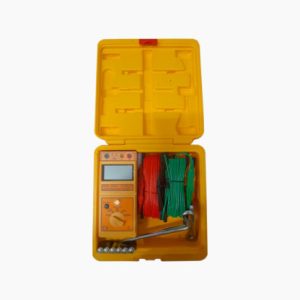
This professional-grade lightning rod earth resistance tester measures the resistance of the earth connection using the three-point method. Compact and lightweight (2.602 kg), its dimensions are 240 x 250 x 100 mm. Furthermore, this tester is supplied in a carrying case, along with three pre-installed cables and two measuring rods.
Measurement range
The lightning rod earth resistance meter performs earth resistance measurements with a constant current of 800 Hz, 2 mA in a voltage range of 0-200 V AC (40 ~ 500 Hz).
Therefore, it offers several measurement ranges: 0-20 Ω, 0-200 Ω, and 0-2000 Ω, with a resolution of 0.01 Ω. Powered by six 1.5 V batteries, it includes features such as open circuit indication and measurement memory. It complies with IEC 1010, overvoltage category III.
As a reminder, the measured resistance of the lightning rod earth must be less than 10 Ohms to be valid. Otherwise, improving the grounding system is mandatory. To that end, we offer several grounding equipment to decrease the resistance value of the grounding electrode.
Furthermore, you can consult our services for advice. So, feel free to contact us: info@lpsfr.com
Three-point method
The three-point method for measuring earth resistance is a precise technique that uses three electrodes and a tellurometer. Two electrodes are placed at a fixed distance to generate an electric current in the ground.
Simultaneously, the third electrode, located between the two, is used to measure the voltage. The lightning rod earth tester injects a current into the ground via the external electrodes. The potential difference is then measured between the third electrode and one of the injection electrodes.
This method allows the specific resistance of the soil to be determined by calculating the resistance between the central electrodes. It is essential for evaluating the effectiveness of grounding systems, particularly for the safety of electrical installations and protection against lightning.