LPS France

French Quality, Worldwide Efficiency

Area protected to date by LPS France ® solutions throughout the world

LPS Wiki: Categories

Early Streamer Emitter lightning rod

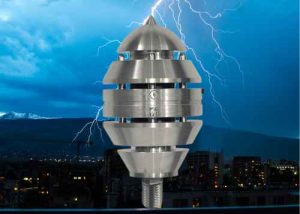
 ELLIPSand PARATON@IRearly streamer emission lightning rods

The early streamer emission (ESE) lightning rod Paraton@ir® creates the optimal conditions to generate a supernatural updraft tracer before another natural updraft tracer captures the surrounding lightning.

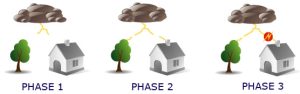
The action takes place in 3 stages:

the three phases of a direct lightning strike

1. Paraton@ir® takes care of:

The element called "charger" is designed to accumulate natural ions in the "Central Inductive System" (patented).
This accumulation occurs as rapidly and in the same proportions as the rise in the ambient electric field generated by an upward tracer.


2. Paraton@ir® creates an electric field of considerable magnitude: 

At the same time, thanks to the "Central Inductive System" and the "Booster," the lightning rod with early streamer emission device Paraton@ir® creates a gigantic electric field with a charge opposite to that of the natural electric field present and stimulates the "Capture Head".
Depending on their number, the “Starting Poles” increase the effectiveness of the starting process tenfold.


3. Lightning capture and conduction by the Paraton@irearly streamer emission lightning rod:

System priming Paraton@ir®  attracts the descending tracer and creates the conditions for a “lightning strike”. The capture tip then guides the lightning current along its axis towards the grounding conductors.


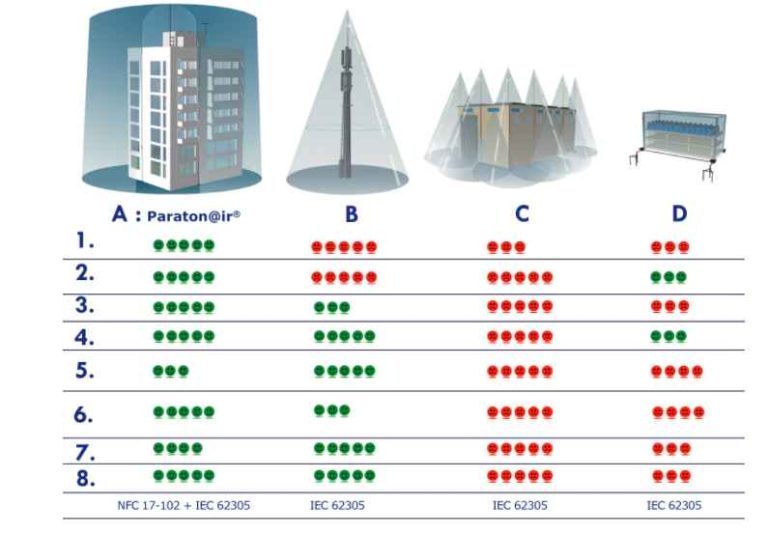
Comparative analysis of the effectiveness of lightning protection solutions

 A: Early streamer emission lightning rod Paraton@ir®

B: Single-point lightning rod

C: Meshed cage or Faraday cage

D: Tensioned cables

Comparative table of lightning protection solutions for direct lightning strikes

1. Protection zone

2. Protection of open areas

3. Study

4. Implementation

5. Qualifications required for implementation

6. Aesthetics (Integration into architecture)

7. Implementation budget

8. Maintenance Costs