
Power surges pose a major risk to all electrical installations. 87% of French buildings experience at least 50 surges per year , 23% of which exceed 1,500 V. These events can cause irreversible damage to sensitive equipment and lead to substantial repair costs. Surge protectors are the essential technical solution for diverting these surges to ground and effectively protecting your electrical installations.
Table of Contents
- Definition and role of a surge protector
- Current standards and classifications in 2026
- Differences and choices between type 2 and 3 surge protectors
- Practical application: protection of EV charging stations and sensitive equipment
- Discover our lightning protection solutions
- Frequently Asked Questions about Surge Protectors
Key points to remember
| Point | Details |
|---|---|
| Definition and function | The surge protector diverts transient overvoltages to earth to protect electrical equipment |
| Regulatory framework 2026 | Since September 2025, main surge arresters are mandatory for 7 categories of buildings, compared to 4 previously according to NF C 15-100 |
| Types and classification | Type 1 for direct lightning protection (25 kA), type 2 for main switchboard protection (5-40 kA), type 3 for fine protection |
| Critical applications | Essential protection for EV charging stations, photovoltaic inverters and sensitive electronic equipment |
| Financial rods | An uncontrolled power surge can cause up to €35,000 in damage to an EV charging infrastructure |
Definition and role of a surge protector
A surge protector is an electrical protection device designed to divert transient overvoltages to earth. Its main role is to maintain the voltage at the terminals of the protected equipment at an acceptable level, thus preventing its damage or destruction.
The operation is based on a simple yet effective principle. When a power surge occurs, the surge protector instantly detects the abnormal voltage rise and creates a low-impedance path to ground. This bypass allows the excess energy to be dissipated in a few microseconds, before it reaches sensitive equipment. The device then automatically returns to its standby state, ready to intervene at the next sign of an anomaly.
Power surges originate from two distinct sources. Direct or indirect lightning strikes generate extremely high voltage spikes, which can reach tens of thousands of volts. Network surges, caused by the operation of inductive devices or faults in the distribution network, create less intense but more frequent disturbances.
The distinction between a lightning rod and a surge protector is fundamental. A lightning rod captures direct lightning strikes and conducts them to ground via dedicated conductors, thus protecting the building's structure. A surge protector operates exclusively on the electrical network to protect connected equipment. These two devices are complementary in a comprehensive lightning protection .
Pro tip: Always install a surge protector, even if you already have a lightning rod. Indirect lightning, which can strike hundreds of meters away, generates voltage surges through electromagnetic coupling on power lines.
The financial impact of uncontrolled power surges more than justifies the investment. Modern electronic equipment, with its sensitive components operating at low voltage, is particularly vulnerable. Replacing it can represent significant costs, not to mention the operational losses associated with production or service shutdowns.
- Destruction of sensitive electronic equipment (PLCs, variable frequency drives, inverters)
- Premature aging of components exposed to repeated power surges
- Risk of fire during major power surges
- Insurance companies will refuse coverage due to the lack of compliant protection
Current standards and classifications in 2026
The NF C 15-100 standard structures all the requirements relating to surge arresters. Since September 2025, main surge arresters have been mandatory for 7 categories of buildings, significantly broadening the scope of application compared to the previous edition. This development reflects the growing awareness of the risks associated with power surges.
The classification distinguishes three types of surge protectors according to their capacity and position within the installation. Type 1 handles direct lightning currents up to 25 kA with a 10/350 µs waveform, characteristic of atmospheric discharge. This device must be installed at the head of the installation when a lightning rod is present or in areas with a high lightning strike density.
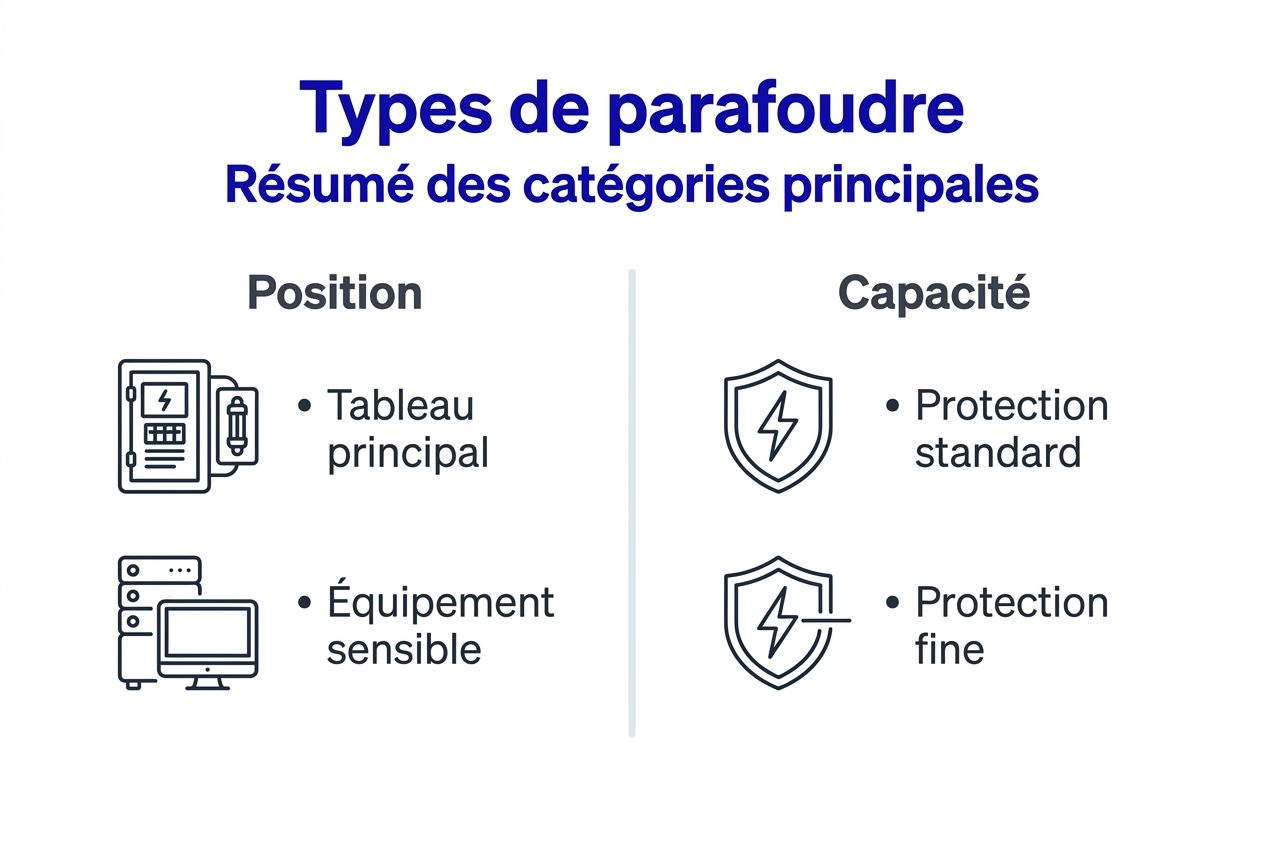
Type 2 protection is the standard for main electrical switchboards. It handles induced overvoltages and network switching, with a discharge capacity of between 5 and 40 kA per phase (8/20 µs waveform). Its installation is becoming mandatory in many configurations, particularly for buildings equipped with charging stations or photovoltaic systems.
Type 3 surge protection provides additional protection as close as possible to sensitive terminal equipment. It limits residual voltage to levels compatible with modern electronics, typically below 1 kV. This device can never be installed alone and always requires the presence of a Type 2 surge protector upstream.
| Kind | Waveform | Rated current | Position | Application |
|---|---|---|---|---|
| Type 1 | 10/350 µs | Up to 25 kA | Installation origin | Direct lightning protection, presence of a lightning rod |
| Type 2 | 8/20 µs | 5 to 40 kA | Main table | Standard protection, mandatory according to NF C 15-100 |
| Type 3 | 8/20 µs | Up to 5 kA | Near equipment | Thin, complementary protection type 2 |
The selection criteria depend on several technical and geographical parameters. The local lightning strike density, expressed in the number of thunderstorm days per year, directly influences the level of protection required. The site's exposure, the presence of sensitive equipment, and the insurers' contractual requirements are also determining factors.
Coordination with the grounding system is absolutely essential. A surge protector can only function effectively with a high-quality ground connection, exhibiting a resistance of less than 10 ohms. The length of the connections between the surge protector and ground must be minimized to reduce the impedance of the current flow circuit.
- Check the conformity of the existing grounding installation
- Size the surge protectors according to the required protection levels
- Select devices that are NF certified or equivalent
- Plan for selective coordination between the different levels of protection
- Install fault disconnection and signaling devices
Differences and choices between type 2 and 3 surge protectors
A thorough understanding of the differences between type 2 and type 3 surge protectors allows for optimization of the protection strategy. These two categories are not opposed but complement each other in a cascading approach.
Type 2: 5-40 kA discharge per phase, for main distribution board, near indirect lightning. This device constitutes the first line of defense against externally generated overvoltages. Its protection level, typically between 1.5 and 2.5 kV, is sufficient for most standard domestic and commercial equipment.
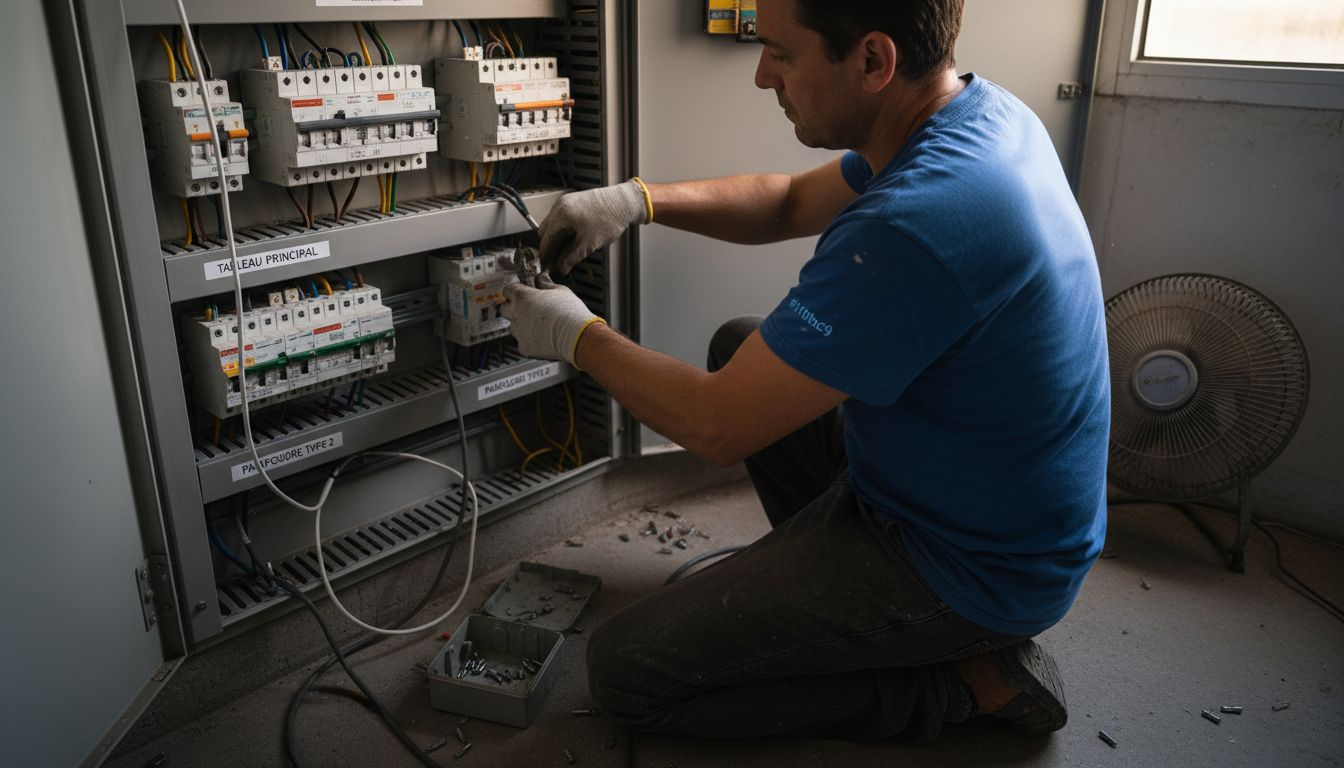
Type 3 comes into play as a second step. Type 3: fine protection near sensitive equipment, protection at 1 kV or less. This additional reduction of residual voltage is essential for power electronics, computer systems, and medical equipment.
Pro tip: The distance between a Type 2 and Type 3 surge protector should exceed 10 meters of cable or include a decoupling inductor to ensure optimal coordination. This separation prevents unwanted interactions during discharges.
The choice of the appropriate type of protection is based on a specific risk analysis. For an EV charging infrastructure installation, the presence of sensitive power electronics generally necessitates a combination of Type 2 protection at the distribution board and Type 3 protection as close as possible to the charging station. This cascaded configuration maximizes protection while respecting economic constraints.
The coordination between the two types follows precise rules. The type 2 surge protector must absorb most of the surge energy, thus limiting the stress on the type 3. If this coordination fails, the type 3 risks premature destruction, leaving the equipment unprotected.
- Type 2 only: sufficient for standard, less sensitive equipment
- Type 2 + Type 3: recommended for power electronics and computing
- Check the compatibility of the Up protection levels between the two types
- Opt for surge protectors with a visual fault indicator
EV charging infrastructure applications perfectly illustrate this complementarity. The charging station integrates complex electronic components, communication systems, and safety devices. surge protection against lightning strikes absolutely requires this multi-layered approach.
Practical application: protection of EV charging stations and sensitive equipment
EV charging infrastructure exhibits specific vulnerabilities to power surges. Onboard electronics, communication systems, and measurement devices are all sensitive points requiring enhanced protection. Photovoltaic inverters share these same characteristics, with increased sensitivity to electromagnetic interference.
A 6,000V surge from an indirect lightning strike at a distance of 500m destroyed the electronics and battery of the EV charging station, with a potential total cost of up to €35,000. This figure includes the replacement of the charging station, intervention costs, downtime of the charging point, and any potential business interruption losses. The lack of compliant protection may also lead to the insurer refusing coverage.
The sizing parameters for surge protectors used in EV charging infrastructure require careful attention. The charging power, typically between 7 and 22 kW for residential and commercial charging points, necessitates appropriately rated protection. Coordination with residual current devices (RCDs) and circuit breakers must be verified to prevent nuisance tripping.
- Always install a type 2 surge protector on the panel supplying the terminal
- Add a type 3 surge protector if the cable distance exceeds 30 meters
- Also protect communication lines (Ethernet, fiber optics)
- Check the electrical continuity of all metallic masses
- Document the installation to facilitate preventive maintenance
Pro tip: Connected EV charging stations require specific protection for data links. RJ45 or fiber optic surge protectors effectively complement primary electrical protection.
Coordinating protection systems with installation standards ensures regulatory compliance. The NF C 15-100 standard imposes precise requirements for circuits powering EV charging infrastructure, including the mandatory presence of surge protectors in most configurations. Failure to comply with these requirements makes the installer liable and may invalidate manufacturer warranties.
The impact on service continuity economically justifies the investment. A charging station out of service for several weeks for repairs generates significant lost revenue for professional operators. Insurance conditions are also evolving towards a systematic requirement for compliant coverage, under penalty of increased deductibles or denial of compensation.
Photovoltaic equipment presents similar risks. Inverters, often installed on or near rooftops, are particularly vulnerable to direct and indirect lightning strikes . Complete protection requires surge protectors for both the direct current (DC) and alternating current (AC) sides, with characteristics adapted to the specific voltages of photovoltaic systems.
Discover our lightning protection solutions
LPS France offers a complete range of solutions to effectively protect your installations against the risks of lightning and power surges. Our lightning protection kits include all the necessary components, sized according to current standards and adapted to your specific configurations.
Our technical experts support your teams through specialized training courses covering the regulatory, technical, and practical aspects of lightning protection. These sessions enable participants to acquire the necessary skills to design, install, and maintain compliant protection systems.
Our products and services guarantee compliance with NF C 15-100 requirements and incorporate the most advanced surge protection technologies. Each solution is designed to offer an optimal level of protection while facilitating maintenance and traceability of interventions.
Frequently Asked Questions about Surge Protectors
When should a surge protector be installed according to the NF C 15-100 standard?
The installation of a surge protector has been mandatory in seven building categories since September 2025. These categories include buildings with lightning rods, public buildings, healthcare facilities, industrial premises with sensitive equipment, EV charging infrastructure, and photovoltaic systems. Local lightning strike density may also make installation mandatory even outside these categories.
How to choose between type 2 and type 3 surge protectors?
Type 2 protection must be installed in the main distribution board for all basic protection. Type 3 protection is only added as a supplement, as close as possible to highly sensitive equipment requiring protection below 1 kV. Combining both types is the optimal solution for installations containing power electronics, computer systems, or communication equipment. Consult the compliance steps to validate your configuration.
What impact does insufficient protection have on insurance?
The absence of a surge protector compliant with NF C 15-100 can lead to a complete refusal of coverage by the insurer in the event of a claim. Insurance companies are increasingly requiring proof of adequate protection, particularly for EV charging infrastructure and photovoltaic systems. Deductibles can also be significantly increased if the protection proves insufficient or does not comply with regulatory requirements.
Can an existing installation be retrofitted with a surge protector?
Retrofitting a surge protector to an existing installation is perfectly feasible and often recommended. The procedure requires prior verification of the grounding quality and the available space in the electrical panel. Modular surge protectors greatly simplify this operation by mounting on a standard DIN rail. Gradually bringing older installations into compliance is a priority to reduce risks and adhere to evolving regulations.
Recommendation
- Surge protection against lightning strikes: Protect your modern installations
- Industrial lightning protection: the complete guide to securing your installations – Lightning Protection Systems France – Lightning Protection
- The complete guide to lightning protection system components
- Protecting Your Home Against Lightning: A Guide – LPS France