
Did you know that 80% of lightning rod failures go unnoticed until a major incident occurs, costing an average of €150,000 in business interruptions? Lightning strikes can cause material damage and major disruptions in industry if equipment is not effectively monitored. Lightning protection in industrial environments now relies on connected solutions that are revolutionizing maintenance and responsiveness to weather events.
Table of Contents
- Key points to remember
- Introduction to lightning protection and its challenges
- Technical operation of ESE and non-communicating lightning rods
- Connected systems contact@ir : architectures, communication and technologies
- Alert management, intelligent maintenance and monitoring via LPS Manager
- Detailed comparison of lps france
- Standards, regulations and maintenance obligations in France
- SI integration, security and future prospects
- Conclusion and best practices for the electrical safety engineer
- Discover lps france solutions for effective and connected lightning protection
- Frequently Asked Questions
Key points to remember
| Point | Details |
|---|---|
| Communicating lightning rods | Remote diagnostics via Paraton@ir reduces on-site visits by 70% and optimizes maintenance. |
| Three architectures Contact@ir | Dongl@ir (80 m, local diagnostics), Rout@ir (300 m, multi-site with history), Contact@ir MD (cellular IoT without local internet). |
| Centralized LPS Manager | Real-time alerts, IEC 62305 compliant historical data, API integration for existing BMS/SCADA systems. |
| Regulatory compliance | The IEC 62305 and NFC 17-102 standards require annual checks and strict traceability of interventions. |
| Appropriate technological choice | The selection between Dongl@ir, Rout@ir and MD depends on the site topography and available network constraints. |
Introduction to lightning protection and its challenges
Industrial and commercial facilities face significant risks from lightning strikes. A direct strike generates power surges that can destroy electronic equipment, cause fires, and lead to costly production shutdowns. Lightning rods form the first line of physical defense by capturing the atmospheric discharge before it reaches critical structures.
The digital transition is profoundly transforming the management of these systems. Connected solutions now enable continuous monitoring, instant alerts, and complete event traceability. This evolution addresses increasing regulatory requirements for compliance and documentation.
Electrical safety engineers and managers must master these new architectures in order to:
- Reduce maintenance costs by targeting necessary interventions
- Ensuring compliance with IEC 62305 and NFC 17-102 standards
- Improve responsiveness to detected failures
- Optimize multi-site management with data centralization
- Ensuring complete traceability for audits and certifications
Traditional preventive maintenance is giving way to a predictive approach based on real data. Connected equipment transmits its operating status, detects anomalies, and automatically triggers the appropriate intervention workflows.
Technical operation of ESE and non-communicating lightning rods
Paraton@ir lightning rods are equipped with an early triggering device, improving protection through an internal mechanism that generates an ionized channel before the main discharge. This early triggering (10, 25, 45, or 60 μs depending on the model) expands the protection radius and improves the capture efficiency.
The principle is based on the early ionization of the surrounding air. When the atmospheric electric field reaches a critical threshold, the ESE device triggers the formation of an upward leader more quickly than a simple lightning rod. This time advantage results in an extended protection zone covering a larger ground area.
Paraton@ir communicating lightning rods natively integrate Contact@ir Ready compatibility. They incorporate sensors and electronics enabling continuous self-diagnosis and wireless data transmission. This embedded intelligence verifies the integrity of the early streamer emission (ESE) device, measures electrical parameters, and detects lightning strikes.
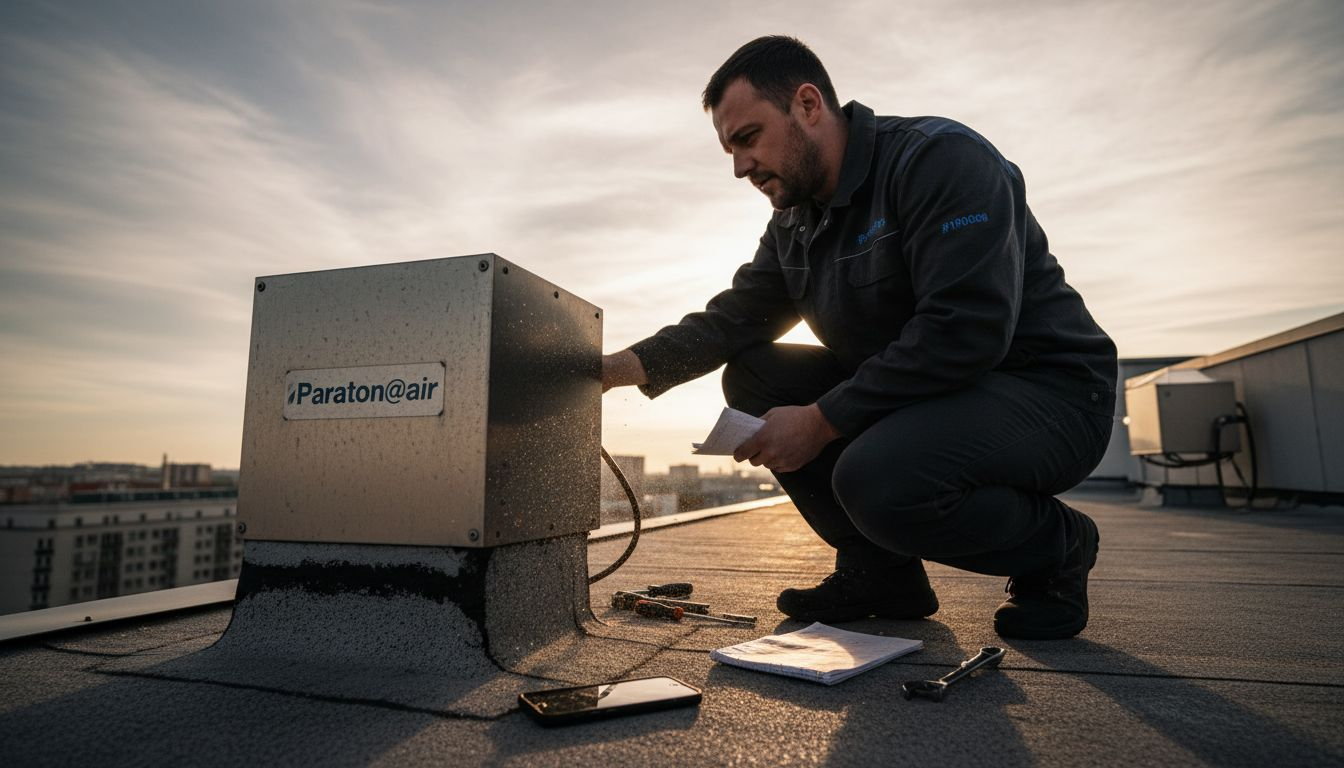
Conversely, Ellips lightning rods are non-communicating but can be tested via wired diagnostics with Test@ir . This range is suitable for installations requiring a proven PDA solution without the need for remote monitoring. Diagnostics are performed manually during scheduled visits.
Both product lines comply with IEC 62305 and NF C 17-102 standards, guaranteeing regulatory conformity. The models differ in size (typically 200×100 mm), prime advance, and communication compatibility. The choice depends on the project's budgetary, topographical, and regulatory constraints.
Pro tip: Assess during the design phase whether maintenance requirements justify the investment in communication equipment. The initial extra cost is quickly recouped on sites with difficult access or multiple buildings.
Connected Systems Contact@ir : architectures, communication and technologies
Contact@ir system offers three architectures adapted to network constraints and operational needs. Contact@ir + Dongl@ir provides local diagnostics over an 80-meter range without history or real-time alerts , ideal for spot checks. The photovoltaic transmitter transmits via 868 MHz radio to the USB receiver connected to an Android smartphone.
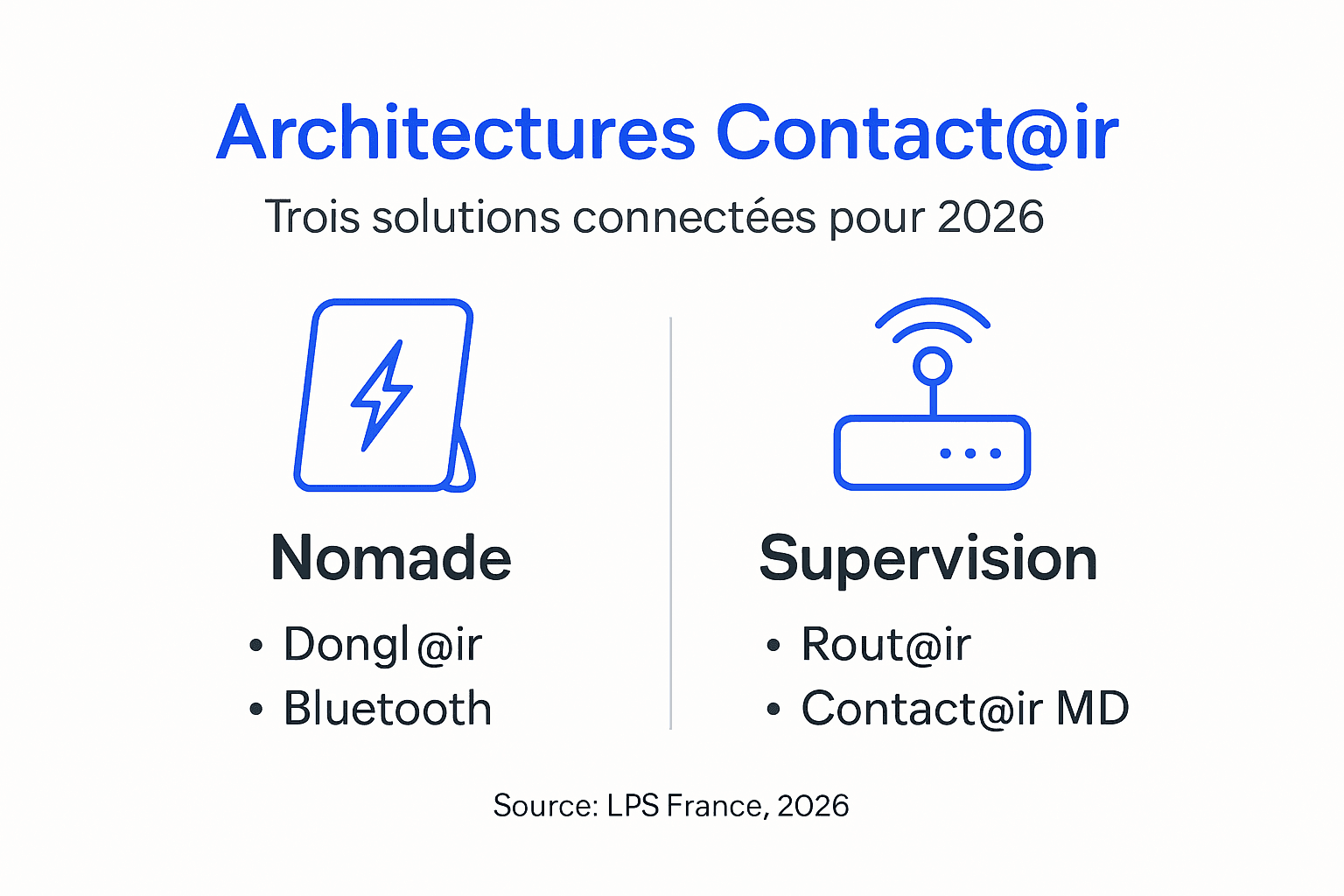
This mobile solution is ideal for remote sites without network infrastructure. The technician travels with the Dongl@ir, queries nearby equipment, and instantly checks its status via the mobile app. No internet connection is required, but no history is retained between readings.
The Contact@ir + Rout@ir architecture allows for up to 999 monitoring points, with historical data, real-time alerts, and cloud uploads if internet connectivity is available. The radio range reaches 300 meters in open field. The Rout@ir concentrator collects data from all transmitters within range, stores it locally, and synchronizes it with the LPS Francecloud.
The Rout@ir operates in hybrid mode. Without internet access, it stores data locally and allows on-site Bluetooth playback via a mobile app. As soon as a Wi-Fi, Ethernet, or mobile data connection becomes available, it automatically transmits the accumulated history and activates remote real-time alerts.
The third option, Contact@ir MD, uses cellular IoT and eSIM for real-time alerts without requiring a local internet connection. Each transmitter integrates an international SIM card and communicates directly with the cloud via 4G/3G/2G/Edge/GPRS networks. This complete autonomy eliminates any dependence on the client's network.
Key technical features include:
- Contact@ir broadcasts every 100 seconds for continuous diagnostics
- Immediate alerts upon detection of system impact or fault
- Photovoltaic power supply, diffused light, no orientation required
- Contact@ir MD synchronizes product data every 12 hours
- Low-power radio protocol guaranteeing multi-year autonomy
The architectural choice depends on four criteria: physical accessibility of the site, IP network availability, number of points to monitor, and allocated budget. Contact@ir connected systems offer the flexibility to adapt the solution to each operational context.
Alert management, intelligent maintenance and monitoring via LPS Manager
LPS Manager centralizes alerts and historical data from multiple sites for efficient management from a single, multi-platform interface. The platform aggregates data from all connected devices, displays real-time status, and automatically generates compliance reports.
The main features transform reactive maintenance into a predictive approach:
- Receive instant push notifications when impacts or defects are detected
- Consultation of complete historical records with precise timestamps for each event
- Multi-site management with map view and filtering by installation
- Generation of compliance reports for IEC 62305 and NFC 17-102 standards
- Secure sharing of information with maintenance teams and external auditors
The system allows for the registration of equipment, guaranteeing traceability and warranty validity . Each lightning rod, meter, or monitoring device is referenced with a serial number, installation date, and certificate of authenticity. This centralized documentation database tracks the entire lifecycle of the equipment.
Interoperability is a major advantage for large installations. LPS Manager exposes an API enabling integration with existing BMS (Building Management System) or SCADA systems. Lightning protection data is thus integrated into comprehensive monitoring dashboards.
Intelligent maintenance drastically reduces unnecessary interventions. Targeted alerts trigger only dispatches justified by actual events or detected deviations. This optimization lowers operating costs while improving the availability of protected facilities.
Pro tip: Configure alert profiles tailored to each equipment type and criticality level right from the start. Train operations teams to interpret notifications and react effectively without constantly requesting technical support.
Detailed comparison of LPS France equipment and solutions
The comparative table highlights the specific features of each LPS France , facilitating selection according to project constraints:
| Equipment | Communication | Diagnosis | Scope | Optimal use case |
|---|---|---|---|---|
| Paraton@ir | Contact@ir Ready native | Real-time via transmitter | Depending on architecture (80/300 m or cellular) | New installations requiring continuous supervision |
| Ellips | Non-communicating | Wired Test@ir | On-site only | Sites with standard scheduled maintenance |
| Dongl@ir | 868 MHz RF reception | Local smartphone | 80 m | Spot checks without infrastructure |
| Rout@ir | Multi-emitter concentrator | Cloud + local Bluetooth | 300 m | Multi-building sites with IP network |
| Contact@ir MD | Autonomous cellular IoT | Cloud direct eSIM | Mobile coverage | Dispersed sites without a local network |
| Compt@ir | Contact@ir Ready Option | 6-digit display + remote | According to the issuer | Traceability of impacts with visual proof |
| Alert@ir XT | Contact@ir Ready without display | Impact alert only | According to the issuer | Event detection without local reading |
The Paraton@ir and Ellips lightning rods share identical regulatory compliance but differ in their monitoring capabilities. Paraton@ir is suitable for operators who prioritize responsiveness and automatically documented compliance. Ellips remains a relevant option for those with tight budgets who can tolerate manual maintenance.
Contact@ir architectures differ in their autonomy and multi-point capability. Dongl@ir minimizes initial investment but requires a physical presence. Rout@ir optimizes the coverage/cost ratio for concentrated sites. Contact@ir MD maximizes deployment flexibility at the price of a mobile data subscription.
The Compt@ir and Alert@ir XT meters add impact traceability to existing installations. Compt@ir provides a convenient local display for quick visual checks. Alert@ir XT prioritizes discretion and remote alerting without any visible components.
The Test@ir wired tester completes the ecosystem for regulatory validations requiring physical measurement evidence. It verifies the proper functioning of priming devices and embedded electronics according to a standardized protocol.
Adapt equipment according to the environment: ATEX zones, corrosive atmospheres, and extreme temperatures influence material selection and protection ratings. Consult detailed technical data sheets to confirm compatibility.
Standards, regulations and maintenance obligations in France
The IEC 62305 and NFC 17-102 standards define the essential requirements for the protection and maintenance of lightning protection systems in France. NFC 17-102:2011 constitutes the French national standard, while IEC 62305 (2024 edition) establishes the harmonized international framework.
These texts impose strict obligations on operators:
- Complete initial verification after installation by a qualified body
- Annual visual inspection of all accessible components
- A complete check is performed after each detected or suspected lightning strike
- Thorough inspection every two years including earth resistance measurements
- A logbook is kept, tracking interventions, measures and modifications made
Compliance with regulations is a prerequisite for valid insurance coverage and legal liability. An incident occurring on a non-compliant or poorly maintained installation exposes the operator to the risk of denied compensation and potential legal action.
The design impacts include calculating the required protection level based on risk analysis, sizing down conductors and grounding connections, and ensuring proper separation distances to avoid inductive effects. The IEC 62305-2 standard details the methodology for assessing lightning risk.
Traceability becomes a core requirement with connected solutions. LPS Manager automates the creation of compliance documentation by archiving event timestamps, verification reports, and certificates of authenticity. This documentation is immediately available for audits without manual reconstruction.
The responsibilities of safety engineers include selecting compliant equipment, overseeing implementation, organizing preventive maintenance, and responding appropriately to alerts. A thorough understanding of IEC 62305 and NFC 17-102 standards is essential to guarantee safety and ongoing compliance.
IT integration, security and future prospects
LPS Manager offers APIs for integration into client BMS/SCADA systems via an authentication key provided upon request. This openness allows for the consolidation of lightning protection data into existing centralized monitoring systems.
Technical integration offers several benefits:
- Correlation of lightning events with electrical incidents or process shutdowns
- Automatic triggering of maintenance workflows in enterprise CMMS
- Power supply for HSE dashboards with indicators and lightning protection
- Long-term archiving in data lakes for advanced predictive analytics
- Interoperability with fire detection and energy management systems
Data security requires special attention. LPS Manager implements role-based access control, secure redundant servers, and encrypted communications. However, public documentation remains limited regarding cryptographic details and cloud architecture.
Enterprise customers should require a security annex detailing: end-to-end encryption protocols, strong authentication mechanisms, logging and log retention policy, backup and business continuity procedures, GDPR compliance and data hosting.
Technological development prospects include artificial intelligence for predictive maintenance, digital twins of facilities, and advanced IoT integration with complementary environmental sensors. LPS France invests 5 to 10% of its annual revenue in R&D targeting these innovations.
The integration of information systems for lightning protection transforms raw data into actionable intelligence. This IT/OT convergence characterizes Industry 4.0 applied to facility safety.
Adopt a phased approach: start with basic monitoring and then enhance integrations as your teams mature. Train employees on the new tools to maximize return on investment.
Conclusion and best practices for the electrical safety engineer
Modern lightning protection relies on three key elements: high-performance equipment, reliable communication, and intelligent monitoring. The three Contact@ir architectures (Dongl@ir, Rout@ir, Contact@ir MD) cover all contexts, from isolated sites to geographically dispersed multi-site parks.
Prioritize connected maintenance to reduce operating costs and improve responsiveness. Real-time alerts prevent failures from worsening and limit service interruptions. Automatic history logging simplifies regulatory compliance demonstrations during audits.
Essential best practices include:
- Assessing needs and supervision versus budgetary constraints from the design stage
- Select a communication architecture adapted to the topography and available network
- Systematically record equipment in LPS Manager for traceability
- Configure relevant alerts to prevent drowning of non-critical information
- Train operations teams to interpret notifications and react effectively
- Plan for gradual IT integration based on organizational maturity
- Document interventions rigorously to build a compliance file
Compliance with IEC 62305 and NFC 17-102 standards mandates rigorous maintenance and comprehensive traceability. Connected solutions largely automate these requirements while enhancing installation safety.
Expand your knowledge through LPS Franceresources: product technical documentation, application guides and standards, training webinars. Staying up-to-date with technological advancements remains essential in this rapidly evolving field.
Proactive lightning protection management ensures the longevity of installations, minimizes the risk of incidents, and optimizes maintenance budgets. Investment in communication equipment typically pays for itself within 24 months at critical or hard-to-reach sites.
Discover LPS France solutions for effective and connected lightning protection
LPS France offers a complete range of lightning protection solutions for industrial and commercial buildings. Paraton@ir early streamer emission (ESE) lightning rods natively integrate communication capabilities for real-time monitoring. Manufactured in France with rigorous quality controls, they guarantee regulatory compliance and long-term reliability.
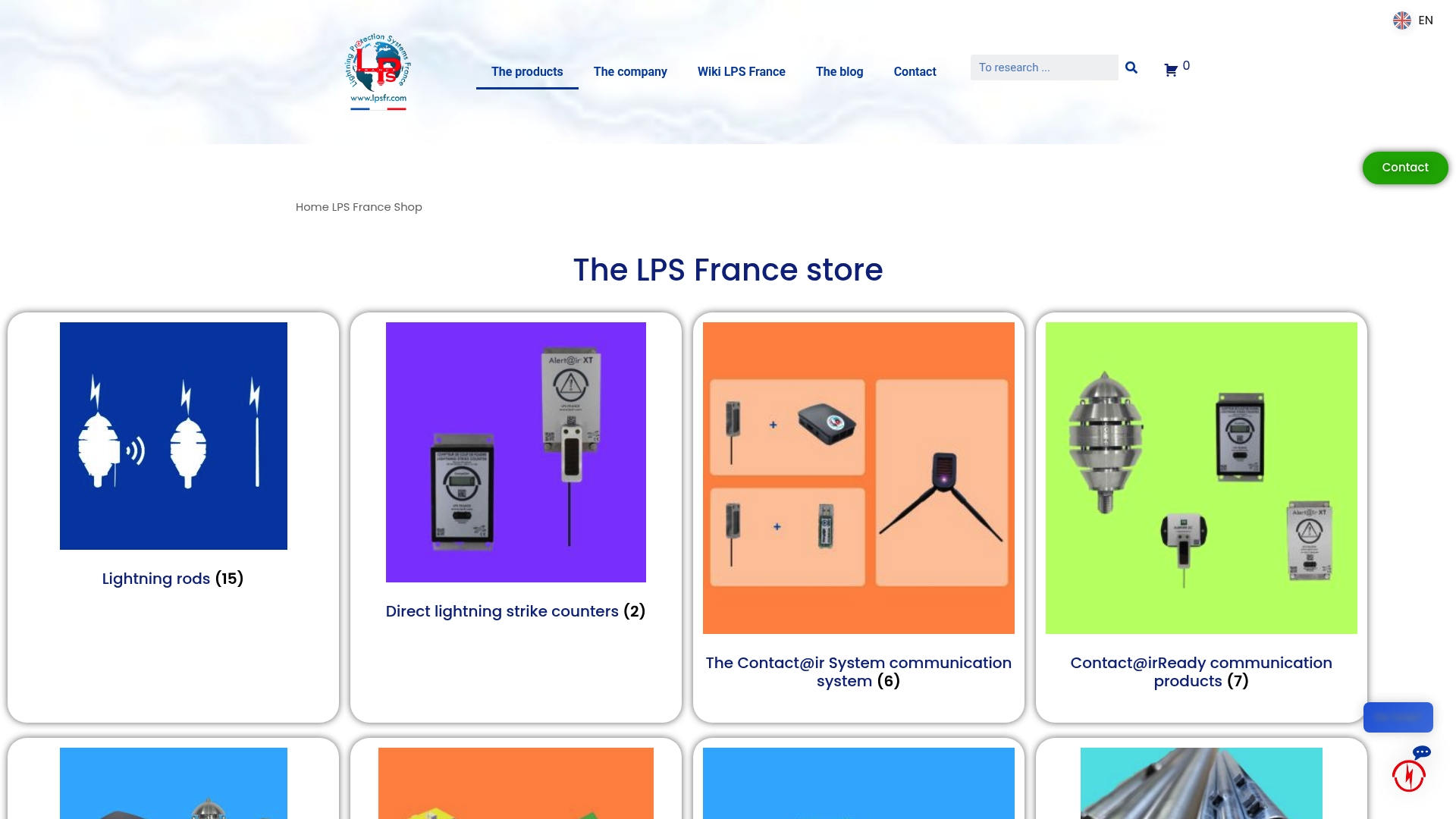
The Contact@ir communication system is available in three flexible architectures to adapt to your network and topographical constraints. Dongl@ir, Rout@ir and Contact@ir MD cover everything from spot diagnostics to multi-site monitoring with instant alerting.
LPS Manager for monitoring and alert management centralizes information, automates compliance reports, and integrates with your existing systems via API. Editions ranging from Free to Enterprise cater to all environments, from simple installations to complex industrial parks.
Benefit from expert support for sizing, installation, and team training. LPS France provides premium technical support and comprehensive documentation to facilitate solution adoption.
Frequently Asked Questions
What is an early streamer emission (ESE) lightning rod and why is it preferred?
A lightning rod with an early streamer emission (ESE) device triggers ion channel formation before standard lightning rods thanks to an active internal mechanism. This time advance (10 to 60 μs) expands the protection zone and improves capture efficiency. The communicating Paraton@ir models add continuous monitoring and automatic alerts, optimizing maintenance.
How to choose between Dongl@ir, Rout@ir and Contact@ir MD for supervision?
Select Dongl@ir for local, on-demand diagnostics without infrastructure (80m range, smartphone readout). Choose Rout@ir if you need multi-point monitoring at a centralized site with internet access (300m range, history log, alerts). For dispersed sites or sites without a client IP network, select Contact@ir MD (standalone cellular IoT, integrated eSIM). Contact@ir systems adapt to every operational context.
What is the importance of LPS Manager in compliant maintenance?
LPS Manager compliance maintenance centralizes alerts, time-stamped history, and equipment documentation, ensuring traceability required by standards. The platform automatically generates IEC 62305 and NFC 17-102 compliance reports, simplifies audits, and validates manufacturer warranties through systematic recording.
What standards regulate lightning protection in France?
The main lightning protection standards in France are NFC 17-102:2011 (French national standard) and IEC 62305:2024 (international standard). They mandate annual inspections, post-impact checks, traceability records, and adherence to risk assessment methodologies. Compliance is a prerequisite for valid insurance coverage and the legal liability of operators.