
Every year, lightning causes considerable damage to industrial and commercial buildings, resulting in loss of life and property. Lightning protection systems channel and dissipate this destructive energy to protect your equipment and employees. However, more than 50% of unmaintained systems exhibit critical failures . Mandatory maintenance according to standards remains the absolute key to the reliability of your protection devices.
Table of Contents
- The regulatory framework mandating the maintenance of lightning protection systems
- The risks and consequences of an unmaintained lightning protection system
- Modern surveillance and connected communication technologies
- Comparison of connected maintenance solutions LPS France
- Integration and traceability via LPS Manager
- Correcting misconceptions about lightning protection maintenance
- Conclusion and practical recommendations for effective maintenance
- Discover LPS France solutions for reliable lightning protection
- Why is annual maintenance mandatory for a lightning protection system?
- What are the main benefits of connected maintenance?
- What major risks are incurred if a lightning protection system is not maintained?
Key points to remember
| Point | Details |
|---|---|
| Vital periodic maintenance | Regular checks prevent critical failures and ensure the safety of the facilities. |
| Mandatory regulatory compliance | The IEC 62305 and NF C 17-102 standards impose strict obligations for annual and post-impact maintenance. |
| Major risks without monitoring | Lack of monitoring leads to invisible wear and tear, costly breakdowns, and significant operating losses. |
| Connected technologies optimize tracking | The Contact@ir System and LPS Manager solutions improve responsiveness and reduce physical interventions. |
| Traceability guarantees compliance | Modern systems ensure the automatic archiving of interventions for regulatory audits. |
The regulatory framework mandating the maintenance of lightning protection systems
Lightning protection standards precisely define your maintenance responsibilities. The NF C 17-102 standard clearly mandates annual maintenance and post-impact inspections, ensuring the continued protection of your installations. This requirement is not a recommendation but a strict regulatory obligation.
The IEC 62305 standard governs the design and monitoring of lightning protection systems internationally. It specifies verification procedures, acceptance criteria, and inspection intervals tailored to each level of protection. An IEC 62305 lightning risk analysis helps determine the optimal inspection frequency for your specific context.
Here are the main obligations according to these standards:
- A complete visual inspection of all system components at least once a year
- Thorough verification after each detected or suspected lightning strike
- Checking the electrical continuity of Equipotential Spark Gap and conductors
- Measurement of earth resistance according to defined thresholds
- Comprehensive documentation of all interventions in a dedicated register
Site managers bear a heightened responsibility with regard to these standards. A documented lack of maintenance can lead to liability in the event of an incident. Adhering to the schedule and precise procedures established by these standards provides your best legal and operational protection.
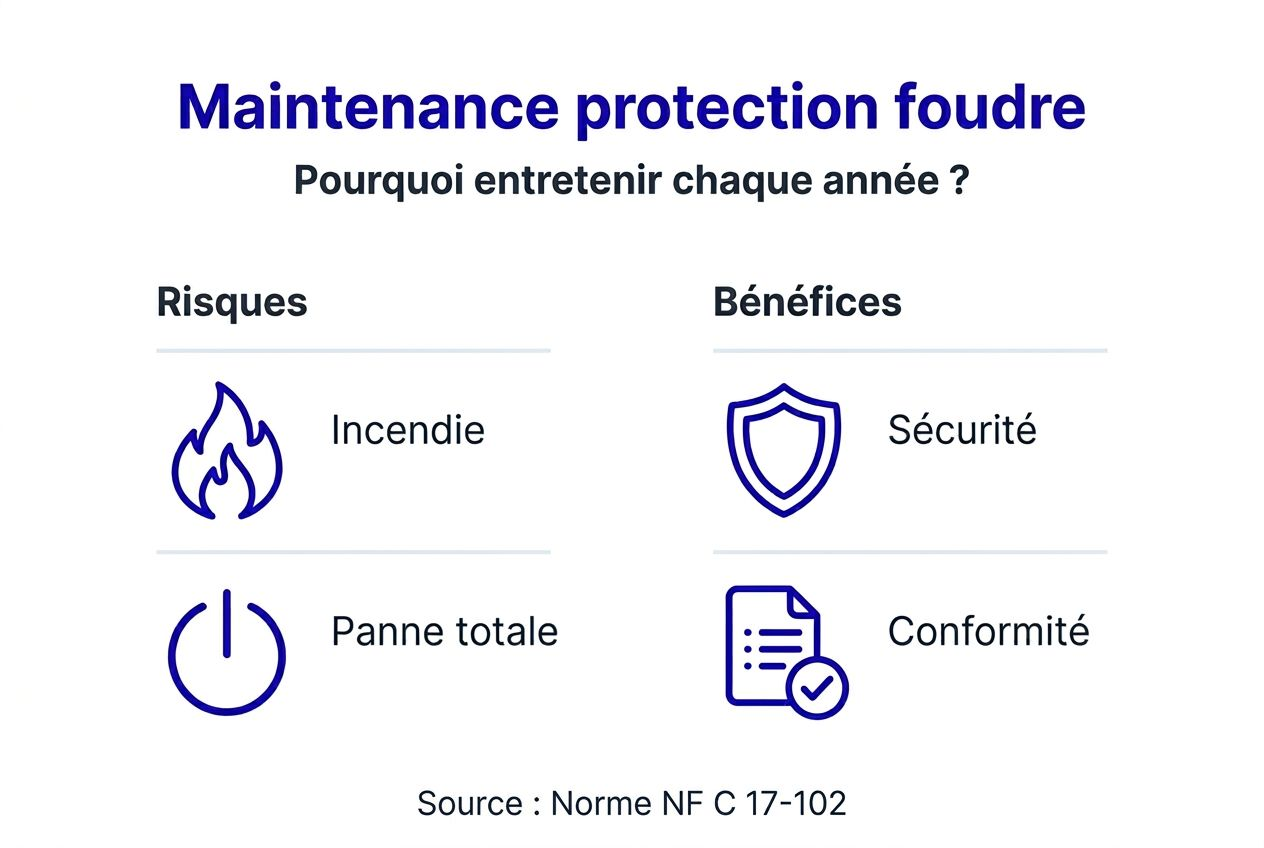
The risks and consequences of an unmaintained lightning protection system
Without regular maintenance, your system's components wear out silently. Conductors corrode, connections loosen, and circuit breakers lose their effectiveness. This invisible degradation gradually compromises the protective function of the entire installation. Undetected component wear leads to critical failure precisely when you need it most.
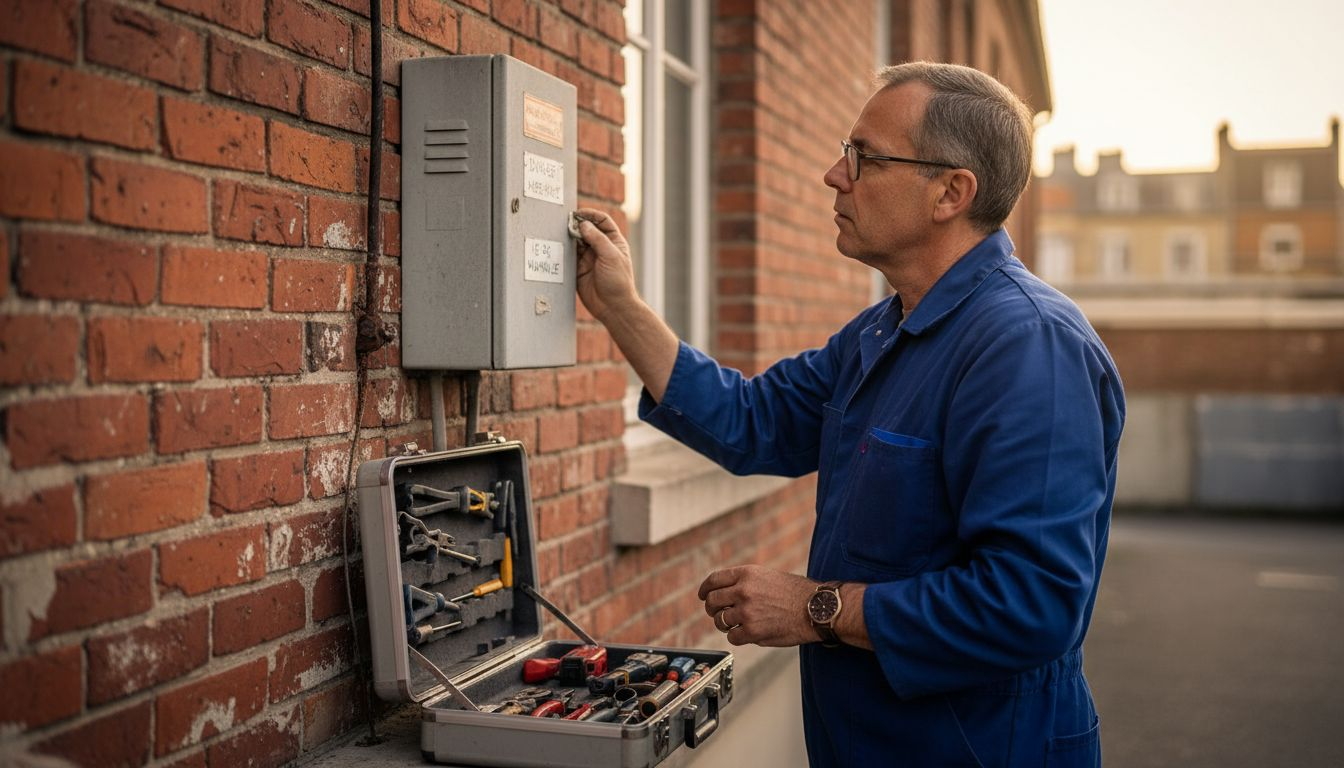
Failing to detect a lightning strike on your installation exposes your equipment to major risks. A faulty lightning rod no longer properly channels energy, allowing lightning to take alternative paths to your sensitive circuits. These unforeseen production shutdowns generate considerable financial losses, far exceeding the cost of structured preventative maintenance.
The direct consequences of neglected maintenance include:
- Destruction of sensitive electronic equipment by uncontrolled power surges
- Unplanned production stoppages that could last several days
- Emergency repair costs multiply standard rates by three or four
- Loss of critical data on industrial computer systems
- Endangering personnel exposed to faulty equipment
“Targeted maintenance after a detected lightning strike can prevent 85% of serious breakdowns in the following 6 months.”
Industrial lightning protection sites require special attention due to the critical importance of service continuity. Planned preventative maintenance typically costs 10 to 15 times less than emergency repairs after an incident. Targeted maintenance following lightning strike detection secures your site and preserves your maintenance budget.
Modern surveillance and connected communication technologies
Connected solutions are revolutionizing the maintenance of lightning protection systems. The contact@ir system offers three architectures adapted to different operational contexts. The Dongl@ir architecture provides on-site local diagnostics with a range of 80 meters, ideal for spot checks without permanent infrastructure.
Rout@ir architecture extends this capability up to 300 meters and adds automatic event logging. This stationary solution collects data from multiple transmitters simultaneously and then transmits it to the cloud via Wi-Fi, Ethernet, or mobile network. Real-time alerts improve incident response , allowing you to intervene immediately after an impact is detected.
The Contact@ir MD solution leverages the cellular IoT network with an integrated eSIM. This standalone architecture requires no dedicated receiver and operates on 4G, 3G, and 2G networks, depending on local coverage. Self-diagnosis is performed every 12 hours, while alerts are instantly transmitted to the central platform without delay.
The operational benefits of these technologies include:
- Drastic reduction in physical interventions on roofs or in hazardous areas
- Immediate detection of lightning strikes with precise time stamping
- Automatic event logging for regulatory traceability
- Significant time savings on preventive maintenance rounds
- Improving technician safety by limiting hazardous access
Pro tip: Choose your solution based on your specific needs. For a single site with a stable IP infrastructure, choose Rout@ir . For dispersed sites or sites without a usable network, opt for Contact@ir MD cellular. This selection optimizes your CAPEX to OPEX ratio over the entire lifecycle.
Comparison of connected maintenance solutions LPS France
Contact@ir architectures address distinct needs depending on your technical and budgetary constraints. The contact@ir Dongl@ir kit is the economical, portable solution for spot checks. Its limited range of 80 meters and lack of historical data make it suitable only for scheduled on-site checks.
The contact@ir rout@ir kit offers extended coverage up to 300 meters with local data logging. This stationary architecture collects data from multiple transmitters and then synchronizes it to the cloud as soon as an internet connection becomes available. Local playback via Bluetooth ensures access to information even without a network connection.
The contact@ir md cellular IoT device represents the ultimate standalone solution. The integrated international eSIM automatically selects the best local mobile network. This complete independence from the client network drastically simplifies deployment in dispersed or sensitive locations.
| Criteria | Contact@ir + Dongl@ir | Contact@ir + Rout@ir | Contact@ir MD |
|---|---|---|---|
| Maximum range | 80 m | 300 m | Mobile network coverage |
| Historicization | No | Yes (local + cloud) | Yes (cloud only) |
| Real-time alerts | No | Yes (if internet access is available) | Yes (cellular) |
| Infrastructure required | Android Smartphone | Mains power + optional internet | None (autonomous) |
| Optimal use | Spot diagnosis | Single multi-point site | Multi-site, dispersed |
| Local reading | Smartphone via USB | Via Bluetooth | No (cloud only) |
The contact@ir transceiver kits can be configured in minutes without any special radio expertise. The transmitter operates continuously thanks to its photovoltaic power supply, which harnesses diffuse light, without requiring any specific orientation. This energy autonomy guarantees 24/7 operation without intervention.
Integration and traceability via LPS Manager
LPS Manager connected management platform centralizes all information from your lightning protection systems. Real-time alerts and time-stamped historical data remain accessible at any time from any connected device. This continuous availability facilitates your teams' responsiveness to critical events.
Multi-site and multi-user management is easily configured via a granular access rights system. You grant the appropriate permissions to each user based on their role: view-only access for auditors, editing for maintenance staff, and full administration for technical managers. LPS Manager ensures traceability of interventions and regulatory compliance through its automatic archiving.
Integration with your existing industrial systems is achieved via a USB API. This interface allows you to connect LPS Manager to your BMS, SCADA, or CMMS platforms for a unified view of all your critical equipment. The LPS France team supports this integration from data retrieval to display in your operational dashboards.
Key traceability features include:
- Automatic recording of all lightning strikes with precise location
- Complete history of maintenance interventions with geolocated photos
- Automated generation of audit reports compliant with regulatory requirements
- Configurable alerts based on your personalized critical thresholds
- Summary dashboard of the status of your entire fleet of facilities
Pro tip: Take full advantage of the API to create a two-way link between LPS Manager and your existing maintenance management system. This integration eliminates duplicate data entry, enhances your workflows, and ensures that every lightning alert automatically triggers a work order in your CMMS.
Correcting misconceptions about lightning protection maintenance
Many believe that non-communicating lightning rods are cheaper in the long run. This view completely ignores the hidden costs of routine maintenance and unnecessary preventative call-outs. A connected system drastically reduces these recurring expenses by targeting only the interventions truly necessary after an event is detected.
Some managers consider periodic maintenance a mere administrative formality. Yet, this regular inspection detects invisible damage that could compromise protection at a critical moment. Worn connections, conductor corrosion, or loose fasteners go unnoticed without methodical inspection.
Telemetry significantly reduces the risk of human error in monitoring installations. A technician might forget a site, misinterpret a status, or overlook an early sign of failure. Lightning strike counters objectively record each event without any subjectivity, creating an irrefutable factual basis for your decisions.
The main misconceptions to correct:
- Myth: “An installed lightning rod requires no maintenance for 10 years”
- Fact: Components wear out gradually and require mandatory annual inspection
- Myth: “Connected maintenance costs more than traditional inspections”
- Reality: Savings on unnecessary travel recoup the investment in 2 to 3 years
- Myth: “A lightning strike is always visible to the naked eye”
- Reality: 70% of impacts leave no visible trace but damage the integrity of the system
Adopting modern solutions generates tangible gains in safety and cost. Data-driven intervention planning optimizes your maintenance resources. You intervene at the right time, on the right site, with the right parts, maximizing the efficiency of your technical teams.
Conclusion and practical recommendations for effective maintenance
Implementing an optimized maintenance strategy rests on several key pillars. Here is a concrete action guide to ensure the long-term security of your lightning protection systems:
Establish a rigorous schedule in accordance with IEC 62305 and NF C 17-102 standards with automatic reminders before each regulatory deadline.
Select the monitoring system that suits your context: Dongl@ir for spot diagnostics, Rout@ir for single multi-point sites, Contact@ir MD for dispersed parks.
Integrate connected tools to strengthen your responsiveness to detected impacts and build irrefutable documentary traceability.
Schedule a post-impact intervention systematically within 48 hours of each alert, with photographic documentation and a detailed technical report.
Promote ongoing training for your maintenance teams on regulatory developments and new remote diagnostic technologies.
Create a summary dashboard of the status of your entire fleet with key indicators: number of impacts per site, compliance rate, average intervention time.
Audit your maintenance process annually to identify areas for improvement and optimize the allocation of your technical resources.
This methodical approach ensures regulatory compliance while maximizing the availability of your critical facilities. Investment in connected technologies pays for itself quickly through reduced unnecessary travel and the prevention of costly downtime.
Discover LPS France solutions for reliable lightning protection
LPS France has been designing and manufacturing complete lightning protection solutions in France since 2010. Our Contact@ir MD devices provide continuous connected monitoring of your installations via an IoT cellular network with an integrated eSIM. This autonomous technology instantly transmits every alert to the central platform without any client-side infrastructure.
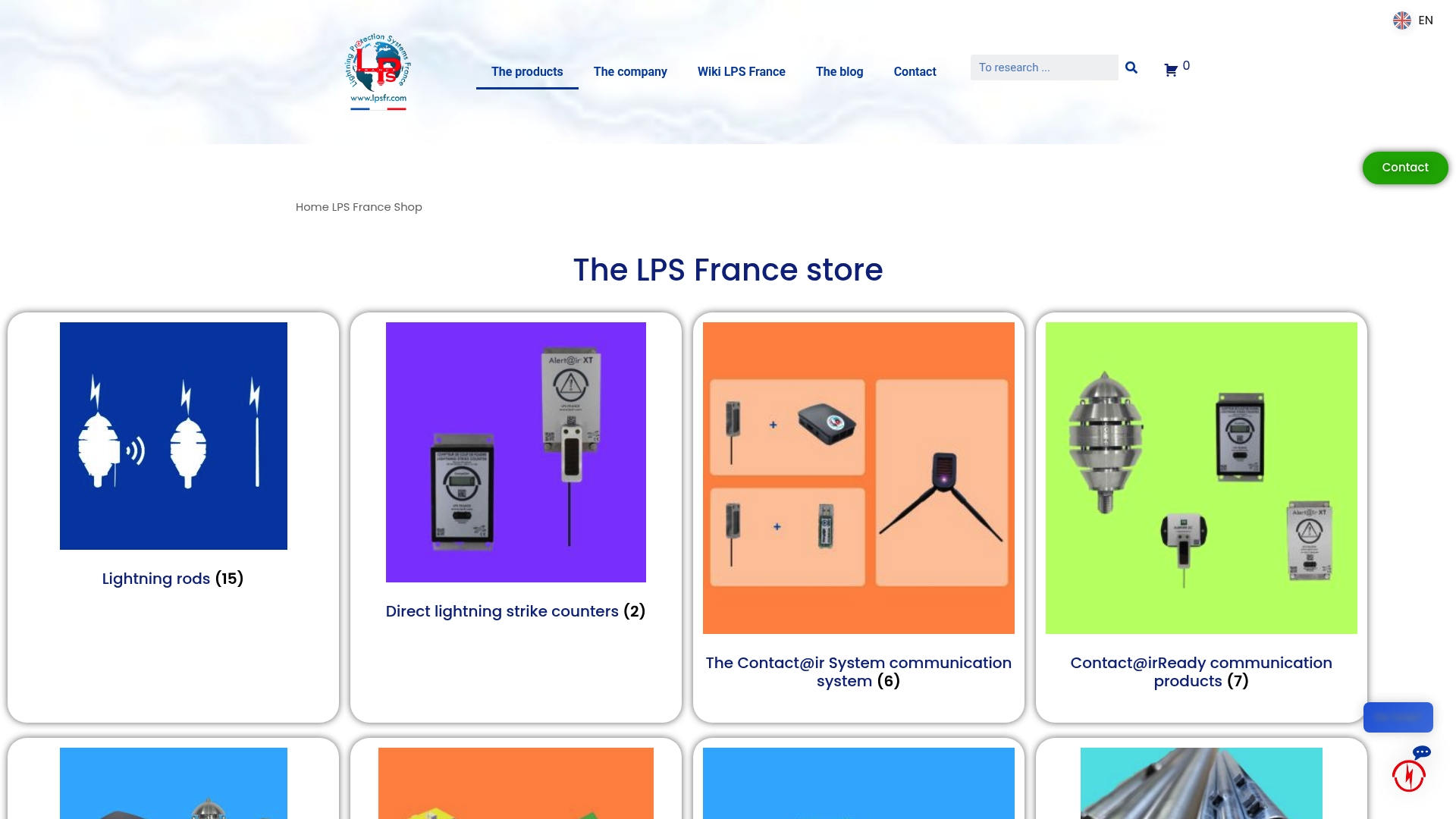
The LPS Manager connected management platform centralizes all your lightning protection data in a single interface accessible from your smartphone, tablet, or computer. You can view the real-time status of each installation, consult the complete history of lightning strikes, and automatically generate your regulatory audit reports. Discover our lightning rod definition Contact@ir range to secure your sites today.
Why is annual maintenance mandatory for a lightning protection system?
The NF C 17-102 standard mandates annual maintenance to guarantee the reliability of lightning protection systems. This regulatory requirement aims to ensure technical compliance and prevent unexpected failures that could compromise safety. Periodic inspections detect progressive wear of components, verify the electrical continuity of connections, and validate the mechanical integrity of the entire system. This annual verification also ensures the safety of people and equipment by confirming that the system will correctly channel lightning energy during the next strike.
What are the main benefits of connected maintenance?
Connected maintenance drastically reduces intervention times thanks to real-time alerts transmitted immediately after each detected impact. This responsiveness limits secondary damage and accelerates the return to normal. The contact@ir system optimizes your maintenance resources and costs by targeting only the necessary interventions, eliminating unnecessary routine preventive maintenance visits. Guaranteed traceability for audits and compliance simplifies your documentation obligations with automatic time-stamped archiving of all events and interventions.
What major risks are incurred if a lightning protection system is not maintained?
Undetected wear and tear on components causes failures at the critical moments when you need protection most. Connections loosen, conductors corrode, and the overall efficiency of the system silently declines. A lack of maintenance leads to wear, failures, and the risk of costly production downtime with significant damage to sensitive equipment. The financial losses from unplanned shutdowns far outweigh the cost of structured maintenance. Regulatory non-compliance also exposes you to potential penalties and makes you legally liable in the event of an incident on a neglected installation. Lightning protection risks increase exponentially without rigorous monitoring.
Recommendation
- Lightning protection guide 2026: criteria, architectures and recommendations
- Lightning protection system: The ultimate guide to lightning solutions
- The complete guide to lightning protection system components
- Industrial lightning protection: the complete guide to securing your installations – Lightning Protection Systems France – Lightning Protection
- Fire Safety Training Val-de-Marne 94 | FORMASAUVER