
Installing a lightning rod isn't enough. Without regular maintenance, inadequate upkeep can reduce its effectiveness by up to 50% , exposing structures and occupants to significant risks. Corrosion, faulty connections, and worn components silently compromise protection. Engineers and specialized technicians know that compliance requires much more than an initial installation. This article details why maintenance is essential, which components to monitor, how modern technologies optimize these operations, and what practices ensure safety and compliance with the 2026 standards.
Table of Contents
- Why is maintenance crucial for lightning rods?
- Components to monitor and inspection protocols
- Technologies and innovations for proactive maintenance
- Best practices and recommendations for engineers and technicians
- Discover our innovative lightning rod maintenance solutions
- Frequently Asked Questions
Key points
| Point | Details |
|---|---|
| Regular maintenance is essential | Without periodic monitoring, the effectiveness of protection systems drops dramatically, increasing the risk of direct impacts |
| Inspection of all components | Spikes, conductors, grounding, and surge arresters require systematic checks to detect corrosion and defects |
| Connected technologies are transforming maintenance | IoT sensors and automated alerts enable condition-based maintenance, reducing unnecessary visits and costs |
| Strict compliance with regulations | IEC 62305:2024 and NFPA 780 standards mandate annual inspections and post-impact interventions |
| Major risks in case of negligence | Undetected faults can lead to fires, property damage, and significant legal liabilities |
Why is maintenance crucial for lightning rods?
Lightning protection systems rely on a continuous chain of integrity. Every link, from the lightning rod to the grounding electrode, must function perfectly to handle currents reaching 200,000 amps in microseconds. Physics allows no weakness. An oxidized connection increases electrical resistance, generating heat and secondary arcs. A broken conductor interrupts the preferential path, forcing the discharge to travel through structures and equipment.
Lightning protection principles require that each component retain its original properties. However, industrial environments accelerate degradation. Saline atmospheres, chemical pollution, mechanical vibrations, and thermal cycles attack materials and assemblies. Studies show that 30% of installations exhibit critical defects after five years without maintenance.
The BS C 62305-3:2024 standard precisely defines the verification requirements. It mandates visual inspections, electrical continuity tests, and earth resistance measurements. These checks identify problems before they cause catastrophic failures. An unmaintained lightning rod becomes a point of vulnerability rather than protection.
The consequences of inadequate maintenance are well-documented: fires ignited by secondary arcs, destruction of electronic equipment by propagating power surges, and even fatal accidents when metal structures become conductor. Insurers often refuse compensation if maintenance records are incomplete. The legal responsibility rests heavily on facility managers.
Pro tip: schedule pre-storm season inspections (March-April) to correct detected defects, then post-season check (October) to assess impacts suffered and accumulated wear.
Statistics reveal the scale of the problem. Systems lacking proper maintenance experience failure rates three times higher in the event of direct impacts. This reality underscores the importance of a proactive rather than a reactive approach. Waiting for an incident to occur is infinitely more expensive than preventing it through regular maintenance.
Preventive maintenance transforms a passive system into active protection. Each inspection reinforces confidence in the device's effectiveness and extends its operational lifespan.
Particularly aggressive environments, such as coastal sites or chemical facilities, require more frequent inspections. Specific materials offer better resistance, but monitoring remains essential. No system is completely immune to natural degradation.
Components to monitor and inspection protocols
Each component of the lightning protection system performs a specific function. Their failure compromises the entire system. Methodical inspection protocols ensure early detection of problems.
Sensor tip and priming device : check for deformation, corrosion, or mechanical damage. Early priming devices (EPDs) require functional testing to confirm proper triggering. Inspect fasteners for loosening due to wind.
Down conductors : Inspect continuity along their entire length, looking for crushed, cut, or corroded sections. Measure electrical resistance between segments. Verify that regulatory spacing is maintained relative to structures.
Connections and assemblies : critical points where resistance increases rapidly. Disassemble representative samples to inspect contact surfaces. Look for oxidation, loosening, or signs of overheating. Tightening torques must comply with manufacturer specifications.
Grounding : Measure resistance with a four-point earth resistance tester. The value must remain below the standard threshold (generally 10 ohms). A significant increase indicates electrode corrosion or soil drying. Partially excavate to check the physical condition.
Surge arresters and protective devices : test tripping, check visual indicators, measure leakage current. Replace impact-damaged units even if indicators appear normal, as internal degradation is not always visible.
Impact counters : record the values and compare them to previous records. An abnormally high number suggests an installation problem or a particularly exposed environment requiring enhanced protection.
Lightning protection compliance requires comprehensive documentation. Each inspection generates a report detailing observations, measurements taken, and corrective actions. These records serve as evidence of due diligence in the event of an incident.
Pro tip: systematically photograph each critical component during inspections. These images facilitate comparisons over time and the detection of progressive degradation invisible during spot checks.
Protocols vary depending on the type of installation and environment. Complex industrial structures require detailed inspection plans identifying each control point. Areas that are difficult to access (high roofs, pylons) require specialized equipment and personnel trained to work at heights.
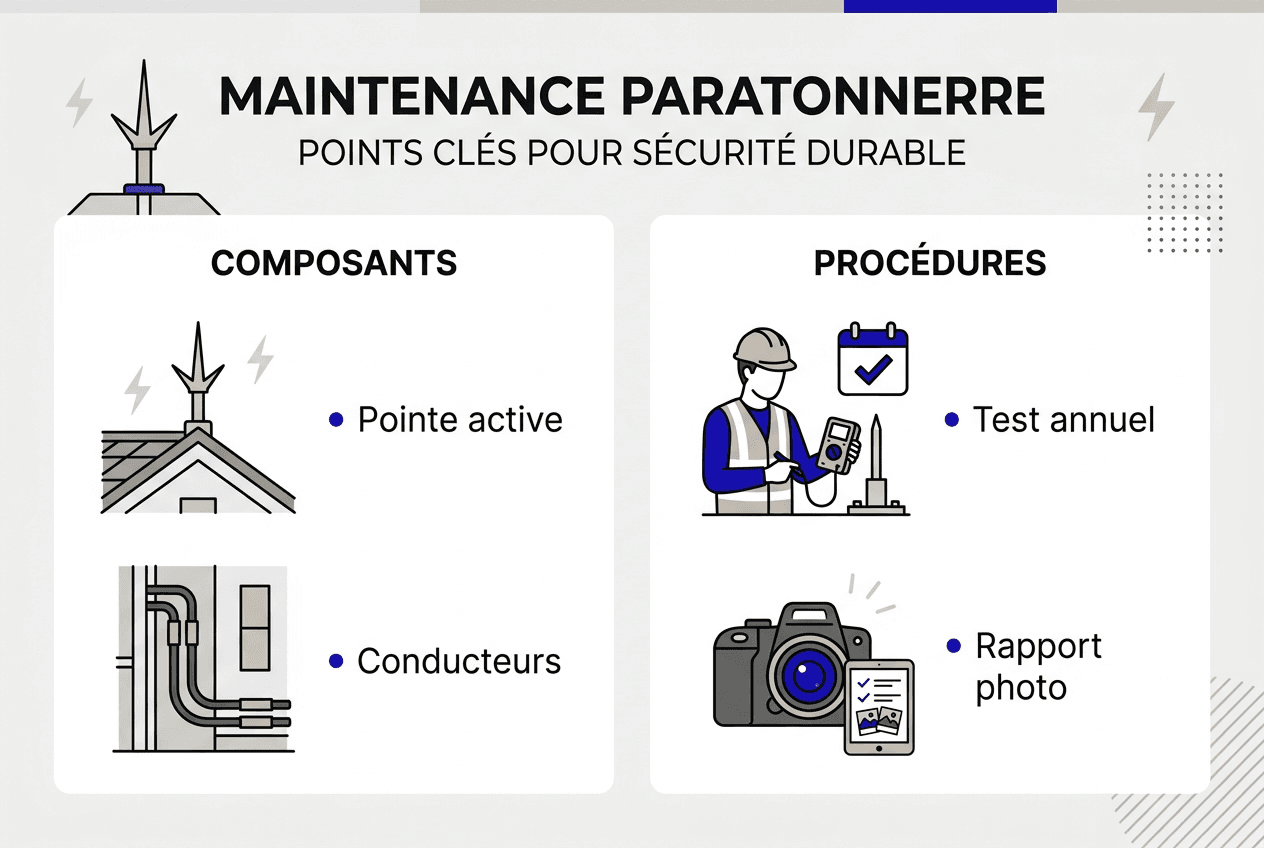
The minimum recommended frequency is annual for standard installations. High-risk sites (explosives storage, critical data centers) warrant semi-annual or quarterly inspections. After each impact confirmed by counter or observation, a complete inspection is immediately required to detect hidden damage.
Corrosive environments (marine atmospheres, polluted industrial areas) accelerate degradation. Adapt materials and frequencies accordingly. Tinned copper or stainless steel are more resistant than bare copper under these conditions.
Technologies and innovations for proactive maintenance
Connected systems are revolutionizing the maintenance of lightning protection installations. Intelligent sensors continuously monitor the condition of components, detect anomalies, and automatically alert managers. This approach transforms reactive maintenance into a predictive strategy.
Communicating impact counters record each discharge, time-stamp events, and measure intensity. This data enables precise correlation between storm activity and system demands. Automatic alerts trigger targeted interventions only when necessary, eliminating unnecessary inspections.
Remote monitoring using IoT technologies allows for the anticipation of faults by automatically alerting upon anomaly detection. Continuity sensors monitor conductor integrity. Earth resistance measurement modules transmit values in real time. Corrosion detectors anticipate failures before they become critical.
Connected lightning protection management platforms centralize data from multiple sites. Dashboards visualize the overall status of the system, identify installations requiring priority attention, and automatically generate compliance reports. Comprehensive historical data facilitates trend analysis and maintenance budget optimization.
| Approach | Frequency of interventions | Operating cost | Fault detection | System availability |
|---|---|---|---|---|
| classic preventative | Fixed (annual) | AVERAGE | Responsive | Planned interruptions |
| Based on condition | Variable (depending on the state) | Optimized | Proactive | Targeted interventions |
| real-time IoT | Continue + event | Reduced | Predictive | Maximum |
Pro tip: Integrate connected monitoring into your overall risk management strategy. Correlation with weather data, statistical exposure analysis, and predictive modeling maximizes return on investment.
The economic benefits are substantial. Reducing unnecessary travel lowers costs by 40 to 60%. Early detection prevents costly breakdowns and extends equipment lifespan. Automated documentation simplifies regulatory compliance and audits.
Safety is also improved. Instant alerts after impacts allow for immediate inspections, identifying damage before it causes secondary incidents. Continuous monitoring eliminates blind spots between scheduled inspections.
Adopting these technologies requires an initial investment, but the return is rapid. Modular systems allow for gradual deployment, starting with critical sites and then expanding to the entire network. Compatibility with existing installations facilitates modernization without complete replacement.
Best practices and recommendations for engineers and technicians
Establishing an effective maintenance program requires rigorous methodology and adaptation to the specific characteristics of each installation. The NFPA 780, IEC 62305, and IEEE standards provide frameworks for mandatory inspections, frequency, and interventions. Their application ensures regulatory compliance and optimal protection.
The frequency of inspections depends on multiple factors. Standard installations in moderate environments require a minimum annual inspection. Critical industrial sites, areas with a high lightning strike density, or aggressive environments warrant semi-annual inspections. After each confirmed strike, a full inspection is required within 48 hours.
The choice of materials directly influences durability and maintenance requirements. Comparison of the main options:
| Material | Conductivity | Corrosion resistance | Relative cost | Typical lifespan | Recommended applications |
|---|---|---|---|---|---|
| bare copper | Excellent | Average | Reference | 20-30 years old | Dry, indoor environments |
| Tinned copper | Excellent | High | +15 % | 30-40 years old | Coastal areas, humid atmospheres |
| Aluminum | Good | Average | -30 % | 15-25 years old | Temporary facilities, limited budgets |
| Stainless steel | Average | Very high | +40 % | 40-50 years old | Harsh chemical environments |
Documentation is the cornerstone of effective maintenance. Each intervention generates a structured report including the date, technician, detailed observations, measurements taken, photographs, and corrective actions. These records demonstrate compliance during audits and facilitate historical analysis.
Validation procedures ensure the quality of interventions. After corrective work, acceptance tests confirm the restoration of nominal performance. Earth resistance measurements, continuity tests, and functional checks of initiation devices validate the effectiveness of the repairs.
Checklist for a complete internal audit:
- Comprehensive verification of all capture points and priming devices
- Visual inspection and continuity tests on 100% of the conductors
- Detailed examination of all connections with disassembly of representative samples
- Multi-point earth resistance measurements with a calibrated tellurometer
- Functional testing of all surge arresters and protection devices
- Recording of impact counters and analysis of trends
- Documentation review and as-built schematic updates
- Assessment of compliance with applicable standards
- Planning corrective actions with prioritization according to criticality
Ongoing training for technical staff ensures the application of best practices. Changes in standards, new technologies, and feedback enhance skills. Professional certifications attest to expertise and reassure clients.
A comparative approach between traditional preventive maintenance and condition-based maintenance reveals significant advantages of the latter. Interventions triggered by actual conditions, rather than a fixed schedule, optimize resources. Connected technologies provide objective data to guide decisions.
To choose the right lightning protection and maintain its effectiveness, consider the required level of protection, the installation environment, the criticality of the protected equipment, and budget constraints. Modular solutions allow for gradual evolution towards intelligent, connected systems.
The specific requirements of industrial lightning protection impose increased demands. Production continuity, personnel safety, and the protection of expensive equipment justify investments in advanced monitoring and proactive maintenance.
Discover our innovative lightning rod maintenance solutions
Optimizing the maintenance of your lightning protection systems becomes simple with the right tools. LPS France offers a complete ecosystem combining high-performance equipment and advanced monitoring technologies.
Connected lightning protection management via LPS Manager centralizes the monitoring of all your sites. Real-time alerts, detailed history, automated reports, and intuitive dashboards transform maintenance into an efficient and traceable process. Reduce unnecessary travel, anticipate failures, and demonstrate regulatory compliance in just a few clicks.
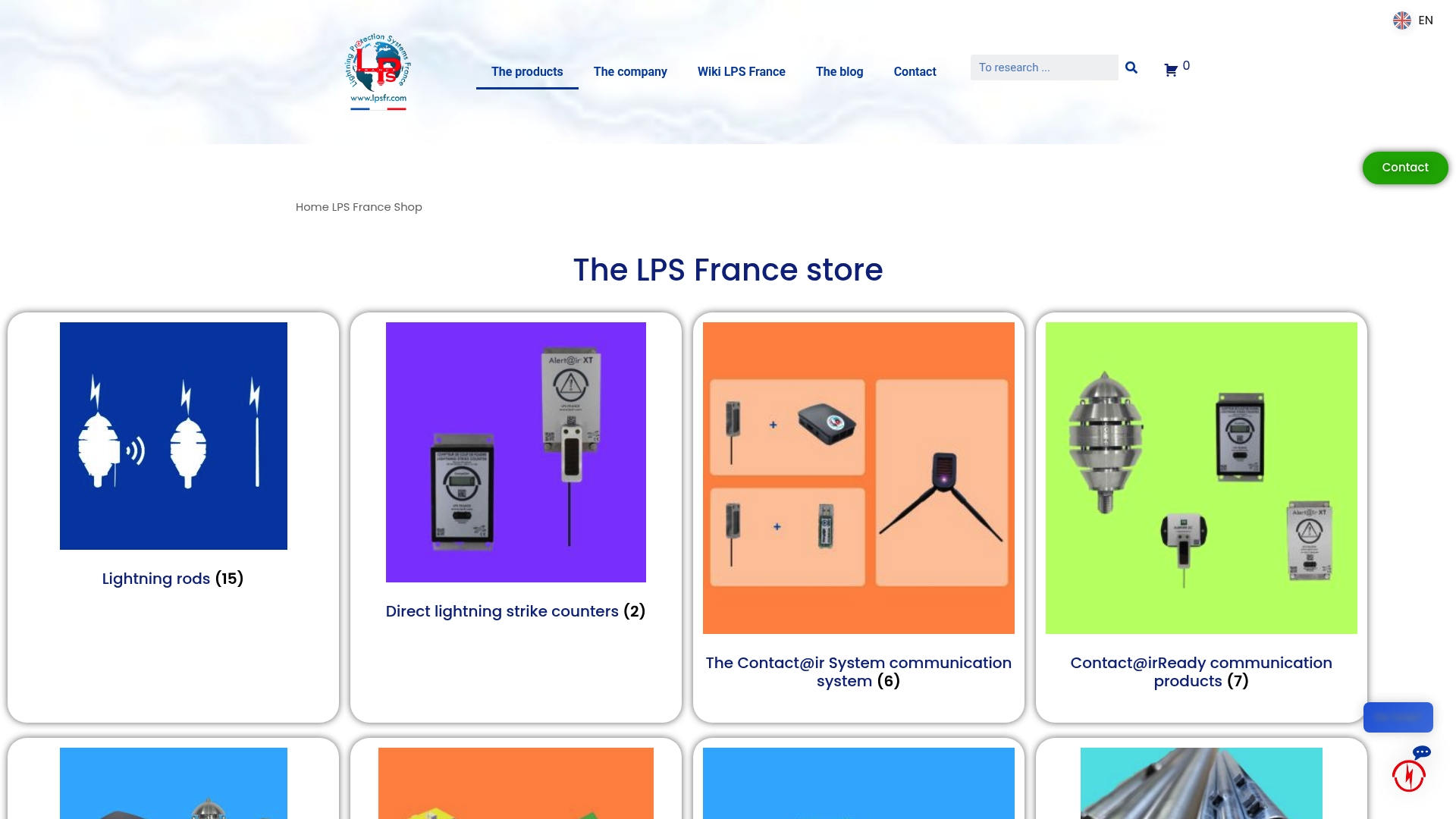
Our Paraton@ir range of early streamer emission (ESE) lightning rods natively integrate remote diagnostic capabilities. When paired with Contact@ir , they communicate their operating status, authenticate their integrity, and immediately report lightning strikes. This embedded intelligence simplifies maintenance and ensures optimal protection.
Explore our LPS France store to discover our full range of grounding equipment, accessories, and solutions. Our experts will assist you in selecting the products best suited to your specific needs and guide you toward effective proactive maintenance.
Frequently Asked Questions
What are the risks of insufficient maintenance?
Neglecting maintenance exposes systems to numerous hazards. System failure upon direct impact can cause electrical arcs, fires, and equipment destruction. Uncontrolled power surges damage electrical and electronic installations. The manager is legally liable if maintenance records are incomplete. Insurance companies often refuse compensation without proof of regular maintenance.
How often should a lightning protection system be inspected?
A minimum annual inspection is recommended for standard installations in moderate environments. Critical industrial sites, areas with high lightning strike density, or aggressive atmospheres require semi-annual or quarterly inspections. Maintenance is mandatory after each lightning strike confirmed by counter or visual observation. IEC 62305:2024 and NFPA 780 standards specify requirements according to protection level and criticality.
What are the most critical components to monitor?
The sensing probe and initiation device form the first link in the chain; their integrity is essential. Down conductors must maintain perfect electrical continuity along their entire length. Connections and assemblies are weak points where resistance increases rapidly due to oxidation. The grounding system ensures final discharge; its resistance must remain below regulatory thresholds. Surge protectors protect internal equipment; their failure exposes it to destructive overvoltages.
How do connected technologies improve maintenance?
Real-time monitoring detects anomalies immediately, triggering alerts before critical failures occur. Condition-based maintenance replaces routine inspections, optimizing travel and costs. Detailed historical data facilitates trend analysis and data-driven decision-making. Communicating impact meters confirm actual stresses, guiding targeted interventions. Centralized platforms simplify multi-site management and automatically generate compliance reports, significantly reducing administrative burden.