
Indeed, you've installed a lightning rod to protect your buildings, but how can you guarantee it actually works when a storm hits or after a lightning strike? Without precise monitoring and appropriate checks, your installation could allow invisible risks to pass through, compromise safety, and expose you to regulatory complications. Anomalies such as corrosion, weak connections, or poor grounding can escape a simple visual inspection and compromise the entire system without you even noticing.
The good news is that there are concrete methods to ensure the effectiveness of your lightning rod and maintain compliance, particularly through regular inspections, post-strike protocols, and the use of smart tools. The points checked during the inspection, such as measuring ground resistance or performing the recommended annual maintenance, make all the difference in anticipating problems and demonstrating the reliability of your installation.
Furthermore, discover below practical advice and specific actions you can implement to eliminate vulnerabilities, strengthen security, and maintain your peace of mind in the face of lightning. Prepare to master each key step so that your lightning rod protects your premises, day after day, in all circumstances.
Table of Contents
- 1. Comply with IEC 62305 and NF C 17-102 standards
- 2. Implement regular on-site and remote diagnostics
- 3. Use LPS Manager for traceability and reporting
- 4. Modernize the facilities with communication systems
- 5. Check the condition of the lightning rod and accessories
- 6. Schedule checks after each lightning strike
Quick summary
| Take into account | Explanation |
|---|---|
| 1. Comply with safety standards | Comply with IEC 62305 and NF C 17-102 standards to ensure effective protection against lightning. |
| 2. Perform regular diagnostics | Implement on-site and remote inspections to ensure your lightning rod is functioning properly. |
| 3. Use LPS Manager for traceability | Centralize your maintenance data and create automated reports to prove your compliance. |
| 4. Modernize with communication systems | Integrate smart devices to receive real-time alerts and ensure proactive maintenance. |
| 5. Plan post-impact checks | After each lightning strike, conduct a quick inspection and document the condition to comply with legal requirements. |
1. Comply with IEC 62305 and NF C 17-102 standards
Furthermore, lightning rods only function correctly if they comply with current safety standards. In France and Europe, two fundamental standards govern lightning protection: IEC 62305 and NF C 17-102 . These standards are not optional; they guarantee that your installation truly protects your buildings and their occupants.
Furthermore, understanding the difference between these two standards helps you choose the right maintenance strategy. IEC 62305 is the international standard that covers the entire protection system (risk analysis, design, installation, maintenance). NF C 17-102 is the French adaptation, with additional requirements tailored to the French regulatory context.
Note that compliance with IEC 62305 and NF C 17-102 standards is not just a legal matter, it is the guarantee that your system works in the event of a lightning strike.
Why these standards really matter:
- Personal safety : they require annual checks and post-impact inspections.
- Legal liability : in the event of an incident, non-compliance will make you liable.
- System efficiency : these define the criteria for the proper functioning of lightning rods.
- Traceability : they require regular documentation of checks.
In general, your installation must be checked annually according to these standards. This means a wired test with testing devices such as the Test@ir , an electrical continuity measurement, and a visual inspection of the entire system. After a lightning strike is detected, an immediate additional check is mandatory.
Paraton@ir and Ellips products from LPS FRANCE are all certified compliant with these standards. Early streamer emission (ESE) lightning rods like these require particular attention during inspections, as their early streamer emission (ESE) time (measured in microseconds) must be validated regularly.
Contact@ir Ready communicating products enable remote monitoring via LPS Manager. This helps you automatically document your checks and meet the deadlines imposed by the standards.
In practical terms, pro tip: Register your lightning rods in LPS Manager as soon as they are installed to activate automatic annual maintenance reminders, ensuring continuous compliance without oversights.
2. Implement regular on-site and remote diagnostics
Remember that a lightning rod without regular maintenance is like a security system that's never been tested. You won't know if it's actually working when you need it. Implementing regular maintenance combines on-site physical inspections with remote checks using connected tools.
It's important to note that on-site diagnosis begins with a visual inspection of visible components. Check the condition of down conductors, fasteners, and areas of potential corrosion. Connections should be clean and tight. Corrosion, mechanical wear, or structural damage are telltale signs.
In reality, after the visual inspection comes the technical verification . This includes measurements of electrical continuity of the conductors and resistance tests of the grounding system. These checks detect anomalies invisible to the naked eye. Maintenance in accordance with standards ensures that each component fulfills its protective role.
Indeed, remote diagnostics transforms passive maintenance into intelligent maintenance, detecting lightning strikes in real time and triggering checks before emergencies.
However, remote diagnostics are a game changer thanks to connected systems:
- Immediate detection of impacts Contact@ir systems detect each lightning strike live.
- Real-time alerts : you are notified on your phone even before arriving on site.
- Automatic logging : each event is recorded to document your compliance.
- Complete traceability : LPS Manager centralizes all diagnostics and verifications.
However, combining the two approaches creates a balanced strategy . Annual inspections capture slow-onset degradation (progressive corrosion, micro-cracks). Remote diagnostics catch acute shocks (lightning strikes, sudden defects). Together, nothing escapes notice.
For multi-site installations, this combination becomes essential. You can't be everywhere at once to visually inspect, but you can receive instant alerts from anywhere in the world via connected monitoring Paraton@ir communicating lightning rods already incorporate this capability.
On the other hand, Pro tip: Schedule your annual inspections shortly after the storm period in your area to check the post-impact condition, then use Contact@ir to detect lightning strikes in real time between visits.
3. Use LPS Manager for traceability and reporting
However, traceability is your best ally when dealing with inspectors, insurers, and auditors. Without it, you cannot prove that your maintenance was performed correctly. LPS Manager centralizes all your diagnostics, checks, and events in one place, accessible from any device.
For example, imagine a realistic scenario: a lightning strike hits your installation on a Sunday evening. Without LPS Manager, you call a technician who wonders if a post-impact check was ever performed. With LPS Manager, the alert notified you instantly, you documented the event, and the subsequent check report is generated automatically.
Specifically, the platform automatically records every event detected by your communicating lightning rods. Lightning strikes, surge protector failures, continuity measurements—all these elements are accumulated in a history accessible in just a few clicks. This traceability becomes your legal proof of compliance.
In particular, LPS Manager transforms maintenance into documented evidence, protecting your legal liability and simplifying your compliance audits.
In fact, here's what traceability actually brings you:
- Complete history : every check, every impact, every intervention remains recorded.
- Automated reports : generate documents ready to present to an auditor in seconds.
- Real-time alerts : receive notifications before the problem even gets worse.
- Multi-user : share information with your maintenance team or partners.
- Geolocation : Locate your facilities on a map for field inspections.
In this regard, the different editions of LPS Manager offer features tailored to your size. The Free version lets you get started with basic files. The Pro edition adds detailed reports and a complete history. The Expert edition offers custom branding and chat support. The Enterprise edition includes API access for integrating with your existing systems.
For managers of multiple facilities, the ability to monitor all sites from a single dashboard is a game changer. You can immediately see which building needs checking, which system has reported an anomaly, and which report needs to be generated.
In this context, Pro Tip: Configure annual maintenance reminders in LPS Manager as soon as you register your first installation, and download the generated reports in PDF format to keep them in your legal archives.
4. Modernize the facilities with communication systems
In other words, your current lightning rods may be working well, but they leave you blind. You'll never know if they've been struck by lightning until your next annual inspection. Upgrading with communicating systems completely changes this equation by transforming your passive installations into intelligent, connected systems.
In other words, modernization doesn't mean replacing everything. You can gradually add smart meters like Compt@ir or Alert@ir XT to your existing downhill drivers. These devices detect each impact and transmit the information in real time via the Contact@ir . It's a smooth evolution that improves your coverage without prohibitive costs.
For new installations or complete replacements, Paraton@ir communicating lightning rods offer an integrated approach. These devices are natively Contact@ir Ready, meaning they automatically transmit remote diagnostics without complex configuration.
First, modernizing your lightning rods with communicating systems gives you three simultaneous advantages: immediate alerts, automatic traceability and preventive maintenance instead of corrective maintenance.
Next, the tangible benefits of modernization:
- Immediate detection : know live when a blow strikes, not three months later.
- Targeted maintenance : intervene only when necessary, reducing unnecessary travel.
- Guarantee preserved : communicating systems extend your coverage and prove your compliance.
- Simple integration : Contact@ir works without requiring major changes to your IT infrastructure.
- Scalability : you add monitoring points gradually according to your needs.
Finally, the choice of communication technology depends on your context. Contact@ir with Rout@ir is suitable if you have good internet connectivity on-site. Contact@ir MD with integrated eSIM works even in areas without a fixed network, thanks to mobile coverage. Dongl@ir offers simple local diagnostics for audits without network dependency.
It's worth noting that predictive lightning rod maintenance becomes realistic once you have collected raw data. You can identify degradation trends before a failure, schedule maintenance optimally, and avoid emergencies.
Note that Pro tip: Start modernization with your critical or multi-building sites where visual monitoring would be costly, then gradually extend to less sensitive facilities.
5. Check the condition of the lightning rod and accessories
Indeed, a lightning rod does not wear uniformly. The tip can corrode, the down conductor can become detached, and the fasteners can loosen. Regular inspections detect these signs of deterioration before they compromise your protection. Systematically inspecting each component of the system ensures that everything is functioning correctly.
Therefore, the inspection begins with a visual check of the tip. Look for corrosion, cracks, or signs of wear. The tip is the part exposed to wind and moisture, so it is often the first to suffer. A damaged tip drastically reduces the system's efficiency.
Furthermore, the down conductor deserves special attention. Check that its routing is correct, that it hasn't been moved, and above all, that its electrical continuity is perfect. Breaks invisible to the naked eye can block the passage of lightning current. You also need to check the protective sheaths and the inspection seal.
Furthermore, checking the lightning rod accessories means verifying that each connection, each fixing and each seal fulfills its electrical and mechanical role.
In addition, here are the essential checks to perform:
- Lightning rod tip : check for corrosion, cracks or abnormal wear.
- Conductor continuity : measure electrical continuity from end to end.
- Protective sheath : inspect that it is not damaged or worn.
- Mechanical fixings : check tightness and absence of play.
- Equipotential bonding : check that critical equipment is connected.
- Electrical panel surge protectors : verify their presence and functional condition.
Note that measuring ground resistance is critical. Improper grounding renders your lightning rod useless as a decorative element. Use a professional ground resistance tester specifically designed for lightning rods to accurately measure the resistance.
In general, accessories such as guy wire kits or additional conductors should also be inspected. Check that nothing is rusted, loose, or improperly attached. Guy wire kits should hold the mast securely without overloading it.
In practice, document each inspection in LPS Manager. Take photos, note the measurements, and keep the evidence. This traceability becomes essential for auditors and for your own future assessments.
Pro tip: Schedule your annual checkups after your area's main storm season, when you can quickly identify damage from lightning strikes.
6. Schedule checks after each lightning strike
Every lightning strike that hits your lightning rod is a stressful event. But it's also an opportunity. A direct strike means your system did its job by intercepting the lightning instead of letting it hit the building. After each strike, a mandatory check should be scheduled promptly to ensure everything is still functioning correctly.
IEC 62305 and NF C 17-102 standards explicitly require it. A post-impact inspection is not optional; it is a legal obligation. Without this documented inspection, you lose your insurance coverage and are liable in the event of a subsequent claim. It's as simple as that.
Rapid impact detection is your top priority. If you have a communication system like Contact@ir with Rout@ir or Contact@ir MD, you receive an instant alert . You know immediately that an impact has occurred. Without a communication system, you might wait months to discover it during an annual inspection.
A rapid post-impact verification minimizes the risk of further damage and proves your regulatory compliance instantly.
Here is what your post-impact protocol should include:
- Received alert : LPS Manager or call detecting impact.
- Quick visual inspection : check for any apparent damage or fire.
- Technical check : measure continuity, earth resistance, condition of connections.
- Photo documentation : photograph the tip, the conductors, the grounding.
- Verification report : generate the report in LPS Manager with all the results.
- Corrective actions : if damage is detected, plan immediate repairs.
The safety protocol includes a thorough visual inspection of the lightning rod, conductors, connections, and grounding. The integrity of critical components must be verified to ensure the continued proper operation of the system. Post-lightning safety demands this systematic rigor.
Communication systems transform this obligation into an operational opportunity. Instead of reacting late, you act immediately. You document each check in LPS Manager to create a complete audit trail. Your insurers see that you are serious about maintenance.
Pro tip: Set up email/SMS alerts in LPS Manager for each detected impact, and systematically schedule an on-site inspection within 48 hours of the alert to document the post-impact status.
The table below summarizes the important strategies mentioned in the article to ensure effective lightning protection in accordance with standards, as well as the recommended tools and solutions for maintenance.
| Thematic | Details | Key Benefits |
|---|---|---|
| Compliance with standards | Application of IEC 62305 and NF C 17-102 standards. Annual checks and checks after each impact. | Infrastructure security and reduced legal liability. |
| Regular diagnosis | Combination of physical inspections and connected monitoring. | Rapid detection of anomalies and preventive intervention. |
| Management with LPS Manager | Centralization of maintenance data and generation of automatic reports. | Full traceability and transparency for audits. |
| Modernization of systems | Addition of communication devices such as Contact@ir and Rout@ir. | Predictive maintenance and real-time impact alerts. |
| Element control | Visual and technical inspection of components such as the tip and connections. | Maintaining efficiency and preventing mechanical failures. |
Ensure the safety and compliance of your lightning rods with LPS FRANCE
Effective maintenance of your lightning rods, based on best practices such as compliance with IEC 62305 and NF C 17-102 standards, requires reliable and innovative solutions. To avoid the risks associated with poorly maintained equipment and ensure rapid diagnosis, LPS FRANCE supports you with products manufactured in France, combining quality, traceability, and connected performance. Thanks to the Paraton@ir and the LPS Manager , benefit from intelligent maintenance that alerts you in real time after each lightning strike and allows you to centralize all your checks with automated reports.
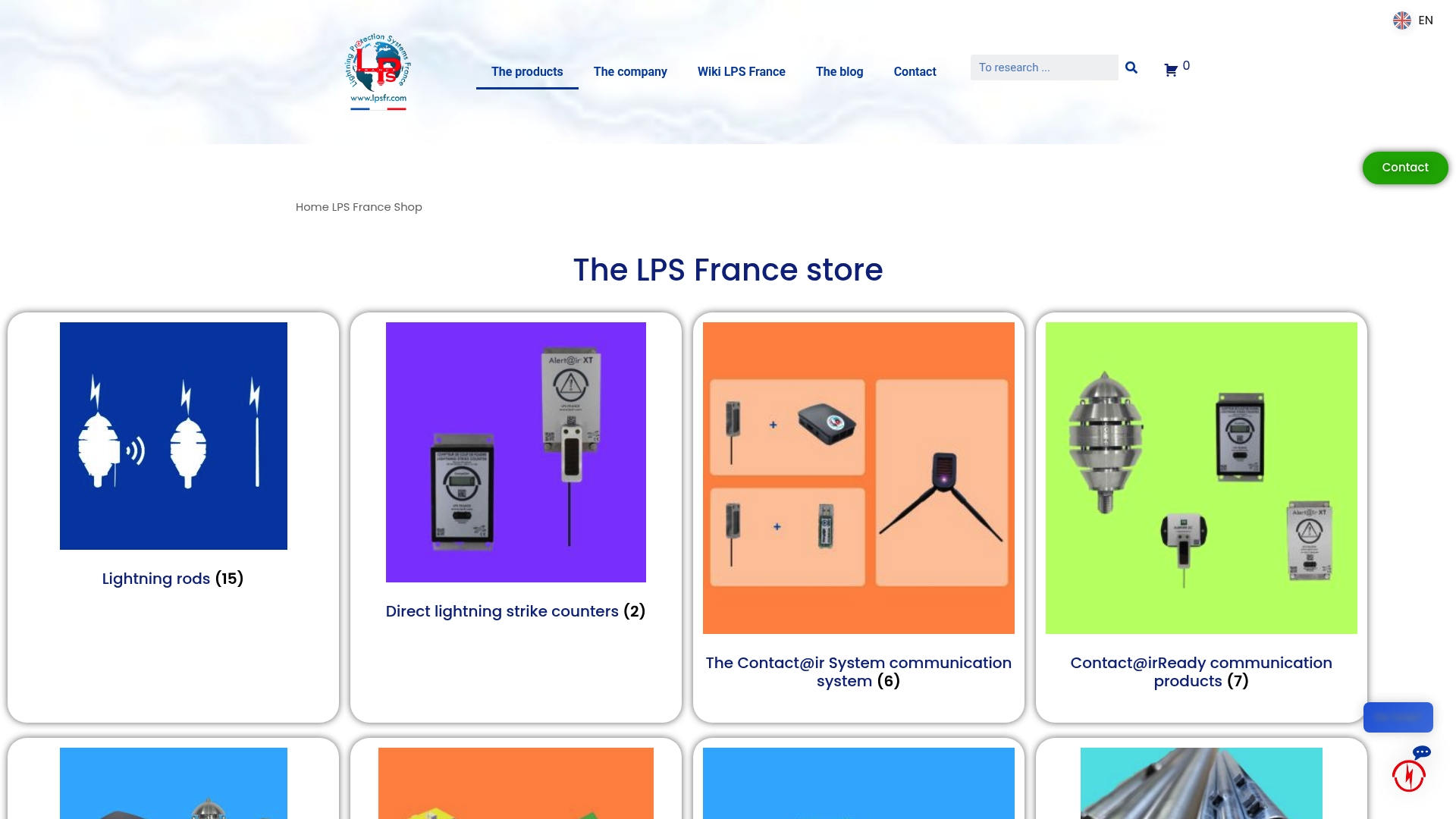
Take your lightning protection to the next level by discovering our comprehensive solutions dedicated to the maintenance and monitoring of your installations. Don't leave your safety to chance; adopt remote monitoring to optimize your interventions and protect yourself from liability. Explore our range in the Maintenance and trust LPS FRANCE through our online store . Your peace of mind starts here.
Frequently Asked Questions
What standards must be followed for the maintenance of lightning rods?
It is essential to comply with IEC 62305 and NF C 17-102 standards to ensure the safety of installations. Make sure your equipment is inspected in accordance with these standards at least once a year.
How can I perform regular diagnostics on my lightning rods?
Perform visual inspections and technical checks of conductors and grounding to detect any anomalies. Schedule these checks at regular intervals, ideally annually, to ensure continuous protection.
What should I do after a lightning strike hits my lightning rod?
It is mandatory to schedule a post-impact verification promptly. Visually inspect, measure continuity, and document the results within 48 hours of the impact to demonstrate compliance and prevent future damage.
How can I use LPS Manager for tracking my lightning rods?
Use LPS Manager to centralize all checks and maintenance history for your lightning rods. Record each event and generate automatic reports to ensure complete traceability and timely compliance verification.
Why is it important to modernize my facilities with communicating systems?
Modernizing with connected systems allows you to receive immediate alerts in the event of a lightning strike and ensures targeted maintenance. Add scalable connected devices to improve your system's efficiency without costly replacements.
How often should I check the condition of lightning rods and their accessories?
Regular checks are necessary, ideally after every storm, to identify wear or damage. Schedule annual inspections to maintain the reliability of the entire system and avoid costly repairs.
Recommendation
- What is a lightning rod: Why mastering it protects your industrial sites
- Predictive Lightning Rod Maintenance: Anticipating for Better Protection – Lightning Protection Systems France – Lightning Protection
- 7 best lightning safety practices to adopt on construction sites
- How lightning rods work: protecting your buildings