
Choosing a suitable lightning protection system requires mastering precise technical, regulatory, and operational criteria. Engineers and installers must reconcile IEC 62305 compliance, site constraints, and connected monitoring technologies. This article details the available solutions, compares communication architectures, and offers recommendations based on your specific use cases to ensure safety and traceability.
Table of Contents
- Key points to remember
- Selection criteria for lightning protection systems
- Communicating pda lightning rods: the paraton@ir range
- Non-communicating ESE lightning rods: the ellips range
- Communication and diagnostic systems: contact@ir, dongl@ir, rout@ir and contact@ir md
- Lightning strike counters and status detectors: compt@ir, alert@ir xt and alert@ir dc
- Intelligent management and monitoring with LPS Manager
- Summary comparison of lps france lightning protection systems
- Recommendations based on specific use cases and contexts
- Discover our complete lightning protection solutions
- Frequently Asked Questions
Key Points to Remember
| Point | Details |
|---|---|
| Mandatory regulatory compliance | Compliance with IEC 62305 and NF C 17-102 standards is essential to ensure the reliability of protection systems. |
| Three communication architectures | Contact@ir with Dongl@ir (80 m, local), Rout@ir (300 m, optional cloud) or Contact@ir MD (cellular IoT eSIM). |
| Communicating vs. traditional lightning rods | Paraton@ir offers real-time alerts and remote diagnostics, Ellips requires wired maintenance. |
| Essential Impact Counters | Compt@ir, Alert@ir XT and Alert@ir DC enable regulatory traceability and targeted maintenance. |
| Centralized management via LPS Manager | Multi-site platform with API, history, automated reports and push notifications. |
Selection criteria for lightning protection systems
The choice of a lightning protection system is primarily based on regulatory compliance. Compliance with IEC 62305 and NF C 17-102 standards is essential to ensure technical and legal reliability. These standards mandate specific early warning advances, calculated protection levels, and maintenance requirements.
The distinction between communicating and non-communicating lightning rods will inform your decision. Communicating models natively integrate remote diagnostic and real-time alert capabilities. Traditional versions require periodic wired maintenance but can be upgraded gradually.
Communication technology determines operational efficiency. Three architectures exist, depending on your network environment and budget constraints.
Connected maintenance is becoming essential for traceability. It reduces travel, improves responsiveness to impacts, and facilitates regulatory compliance. Selection criteria also include the physical accessibility of the site and the ability to manage multiple sites for large projects.
Pro tip: First, assess on-site network availability (Wi-Fi, Ethernet, mobile coverage) before choosing your communication architecture. This will prevent additional network infrastructure costs later on.
Technical criteria to prioritize:
- Lead time at ignition adapted to the required protection level (10 to 60 µs)
- Remote monitoring capability subject to access constraints
- Event history for audits and compliance
- Compatibility with existing management tools (BMS, SCADA)
- System scalability for future upgrades
Communicating ESE lightning rods: the Paraton@ir range
Paraton@ir range represents the high-end communication solution for demanding new installations. Paraton@ir range uses a trigger advance between 10 and 60 µs, combined with 868 MHz radio communication for intelligent maintenance. Four models (10, 25, 45, 60 µs) allow protection to be tailored to the risk level and installation height.
These Paraton@ir communicating lightning rods natively integrate Contact@ir Ready functions. Self-diagnosis is performed continuously every 100 seconds. Impact alerts are instantly transmitted to the cloud via Rout@ir or Contact@ir MD.
Integration with LPS Manager centralizes all information. You receive push notifications upon incidents, view the complete history, and generate automated maintenance reports. This traceability meets the NF C 17-102 requirements for annual and post-event verification.
Pro tip: For multi-building sites, deploy a Rout@ir managing up to 999 Contact@ir . This optimizes costs and operational simplicity compared to decentralized solutions.
Paraton@ir operational advantages:
- Early detection with customized priming advance
- Real-time impact alerts without human intervention
- Drastic reduction in diagnostic travel
- Guaranteed compliance with standards (IEC 62305, NF C 17-102)
- Made in France with full traceability
Non-communicating ESE lightning rods: the Ellips range
The Ellips range offers a proven ESE solution for sites requiring standard protection. The Ellips range provides a standard ignition advance of 60 µs, compliant with IEC and NF C standards, with the option to integrate smart meters for modernization. Four models (Ellips 1.0 to 1.4) cover different levels of protection.
The diagnosis is performed via Test@ir, a wired tool enabling on-site verification. This approach is suitable for installations where regular physical access remains possible. Its compact dimensions (200×100 mm) and refined aesthetics facilitate architectural integration.
Gradual modernization is a major advantage. Later, add a Compt@ir or Alert@ir XT counter to the down conductor. You then gain remote monitoring and alerts via Contact@ir System without replacing the lightning rod. This Ellips range is therefore designed for phased investment.
Typical use cases Ellips :
- Isolated sites with regular scheduled maintenance
- Budget-constrained projects requiring reliable protection
- Modernizing existing facilities in stages
- Environments where network connectivity is problematic
- Integration into LPS Manager via manual entry of controls
Communication and diagnostic systems: Contact@ir, Dongl@ir, Rout@ir and Contact@ir MD
Contact@ir System communication architectures structure your maintenance strategy. Three options address distinct contexts based on connectivity, range, and budget.
Contact@ir with Dongl@ir offers a cost-effective mobile solution. It has a limited range of 80 meters and receives data via USB on an Android smartphone using a dedicated app. There is no cloud history or real-time alerts. It is ideal for ad-hoc diagnostics in remote locations without network infrastructure.
Contact@ir with Rout@ir combines local and remote monitoring. It offers an extended range of 300 meters, manages up to 999 transmitters, and provides on-site Bluetooth reading. An internet connection (Wi-Fi, Ethernet, mobile data) enables real-time alerts to the cloud. Without internet access, local history is stored followed by delayed synchronization. Its architecture is optimal for multi-point industrial sites.
Contact@ir MD leverages standalone cellular IoT. Contact Contact@ir MD uses cellular IoT connectivity with an integrated eSIM for real-time alerts without relying on a local network. Features include self-diagnosis every 12 hours, instant alerts, and 4G/3G/2G/Edge/GPRS compatibility. It's a plug-and-play solution for multi-site deployments.
| Architecture | Scope | Historical | Real-time alerts | Use Cases |
|---|---|---|---|---|
| Contact@ir + Dongl@ir | 80 m | No | No | Spot diagnosis, isolated sites |
| Contact@ir + Rout@ir | 300 m | Yes (local + cloud) | Yes (if internet access is available) | Multi-point, centralized monitoring |
| Contact@ir MD | Mobile network | Yes (cloud) | Yes (cellular) | Multi-site, no client LAN |
Technical considerations:
- Security: LPS Manager access control, redundant servers, dedicated VLAN recommended for Rout@ir
- Latency: a few seconds for alerts (dominated by IP or mobile transit)
- Bandwidth: very low, compatible with modest links (<< 1 kB/frame)
- Transmission frequency: 100 s (standardContact@ir ), 12 h (MD) + immediate events
These Contact@ir communication systems integrate natively with LPS Manager for complete centralization.
Lightning strike counters and status detectors: Compt@ir, Alert@ir XT and Alert@ir DC
Counting and detection devices structure regulatory maintenance. The NF C 17-102 standard mandates annual checks and checks after each impact. This equipment automates this traceability.
Compt@ir offers a high-sensitivity 6-digit digital counter. Minimum detected current ≥ 1 kA, maximum > 100 kA, IP65 rated enclosure. Mounts on flat or round conductors, records positive and negative current surges. The Contact@ir System option activates cloud reporting and alerts.
Alert@ir XT detects lightning strikes without a local display. It operates autonomously without a power supply and has compact dimensions of 70×50×60 mm. Alert@ir DC provides remote monitoring of surge protectors with real-time alerts and a 5-year battery life , facilitating proactive maintenance. Compliant with NF EN 50164-6, it can be installed on existing systems of all brands.
Alert@ir DC continuously monitors the status of surge protectors. Compatible with all surge protectors, it provides email and smartphone fault alerts and installs in seconds. Powered by photovoltaic energy with a backup battery (5-year autonomy). It prevents blind spots on critical failures of internal protection devices.
These lightning strike counters improve responsiveness and reduce unnecessary interventions. Automatic logging in LPS Manager provides regulatory evidence and facilitates audits.
Operational benefits:
- Automatic triggering of post-impact verification procedures
- Reducing maintenance costs through targeted interventions
- Full traceability for regulatory compliance and insurance
- 24/7 monitoring without staff mobilization
- Gradual expansion on existing installations
Intelligent management and monitoring with LPS Manager
LPS Manager centralizes the lightning protection ecosystem on a single platform. It centralizes alerts, diagnostics, and historical data, and offers multi-site management with APIs for BMS/SCADA integration . This web and mobile application (Android, iOS, Windows, macOS) transforms reactive maintenance into proactive monitoring.
Centralized alerts and diagnostics eliminate information silos. Push notifications are sent for impacts or faults, and a complete, time-stamped history and Google Maps geolocation of equipment are provided. The bilingual French/English interface facilitates international coordination.
Multi-site management becomes seamless. Create unlimited folders (Pro version), share access according to user rights, and generate automated reports. Pricing options are as follows: Free (€0), Data (€2.99/month), Pro (€9.99/month), Expert (€29.99/month), Enterprise (price upon request with API).
BMS/SCADA integration via API enables interoperability. Retrieve telemetry data from existing systems, create custom dashboards, and populate data lakes for predictive analytics. The LPS France team provides support from configuration to display.
Pro tip: Start with the Free version to validate the concept, then migrate to Data as soon as you need detailed historical data. The Pro investment (€9.99/month) quickly pays for itself with automatic report generation.
This intelligent LPS Manager relies on redundant secure servers with strict access control.
Key features:
- Configurable real-time push and email alerts
- Historical events with precise timestamps
- Generation of maintenance reports compliant with standards
- Unlimited photo and document storage (Expert)
- Technical support via email (Pro) or chat (Expert)
Summary comparison of lightning protection systems LPS FRANCE
The following table summarizes the solutions according to key decision criteria. This overview facilitates quick comparison and informed choice.
| System | Communication scope | Connectivity type | Cloud history | Real-time alerts | Priority use case |
|---|---|---|---|---|---|
| Paraton@ir + Dongl@ir | 80 m | RF 868 MHz + USB | No | No | Spot diagnosis, isolated areas |
| Paraton@ir + Rout@ir | 300 m | RF 868 MHz + Internet | Yes | Yes (if internet access is available) | Multi-point, site supervision |
| Paraton@ir + Contact@ir MD | Mobile network | cellular IoT eSIM | Yes | Yes | Multi-site, no LAN |
| Ellips + communicating meter | According to the counter | Same as Contact@ir | Depending on configuration | Depending on configuration | Gradual modernization |
| Compt@ir / Alert@ir XT | According to Contact@ir | RF or IoT | According to architecture | According to architecture | Traceability impacts |
| Alert@ir DC | According to architecture | Via Rout@ir/MD | Yes | Yes | Lightning protection monitoring |
All systems comply with IEC 62305:2024 and NF C 17-102:2011 standards. Technical differences focus on range, network autonomy, and cloud integration level. The Rout@ir and MD architectures offer a better balance between monitoring and compliance for critical installations.
The selection depends on three variables: site size, network constraints, and acceptable OPEX budget. Small/medium-sized sites with internet access favor Rout@ir. Multi-site, dispersed sites without LANs opt for MD. Isolated sites with scheduled maintenance use Dongl@ir.
Recommendations based on specific use cases and contexts
The optimal choice depends on your specific operational environment. The choice of architecture will vary depending on whether a site is isolated, a multi-site network with internet access, or a multi-site network without a LAN , ensuring effective and compliant protection. Here are some typical scenarios with appropriate solutions.
1. Isolated site without a reliable network: Contact@ir with Dongl@ir is the perfect solution. Manual diagnostics during scheduled visits, minimal CAPEX, no infrastructure dependency. Log results in LPS Manager via manual entry.
2. Multi-point industrial site with internet access: Contact@ir with Rout@ir optimizes monitoring. Centralize up to 999 transmitters, local backup history, real-time cloud alerts. Integrate APIs into existing BMS for a unified view.
3. Multi-site deployments without a shared LAN: Contact@ir MD eliminates network constraints. Each site communicates directly via eSIM, with centralized LPS Manager maintenance and immediate alerts from all locations. Ideal for energy or telecom distributors.
4. Gradual modernization of existing installations: Keep your Ellips , add Compt@ir or Alert@ir XT counters. You gain traceability and alerts without replacing functional equipment. Rapid ROI on reduced travel.
5. Critical surge protection monitoring: Deploy Alert@ir DC on sensitive electrical panels. 5-year battery life, instant fault alerts, universal compatibility. Prevent costly breakdowns through preventative maintenance.
6. Installation team training: Leverage LPS Academy to master diagnostic reading, alert interpretation, and LPS Manager operation. Training investment quickly pays for itself.
Pro tip: Manage your project in phases. Start in the critical zone with Rout@ir , validate the maintenance process, and then gradually expand. This approach reduces risks and demonstrates ROI before generalization.
These recommendations for choosing lightning protection systems are based on field feedback and French regulatory constraints.
Discover Our Complete Lightning Protection Solutions
LPS France supports you from the design to the maintenance of your lightning protection systems. Our solutions adapt to all types of sites, from simple installations to complex multi-point industrial systems. Native integration with LPS Manager guarantees connected monitoring and compliance with IEC 62305 and NF C 17-102 standards.
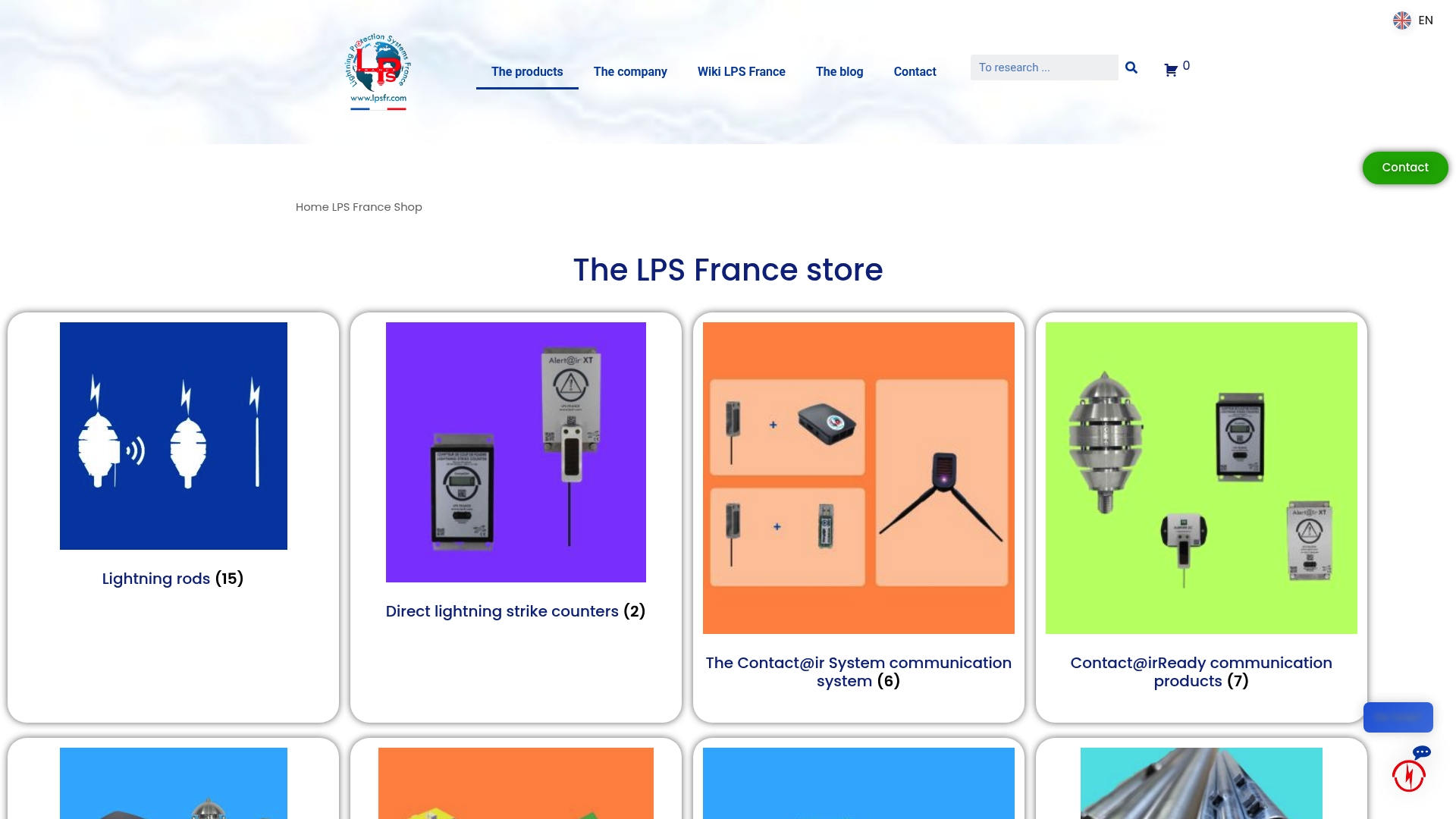
Our recognized expertise covers Paraton@ir and Ellipslightning rods, Contact@ir systems (Dongl@ir, Rout@ir, MD), Compt@ir and Alert@irmeters, and the LPS Manager platform. Made in France, with complete traceability and fast delivery (24 to 48 hours for standard products). A comprehensive catalog includes grounding accessories, surge protectors, and connectors tailored to each project.
LPS Academy training courses enhance your teams' skills. Specialized modules for installers and engineers, recognized certifications, and premium technical support are available. Consult our home lightning protection guide for residential applications or register for professional lightning protection training
Guaranteed extension via LPS Manager registration, responsive technical support, and project support from initial audit to final deployment. Contact us for a personalized audit and tailored technical proposal.
Frequently Asked Questions
What are the advantages of communicating lightning rods?
Connected lightning rods offer proactive maintenance through real-time alerts upon impact or fault. You reduce unnecessary travel thanks to precise remote diagnostics. Automatic traceability in LPS Manager simplifies compliance with NF C 17-102 standards and regulatory audits. Complete event history provides legal proof and facilitates insurance claims.
How to choose between Contact@ir with Dongl@ir and Contact@ir with Rout@ir ?
Dongl@ir is suitable for remote sites without reliable internet connectivity where scheduled maintenance is sufficient. Rout@ir is ideal for multi-point sites requiring centralized monitoring and real-time alerts. If internet access is available, Rout@ir offers a rapid return on investment through reduced travel and improved responsiveness to incidents.
Why integrate a lightning strike counter into my system?
The meter precisely monitors actual impacts on the installation, automatically triggering mandatory regulatory checks. This traceability meets the NF C 17-102 requirements for post-event maintenance. Maintenance becomes targeted, reducing operational costs and improving audit compliance. The time-stamped history serves as evidence for insurance and liability purposes.
Is the Contact@ir MD system suitable for sites without a LAN connection?
Yes, Contact@ir MD uses cellular IoT with an integrated eSIM, eliminating the need for a client LAN. Alerts are sent in real time via locally available 4G/3G/2G mobile networks. This complete autonomy is ideal for dispersed multi-point sites or environments with limited network infrastructure. It features self-diagnosis every 12 hours, immediate impact alerts, and monitoring via LPS Manager from anywhere.