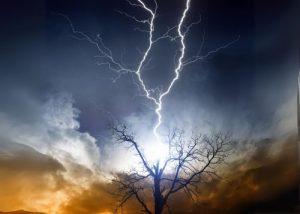
Trees are often struck by lightning due to several factors:
1 - Height:
Trees are often the tallest structures in an area, making them more susceptible to lightning strikes. Lightning tends to strike the tallest object in its immediate vicinity.
2 - Internal composition:
Trees contain water and sap, which are good conductors of electricity. When lightning strikes a tree, the electricity travels through the sap and water, often causing significant damage.
3 - Relative insulation:
In a rural or forest environment, trees may be relatively isolated from other structures, increasing their likelihood of being struck.
4 - Large surface area:
The surface of trees, with their branches and leaves, offers a large area for lightning to strike.
To protect trees from lightning, it is possible to install lightning rod systems specifically designed for trees. These systems channel the electrical discharge of lightning to the ground, thus preventing damage to the tree.