
Protecting your industrial facilities against lightning is no longer simply a matter of installing a lightning rod and hoping for the best. Between the complexity of the systems, stringent standards, and the emergence of communication technologies, choosing the right solution and ensuring effective monitoring of your system is becoming increasingly difficult. Ignoring certain criteria or delaying modernization exposes your site to unforeseen production downtime and high repair costs.
Fortunately, there are clear methods for mastering each step, from equipment selection and monitoring to proactive maintenance. By combining connected technology and intelligent management, you can anticipate incidents, centralize alerts, and simplify regulatory compliance.
Discover practical advice for adapting, improving, and ensuring the long-term viability of your lightning protection system. You will learn how to move from traditional management to advanced monitoring and why every decision directly impacts the safety and security of your site.
Table of Contents
- Understanding how a ESE lightning rod works
- Identify non-communicating lightning rods for conventional projects
- Use communicating lightning rods for advanced monitoring
- Integrate the counter and impact detector systems
- Implement wired and remote diagnostic solutions
- Optimize management with a dedicated software platform
Quick summary
| Key message | Explanation |
|---|---|
| 1. Enhanced protection with a ESE | A ESE offers up to 60% more protected surface area thanks to its early priming. |
| 2. Non-communicating lightning rods for standard sites | Suitable for simple installations, they guarantee protection without expensive technology or connectivity. |
| 3. Advanced monitoring with communicating lightning rods | Real-time alerts allow for rapid responses to lightning strikes, thus optimizing maintenance. |
| 4. Importance of impact counters | They provide a record of lightning strikes, essential for regulatory compliance and maintenance. |
| 5. Combination of wired and remote diagnostics | Using both methods ensures complete verification and continuous monitoring of the protection system. |
1. Understanding how a ESE lightning rod works
An early streamer emission (ESE) lightning rod works on one fundamental principle: capturing lightning before it strikes your structures. Unlike traditional lightning rods, the ESE uses early streamer emission technology that creates an ionized path to the storm cloud.
As a thunderstorm approaches, the electric field intensifies around your installation. The PDA detects this increase and produces an upward electric arc that "meets" the downward lightning leader well before it becomes dangerous. This process creates wider radius protection than a conventional lightning rod.
The system is based on several key elements:
- The receiving tip captures the electrical signals from the cloud
- The ionizing circuit generates a plasma that extends the protection radius
- Down conductors carry the current to earth
- Grounding dissipates energy safely
The ESE offers an early flashover advance measured in microseconds (µs), allowing it to protect areas up to 60% larger than a conventional lightning rod.
When you compare the operation of a PDA lightning rod to a conventional system, the major difference lies in its early warning capability. Your industrial installation benefits from a faster response to extreme electrical events.
In practice, this means:
- Enhanced protection around critical areas
- A reduction in the risk of side impacts
- Better coverage of complex structures
- Compliance with strict industry standards such as NFC 17-102
For industrial sites, understanding this mechanism helps you properly size your system. A 10 µs ESE offers different protection than a 60 µs model. You must adapt your choice to the geometry of your building and the identified risks.
Pro tip: When installing a PDA, always check that the down conductors follow a straight vertical path without sharp bends, as changes in angle slow down the evacuation of current and can reduce the efficiency of your system.
2. Identify non-communicating lightning rods for conventional projects
Non-communicating lightning rods represent the proven solution for conventional industrial installations that do not require remote monitoring. Unlike connected systems, these devices operate autonomously without relying on a network infrastructure or real-time alerts.
A non-communicating lightning rod, such as the Ellips , captures lightning and dissipates it to the ground using the same physical principles as a traditional PDA. The major difference lies in the absence of integrated sensors that would transmit data on the system's status.
These lightning rods are particularly suitable for the following situations:
- Industrial buildings located in areas without reliable connectivity
- Installations where ease of operation takes precedence over remote monitoring
- Projects with controlled budgets requiring solid protection
- Temporary sites or lightweight structures
- Historic buildings where adding network cables poses a problem
Non-communicating lightning rods offer effective and long-lasting protection without subscription fees or technological dependency, making them ideal for conventional installations.
When you examine the features of a lightning rod , you'll notice that non-communicating models adhere to the same standards as their connected counterparts. They comply with NFC 17-102:2011 and IEC 62305 , guaranteeing protection that meets industry standards.
The identification of these lightning rods is based on several concrete criteria:
- Absence of integrated radio transmitter or communicating electronics
- Simple receiving tip without additional electronic priming circuit
- Dimensions and weight conform to standards, without additional modules
- Direct wired installation without communication gateways
- Maintenance performed via on-site physical inspection only
For standard projects, you can later add a smart meter such as a Compt@ir or Alert@ir XT if you decide to upgrade your system. This flexibility allows for a gradual evolution of your protection infrastructure.
Pro tip: Keep complete documentation of your non-communicating installation with installation dates and verification history, as the absence of a digital register makes the paper file essential for traceability and regulatory compliance.
3. Use communicating lightning rods for advanced monitoring
Connected lightning rods transform your approach to lightning protection by integrating IoT sensors and real-time data transmission. These systems automatically detect strikes, alert your team instantly, and create a comprehensive history accessible from anywhere.
The Paraton@ir represents this new generation of lightning rods capable of communicating with your infrastructure. Each unit periodically sends its operating status and triggers an immediate alert in the event of a lightning strike.
This advanced monitoring system operates according to a simple yet robust process:
- The lightning rod detects a lightning strike
- A radio signal is transmitted instantly to your receiver
- The alert is sent back to the cloud platform
- You will receive a notification on your phone or computer
- The data is automatically recorded for traceability
Communicating monitoring makes it possible to detect impacts instantly and to organize a post-event verification in the following hours, significantly reducing the risk of secondary damage.
maintenance of communicating lightning rods relies on this collected data to anticipate failures. You move from a reactive approach to a proactive one where each event triggers a scheduled intervention.
For a multi-site industrial installation, the advantages become obvious:
- Centralized visibility across all lightning rods in the group
- Immediate alerts enabling rapid action
- Complete history facilitating audits and compliance
- Reduction of unnecessary technician travel
- Optimizing maintenance and the associated budget
- Traceability guaranteeing regulatory compliance
You can easily integrate these communicating lightning rods into your existing infrastructure. The LPS Manager centralizes all events and allows you to configure custom alert rules according to your priorities.
Switching to advanced monitoring doesn't mean replacing your entire system. You can gradually equip your critical buildings and modernize your existing systems by adding smart meters.
Pro tip: Configure different alert levels in LPS Manager according to the criticality of each area: immediate email alerts for sensitive areas, consolidated daily alerts for less critical areas, which avoids information overload.
4. Integrate the counter and impact detector systems
Lightning strike counters and impact detectors are essential tools for proving that your lightning rod is actually functioning. These devices record every lightning strike they detect, creating crucial evidence for maintenance and regulatory compliance.
A digital lightning strike counter detects both positive and negative strikes passing through a conductor. The device automatically records the total number of strikes, regardless of your presence on site.
This information is of paramount importance for several reasons:
- Documented evidence of your lightning rod's activity
- Automatic triggering of mandatory post-event checks
- Accurate history for compliance audits
- Data to optimize your maintenance strategy
- Justification for investments in lightning protection
An impact counter allows you to move from guesswork to certainty, transforming your approach to lightning maintenance into decisions based on measurable facts.
There are two main categories of meters. The Compt@ir offers a digital display allowing direct reading on site. The Alert@ir XT operates without a display, transmitting data directly via contact@ir System for remote access.
Integrating these systems into your protection architecture follows a logical process:
- Installation of the meter on the main downpipe
- Simple electrical connection, no external power supply required
- Initial reading to establish the reference point
- Configuring the communication transmission if desired
- Data integration into your maintenance file
- Automatic scheduling of checks following detected impacts
For existing installations, adding a meter does not require major modifications. You can gradually equip your lightning rods and modernize your monitoring approach progressively.
The advantage of combining a meter with a communicating transmitter becomes clear in multi-site operations. You centralize all lightning events and automatically trigger your maintenance workflows without manual intervention.
Pro tip: Install meters on all your main conductors, because lightning can take multiple paths to earth simultaneously, and each point of impact generates a separate mandatory intervention.
5. Implement wired and remote diagnostic solutions
Your lightning protection system can be diagnosed in two complementary ways: through direct physical access or via remote transmission. Combining these two approaches offers maximum flexibility and operational resilience.
Wired diagnostics involve an on-site visit using specialized testing equipment. A technician will go onto your roof or near the lightning rod and take precise measurements to verify its proper functioning. This approach guarantees irrefutable and physically documented verification.
Remote diagnostics uses integrated sensors and radio frequency or cellular connections to transmit system status without requiring human presence. This solution drastically reduces travel costs and enables continuous monitoring.
Here are the distinct advantages of each approach:
Wired diagnostics:
- Complete and certified verification
- Rapid on-site intervention
- No dependence on a network infrastructure
- Indisputable physical documentation
Remote diagnosis:
- Reduction in travel and costs
- 24/7 continuous monitoring
- Immediate alerts in case of a problem
- Centralization of multi-site data
Combining programmed wired diagnostics with continuous remote monitoring creates the best balance between technical certainty and operational efficiency.
Your diagnostic strategy should combine both. A remote diagnostic device for lightning rods powered by photovoltaic panels transmits the status of the equipment without manual intervention, while annual wired checks validate regulatory compliance.
The practical implementation follows this logic:
- Installation of remote transmitters on critical lightning rods
- Setting up a centralized reception via a cloud platform
- Scheduling of mandatory annual wired inspections
- Planning of additional interventions following remote alerts
- Integrated documentation of all diagnostics in LPS Manager
- Automation of compliance reports for audits
This hybrid architecture offers comprehensive coverage. You detect problems immediately via remote monitoring and validate them with a scheduled visit before they create risks.
Pro tip: Schedule your annual wired visits after autumn to take advantage of a period of calm in terms of storms, and schedule interventions following remote alerts within a maximum of 72 hours to maintain your regulatory compliance.
6. Optimize management with a dedicated software platform
A dedicated software platform transforms your lightning protection management by centralizing all events, alerts, and history in one place. Without the right software, you navigate between paper documents, emails, and phone calls to monitor the status of your system.
Software management provides complete visibility into your protection infrastructure. You can instantly see which lightning rod was struck, when it happened, and what maintenance is required. This centralized system eliminates oversights and documentation discrepancies.
A high-performance platform allows you to:
- Receive real-time alerts on mobile and computer
- View the complete history of all events
- Automatically generate compliance reports
- Manage multiple sites from a single interface
- Collaborating with technicians and auditors
- Archive the data for regulatory audits
- Plan maintenance interventions optimally
A dedicated software platform converts raw data into operational decisions, transforming your approach to lightning protection maintenance from reactive to proactive.
Lightning protection management via a software platform integrates all elements of your system. Communicating lightning rods send their alerts directly to the platform. Strike counters automatically populate the history log. Inspection reports are digitally saved for traceability.
To implement this solution, follow this approach:
- Assess your needs in terms of sites and equipment to be monitored
- Select a platform compatible with your existing infrastructure
- Configure alert rules according to the priorities of your zones
- Train your team to use the essential features
- Gradually import existing historical data for traceability
- Automate regulatory reports and scheduled audits
The return on investment becomes apparent quickly. Technician visits are reduced thanks to targeted alerts. Audits become streamlined with automatically generated reports. Product warranties are easily validated with documented traceability.
You can start simply with a single installation and gradually scale up to a sophisticated multi-site system. The flexibility of the software editions allows you to adapt to your budget and growing needs.
Pro tip: Set up separate access profiles for your technicians, managers and auditors, allowing each person to see only relevant information without being overwhelmed by all system data.
| Subject | Description | Key Details |
|---|---|---|
| Lightning rod ESE | Uses early-release technology to capture lightning before impact. | Extended protective radiation thanks to an ionizing circuit. |
| Non-communicating lightning rod | Operates independently without data transmission. | Suitable for areas without network coverage or for limited projects. |
| Communicating lightning rod | Integrates IoT sensors for real-time monitoring. | Ideal for centralized visibility and increased traceability. |
| Counters and impact detectors | Record lightning strikes for documentation and maintenance. | Enables predictive maintenance and proof of compliance. |
| System diagnostics | Wired and remote diagnostics of lightning protection systems. | Ensures operational reliability and reduces operating costs. |
| Dedicated software platform | Centralizes the management of protections and events related to lightning. | Improves operational efficiency and regulatory compliance. |
Effectively protect your industry with the right lightning rods and connected management
Faced with the specific challenges of lightning protection in industrial environments, it is crucial to choose high-performance lightning rods such as the Paraton@ir with early streamer emission (ESE) technology or the classic Ellips . These solutions guarantee perfect control of the electrical phenomenon and maximum safety for your infrastructure.
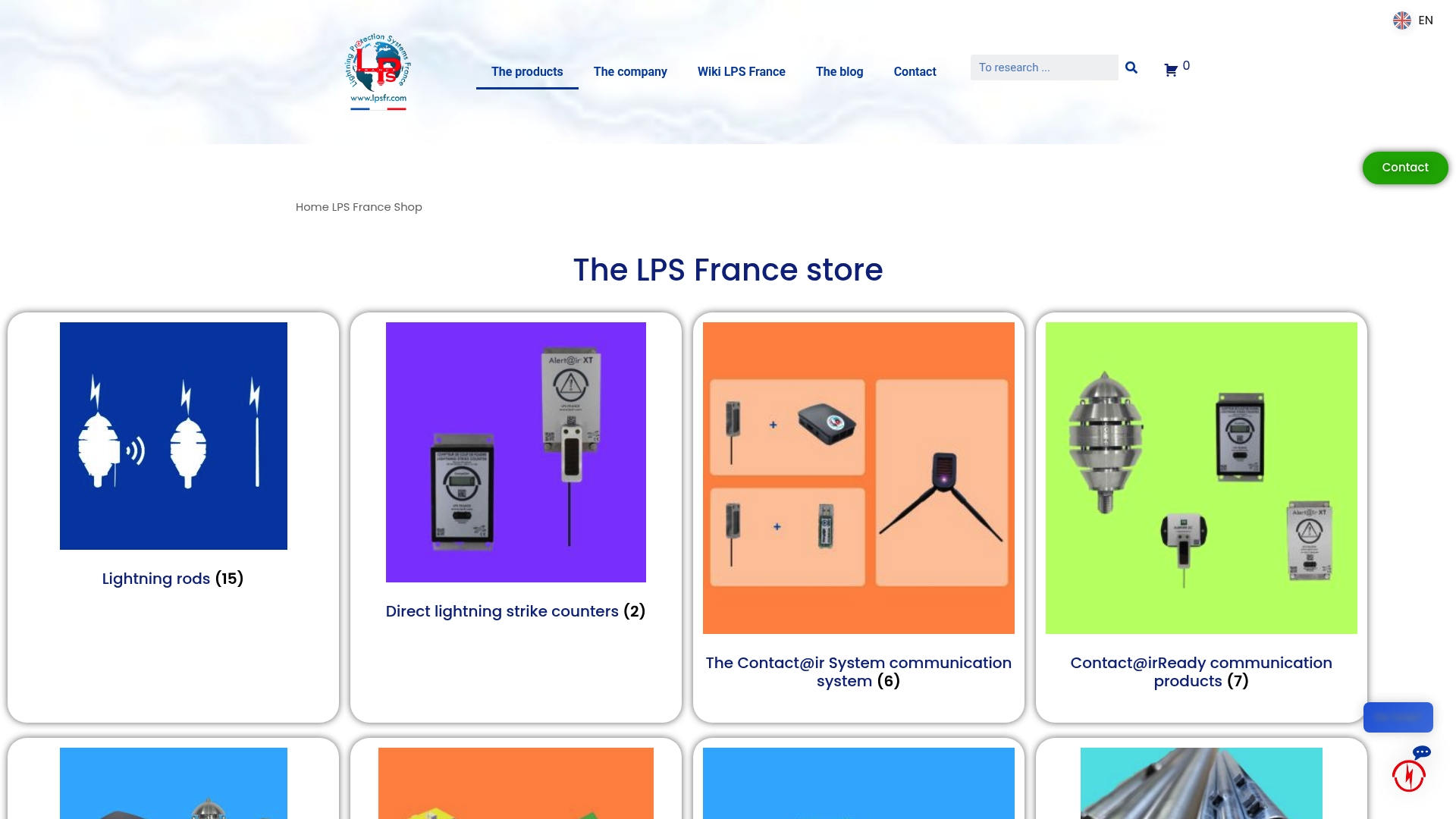
Discover on our website how to combine these reliable technologies with advanced diagnostic and monitoring systems via the LPS Manager . Benefit from precise traceability, real-time alerts, and proactive maintenance to minimize the risk of costly downtime. To deepen your understanding, also explore our section dedicated to Direct Lightning Protection and our comprehensive Lightning Wiki .
Don't wait any longer to secure your industrial sites with innovative and proven French solutions. Take action today by visiting our shop to choose the product that perfectly meets your protection and connected control needs.
Frequently Asked Questions
What are the different types of lightning rods available for industrial safety?
Lightning rod types include early streamer emission (ESE) lightning rods, non-communicating lightning rods, and communicating lightning rods. Each type offers varying levels of protection and features suited to different industrial environments.
How do I choose the right lightning rod for my industrial installation?
To select a lightning rod, assess the size of your building, the risk of lightning strikes, and compliance standards. A good practice is to examine the technical specifications to tailor the model to your specific needs.
What is the difference between a conventional lightning rod and an early streamer emission (ESE) lightning rod?
The main difference lies in the early streamer emission (ESE) mechanism. A lightning rod with an ESE captures lightning earlier by creating an ionized path, thus providing up to 60% more protection compared to a conventional lightning rod. Choose an ESE for enhanced safety around critical areas.
Why use communicating lightning rods in an industrial environment?
Connected lightning rods enable real-time monitoring, instantly alerting your team in the event of a lightning strike. To optimize management, integrate connected lightning rods into your equipment choices to improve responsiveness and maintenance.
How do I maintain my lightning rods?
Lightning rod maintenance should include regular inspections, both physical and remote if your system allows. Schedule checks at least once a year to ensure proper operation and document each intervention to ensure regulatory compliance.
What regulations should be considered when installing lightning rods?
It is crucial to comply with standards such as NFC 17-102 and IEC 62305 when installing lightning rods. Ensure your installation meets these requirements to avoid safety and liability issues.
Recommendation
- What is a lightning rod: Why mastering it protects your industrial sites
- 6 best lightning rod maintenance practices you should know
- 7 best lightning safety practices to adopt on construction sites
- How to choose the right lightning protection
- 7 Types of Industrial Lighting Solutions Explained
- Nätverkssäkerhet – Så skyddar du företaget effektivt