
Some professionals still perceive lightning protection as a complex technology whose effectiveness remains uncertain. This view often stems from a lack of understanding of lightning protection principles and current standards. However, mastering the technical operation of protection systems is essential to guarantee the safety of infrastructure and ensure regulatory compliance. This article details the technical mechanisms, key devices, regulatory requirements, and best installation practices for effective protection in 2026.
Table of Contents
- The fundamental principles of lightning protection
- Key components in a lightning protection system
- Standards and regulatory compliance in lightning protection
- Best practices for installing and maintaining lightning protection systems
- Frequently asked questions about how lightning protection works
Key points to remember
| Point | Details |
|---|---|
| Load sensing | Lightning rods capture the electrical discharge and direct it safely to the ground. |
| Equipment protection | Surge protection devices limit damage to sensitive equipment. |
| Regulatory compliance | Compliance with standards guarantees the technical efficiency and legal validity of the installations. |
| Regular maintenance | Regular maintenance ensures continued functionality and preserves commercial warranties. |
The fundamental principles of lightning protection
Lightning is a natural electrical phenomenon whose energy can reach several hundred thousand amperes. When lightning strikes a structure, two major risks arise: the direct impact, which generates extreme thermal and mechanical stresses, and the induced overvoltages that propagate through adjacent electrical circuits.
Lightning rods operate according to a well-established physical principle: they create a point of least electrical resistance to channel the atmospheric discharge. The structure captures the lightning before it reaches vulnerable parts of the building, and then the down conductor carries the current to a grounding system that dissipates the energy into the ground. This approach protects the building envelope but is not sufficient to eliminate all risks.
Transient overvoltages pose a distinct danger. Even without a direct impact, a nearby lightning strike induces sudden voltage fluctuations in electrical installations. These electromagnetic disturbances can destroy sensitive equipment in microseconds. Surge protection devices act like controlled spark gaps: they detect the abnormal voltage rise and divert the excess energy to ground, thus limiting the residual voltage to a level acceptable for the protected equipment.
Effective protection relies on a comprehensive approach integrating external capture, appropriately sized conductors and coordinated internal protection.
Pro tip: Grounding is the critical link in the system. High ground resistance compromises the dissipation of lightning current and increases the risk of bypassing it. Always check the resistance value during periodic inspections.
The components of a complete system include:
- Rooftop or mast-mounted collection devices
- Down conductors sized according to the expected current
- The earthing system with buried rods and conductors
- Surge protectors on the main electrical panels
- Monitoring and diagnostic equipment
Key components in a lightning protection system
The selection of components depends on the site characteristics, the required level of protection, and operational constraints. The choice of lightning protection devices must be adapted to the specific application and the expected overvoltage environment.
Single-point lightning rods versus early streamer emission (ESE) lightning rods
Single-point lightning rods (SPRs) are based on a proven principle: a metal rod creates a local electric field that facilitates the initiation of the upward leader. Their protection radius is calculated using the fictitious sphere or mesh method, as defined by standards. These devices are suitable for simple structures where the geometry allows for complete coverage.
Early streamer emission (ESE) lightning rods incorporate an electronic system that generates a high-voltage pulse when a storm cloud approaches. This pulse advances the emission of the upward leader by a few microseconds, theoretically extending the protection radius. Paraton@ir models offer advances of 10, 25, 45, or 60 µs, allowing coverage to be tailored to specific needs.
| Criteria | Simple tip lightning rod | Early streamer emission (ESE) lightning rod |
|---|---|---|
| Principle | Passive capture by point effect | Active priming with time advance |
| Protection radius | Limited, requires several points | Extended according to the advance at priming |
| Maintenance | Visual inspection and electrical continuity | Additional electronic control required |
| Initial cost | Economic | Superior investment |
| Typical applications | Standard buildings, simple facilities | Industrial sites, complex structures |
Pro tip: To choose the right lightning protection , first conduct a risk analysis based on local lightning strike density, building height, and equipment sensitivity. This approach prevents both undersizing and oversizing.
Surge arresters and electrical circuit protection
Surge protectors are available in three classes depending on their location in the installation. Type 1 surge protectors are installed at the main distribution board and withstand direct lightning strikes. Type 2 protectors protect sub-distribution boards against induced surges. Type 3 protectors provide fine-grained protection for sensitive terminal equipment.
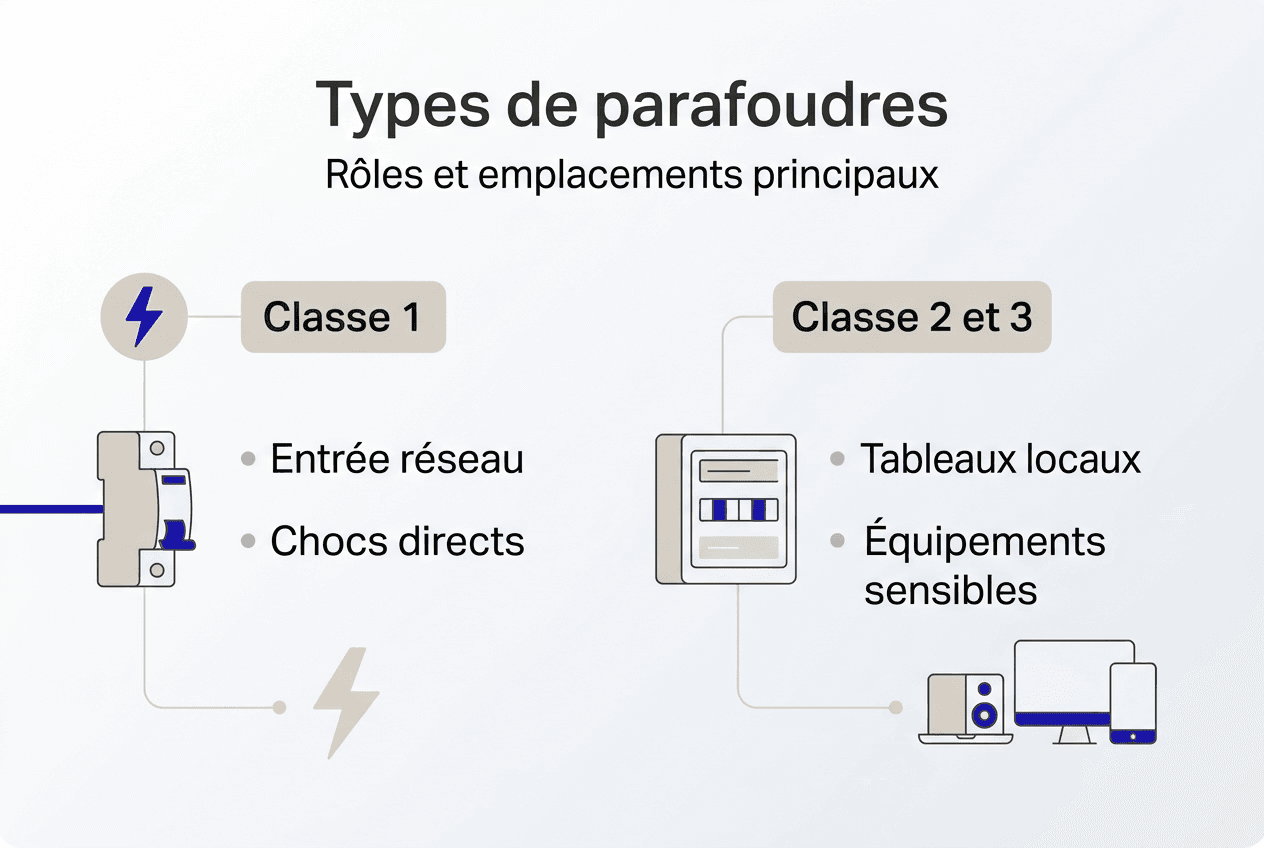
Sizing requires determining the maximum discharge current (Imax), the protection voltage (Up), and the discharge capacity (In). Proper coordination between the different levels ensures cascading protection without the risk of premature failure.
Grounding systems
Grounding serves several functions: dissipating lightning current, providing a potential reference for electronic equipment, and ensuring personal safety. Configurations vary depending on the soil type: vertical earthing rods in conductor soils, trench loops in resistive soils, and buried plates for temporary installations.
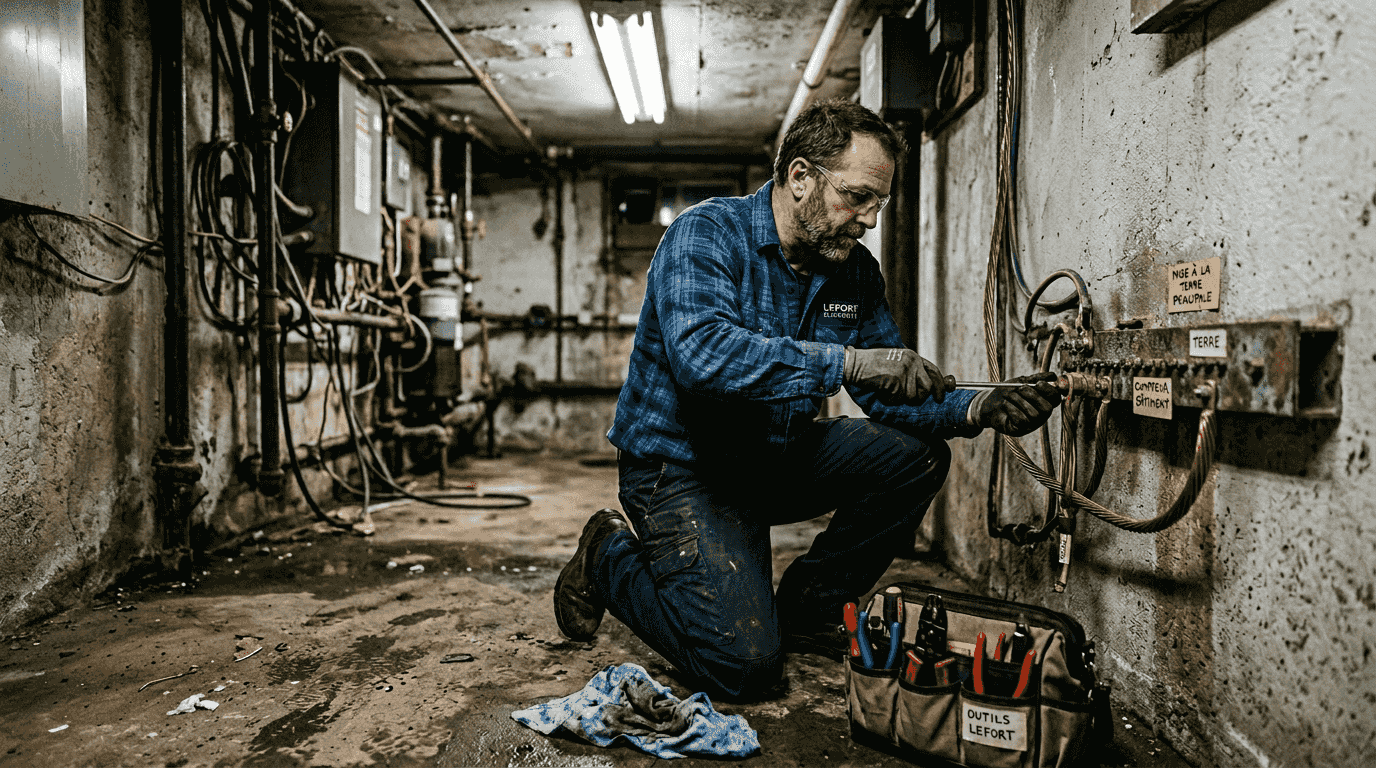
The overall resistance must comply with standard values, typically less than 10 ohms for critical installations. Regular measurements with a tellurometer verify long-term stability, as corrosion and humidity variations affect performance.
Factors to consider include:
- Soil type and measured resistivity
- Electrode burial depth
- Interconnection with the metallic masses of the building
- Galvanic isolation if necessary to avoid ground loops
Standards and regulatory compliance in lightning protection
The European regulatory framework harmonizes technical requirements through the NF EN 62305 series, transposing the international standard IEC 62305:2024. This series covers risk assessment, the design of external and internal systems, damage to structures, and power and communication networks.
The NF C 17-102:2011 standard supplements this system in France by specifying the installation rules for lightning rods with early streamer emission (ESE) devices. It defines the methods for calculating protection radii, conductor spacing, and minimum material characteristics.
For sensitive infrastructure, several regulations mandate lightning protection. Publicly accessible establishments (ERP), facilities classified for environmental protection (ICPE), and critical infrastructure must demonstrate compliance during regulatory inspections. Failure to comply exposes the company to administrative penalties and may result in civil liability in the event of a disaster.
The verification process includes several steps:
- Initial inspection upon acceptance of the work
- Periodic checks are carried out annually or biannually, depending on the classification
- Checks after any direct lightning event
- Complete documentation including plans, measurement reports and certificates
Lightning protection compliance requires rigorous traceability. Technical files must archive installation plans, component product datasheets, verification reports, and maintenance records. This documentation demonstrates due diligence in the event of a dispute and facilitates regulatory audits.
The lightning protection compliance steps include preliminary risk analysis, design according to applicable standards, installation by qualified professionals, and the implementation of a preventive maintenance plan. Each phase generates specific deliverables that constitute the regulatory file.
Best practices for installing and maintaining lightning protection systems
The installation of a lightning protection system follows a logical sequence that determines its final effectiveness. The first phase consists of carrying out a detailed technical study incorporating architectural plans, soil resistivity measurements, and an inventory of the equipment to be protected.
Lightning rod installation phases
- Placement of collection devices according to coverage calculations
- Installation of downpipes with appropriate fixings every 1.5 meters
- Installation of the earthing system with resistance measurement after burial
- Interconnecting metallic masses to avoid potential differences
- Installation of surge protectors on electrical panels, respecting cable lengths
- Electrical continuity tests across the entire installation
- Handover of the technical file and operator training
Pro tip: Photograph each step of the installation, especially elements that will be hidden (buried conductors, connections in conduits). This visual documentation simplifies future diagnostics and proves compliance with regulations.
Preventive maintenance and periodic inspections
The frequency of inspections depends on the building's classification. High-risk sites require annual inspections, while biennial inspections are sufficient for standard facilities. Each inspection covers several critical points:
- Visual condition of the capture devices (corrosion, deformation, fixings)
- Electrical continuity of down conductors
- Earth resistance measurement
- Operation of surge protectors (indicator lights, discharge counters)
- Tight connections and absence of oxidation
Connected tools are transforming traditional maintenance. Compt@ir lightning strike counters record each strike and transmit the information via the Contact@irsystem. This remote monitoring enables targeted intervention after an event, reducing unnecessary travel costs.
The Alert@ir XT and Alert@ir DC detectors monitor down conductors and the status of surge arresters, respectively. In the event of a malfunction, an instant alert is sent to maintenance teams via the LPS Manager application. This responsiveness minimizes periods of vulnerability during which the system could fail without the operator being aware of it.
Measures following direct impact
When lightning strikes the installation, several actions must be taken immediately. Visually inspect the lightning strike points for signs of melting or perforation. Check electrical continuity on all conductors, as the dissipated energy can cause internal breaks that are invisible from the outside.
Always replace surge protectors that have tripped, even if their indicator light shows they are functioning correctly. Internal aging compromises their ability to protect against subsequent surges. Re-measure the earth resistance, as soil heating can alter its conductor properties.
Industrial lightning protection requires comprehensive documentation of every event. Record the date, estimated time, visual observations, measurements taken, and corrective actions. This log constitutes the installation's history and informs statistical analysis of lightning strikes.
Explore complete lightning protection solutions at LPS France
Professionals seek reliable equipment combined with solid technical expertise. LPS France designs and manufactures early streamer emission (ESE) lightning rods , compliant with current standards. The Paraton@ir offers four models with advances from 10 to 60 microseconds, covering needs from commercial buildings to critical industrial facilities.
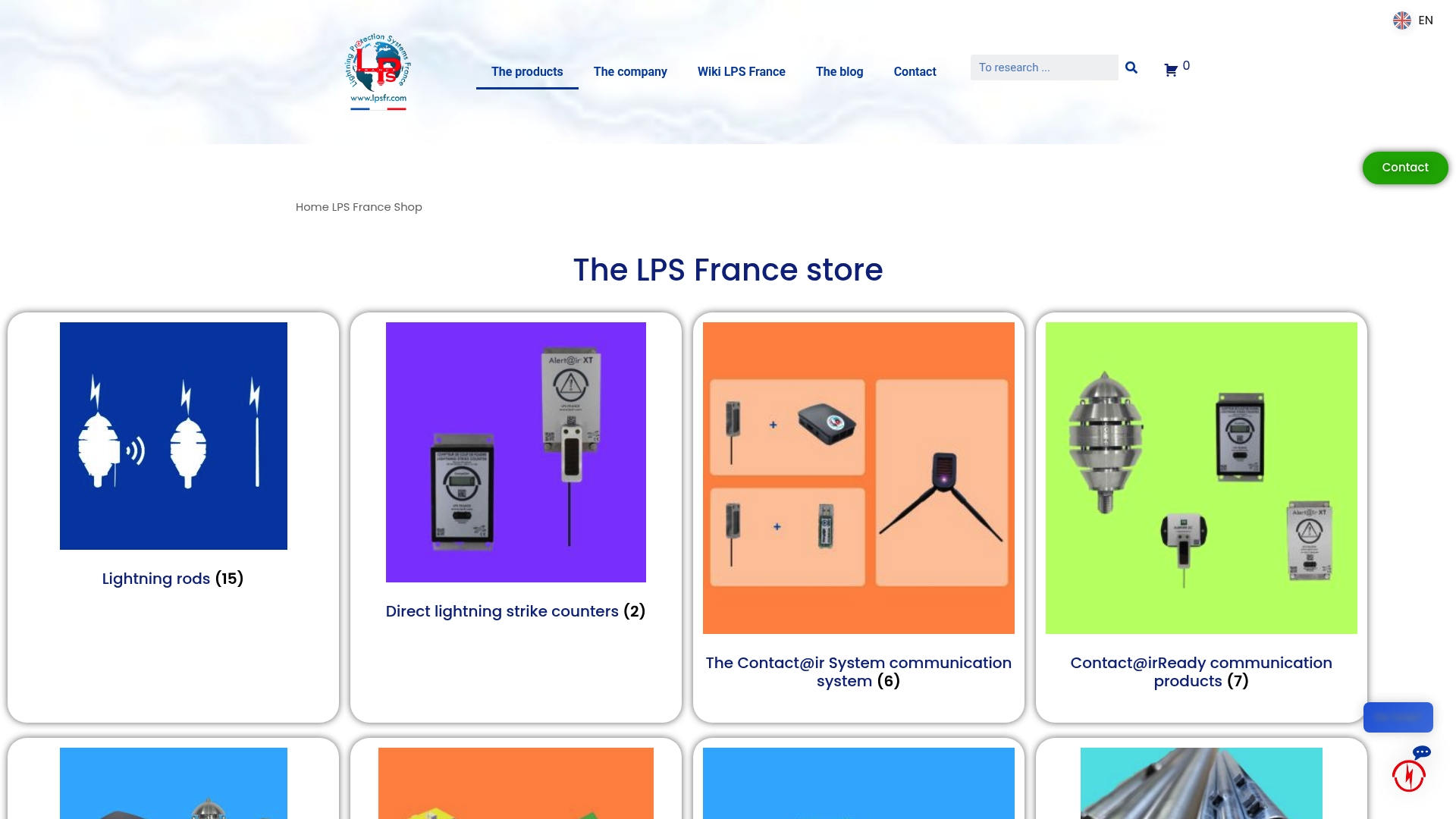
Connected lightning protection management represents a major evolution for multi-site managers. The LPS Manager application centralizes alerts, archives verification reports, and automatically generates maintenance reminders. The Contact@ir and Contact@ir MD systems transmit equipment status in real time, transforming reactive maintenance into a predictive approach.
Engineers and installers benefit from comprehensive technical support: system sizing, product training, and assistance during critical phases. The online store provides access to the entire catalog with detailed technical documentation, facilitating site preparation and supply management.
Frequently asked questions about how lightning protection works
What is the main role of a lightning rod in a protection system?
The lightning rod creates a preferred point of capture that attracts the electrical discharge before it reaches vulnerable parts of the structure. It then channels the lightning current to the grounding system, which dissipates the energy into the ground without causing damage.
How to choose a protection device suitable for an industrial site?
The analysis begins with a risk assessment according to standard NF EN 62305-2, taking into account local lightning strike density, building dimensions, and equipment sensitivity. This study determines the required level of protection (I to IV), which dictates the sizing of lightning rods, conductors, and surge arresters.
What are the essential standards in force in 2026?
The NF EN 62305 series constitutes the main technical reference, supplemented by the NF C 17-102 standard for lightning rods with early streamer emission devices. Surge arresters must comply with the NF EN 61643 series, and earthing systems follow the requirements of NF C 15-100 for low-voltage installations.
How to ensure regular maintenance of lightning protection systems?
Preventive maintenance combines periodic visual inspections, electrical measurements of continuity and earth resistance, and verification of the proper functioning of surge protectors. Connected systems like Contact@ir automate continuous monitoring and trigger alerts in case of anomalies, optimizing interventions.
What should be done in the event of a direct lightning strike on a protected installation?
After a lightning strike, immediately inspect the surge arresters, check the electrical continuity of the conductors, and systematically replace any affected surge protectors. Re-measure the earth resistance and document the event in the maintenance log. Lightning protection compliance procedures mandate this complete verification before the system is returned to service.
Do lightning rods require a power supply to function?
Simple-point lightning rods operate purely passively without a power supply. Early streamer emission (ESE) lightning rods incorporate self-contained electronics powered by photovoltaic cells, ensuring continuous operation without connection to the building's electrical grid.