
Many people believe that a lightning rod is sufficient to protect any installation from lightning. This misconception exposes sensitive equipment to induced surges that can destroy electronics and critical systems. Distributed surge protection devices ( DSPs) play an essential complementary role in electrical protection by mitigating these surges. This article clarifies their differences to improve design and maintenance.
Table of Contents
- Introduction and context of lightning protection
- Functioning and role of the lightning rod
- Operation and role of the DPS (surge protection device)
- Technical and functional comparison between lightning rods and DPS
- lps france monitoring, maintenance and connected solutions
- Practical application: on-site integration of devices and recommendations
- Conclusion: Choosing the right combination for optimal protection
- Discover our lightning protection solutions at lps france
- Frequently Asked Questions
Key points to remember
| Point | Details |
|---|---|
| Lightning rod | Captures the direct lightning discharge and conducts it to the earth |
| DPS | Limits power surges in electrical circuits caused by lightning strikes |
| Standards | NF C 17-102 and IEC 62305 govern their use and maintenance |
| Supervision | Connected solutions improve responsiveness and traceability of events |
| Integration | The correct combination maximizes safety and regulatory compliance |
Introduction and context of lightning protection
Industrial and commercial facilities face major risks from lightning strikes. A discharge can reach 200,000 amps and generate surges capable of paralyzing production and equipment.
The consequences include costly production shutdowns, significant damage to sensitive electronics, and risks to personnel safety. Financial losses often exceed several hundred thousand euros per incident.
The NF C 17-102 standard mandates annual verification of devices to guarantee their effectiveness. IEC 62305 defines appropriate protection levels based on lightning risk exposure.
The French regulatory framework requires:
- Risk analysis according to IEC 62305-2
- Installation compliant with NF C 17-102 standards
- Documented preventive maintenance
- Traceability of interventions and impacts
A comprehensive approach combines several complementary measures. The lightning rod addresses the risk of direct impact, while the DPS protects against induced effects. This multi-level strategy drastically reduces vulnerability.
Lightning protection principles are based on capturing, channeling, and limiting overvoltages. Each component fulfills a specific function in this safety chain.
Functioning and role of the lightning rod
The lightning rod is the first line of defense against direct lightning strikes. It captures the atmospheric discharge and channels it to the ground via down conductors.
Its principle is based on creating a preferential point of impact. The metal tip attracts the discharge before it strikes vulnerable structures or equipment.
Early streamer emission (ESE) lightning rods improve capture speed thanks to an advance in the early streamer emission process. This technology increases the effective protection radius.
The models differ in their time advance:
- 10 µs ESE for standard protection
- ESE 25 µs for moderately exposed areas
- ESE 45 µs for sensitive sites
- 60 µs ESE for critical installations
Each advance level defines the protection radius according to installation height and required level (I to IV). The operation of lightning rods follows precise physical laws validated in the laboratory.
Traditional maintenance requires periodic wiring tests. The technician checks electrical continuity, the condition of the connections, and the absence of corrosion according to protocol NF C 17-102.
Pro tip: Communicating systems reduce unnecessary manual inspections. Remote monitoring detects faults instantly and optimizes field intervention planning.
The emergence of connected solutions is transforming lightning rod management. Automatic diagnostics and real-time alerts enable proactive rather than reactive maintenance.
Operation and role of the DPS (Surge Protection Device)
The DPS protects electrical networks against lightning-induced surges. Even without a direct strike, electromagnetic propagation generates destructive voltage spikes.
Its specific role is to limit the amplitude of transient overvoltages. The device detects abnormal voltage rises and diverts current to ground within nanoseconds.
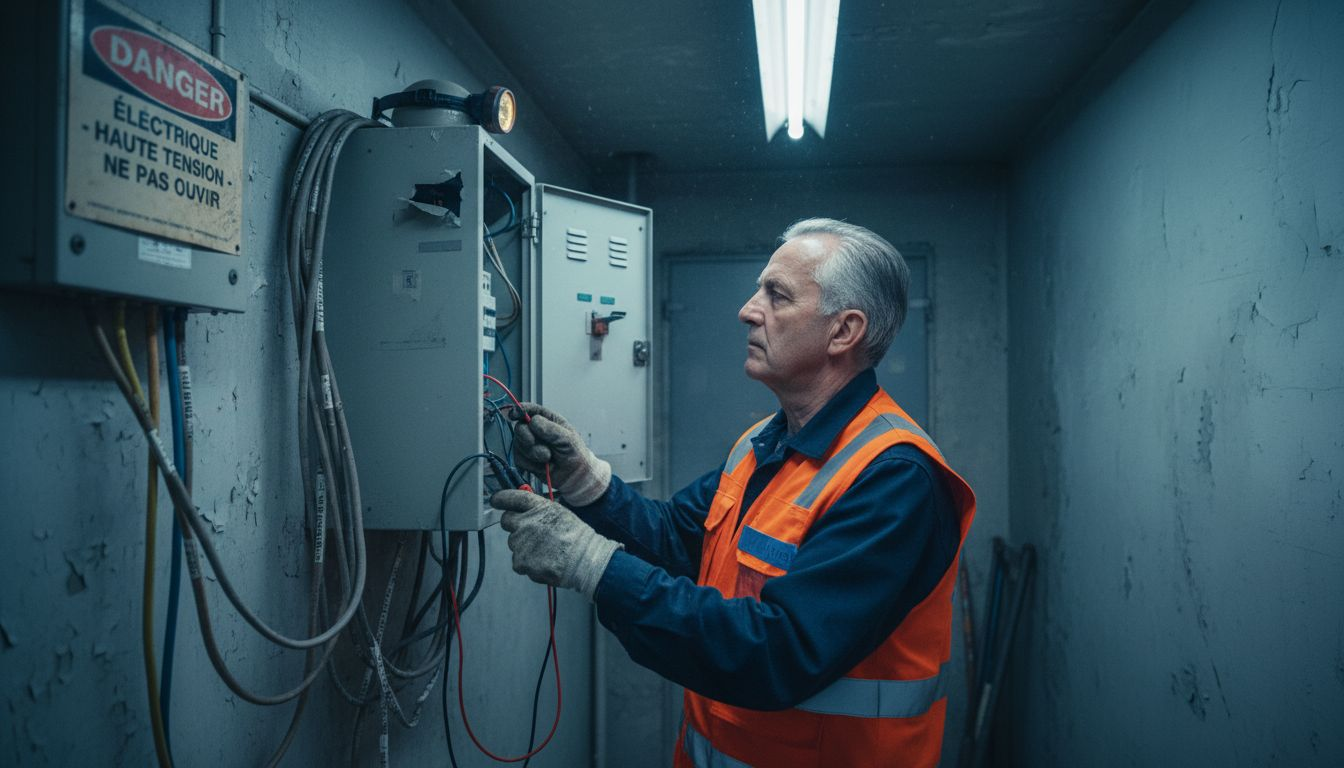
devices (PSDs) limit induced electrical surges, preventing the destruction of sensitive equipment. Automation systems, servers, and industrial electronics require this protection.
Key technical features include:
- Nominal discharge capacity (kA)
- Response time less than 25 ns
- Protection modes (common/differential)
- Protection level (Up) adapted to the equipment
The IEC 61643 and NF C 17-102 standards define performance and installation requirements. Classification is type 1, 2, or 3 depending on the position in the electrical network.
Continuous monitoring prevents hidden failures. A DPS can be destroyed by a power surge without any visible external signs, leaving the installation vulnerable.
Pro tip: Integrating connected diagnostics optimizes safety and lifespan. Immediate alerts in case of failure allow for replacement before the next lightning strike.
Surge protection requires coordination between different levels. Cascade DPS ensures optimal protection from the main switchboard to the terminal equipment.
Technical and functional comparison between lightning rods and DPS
Confusion between lightning rods and DPS (Dynamic Protection System) leads to costly design errors. Their functions are complementary, not interchangeable.
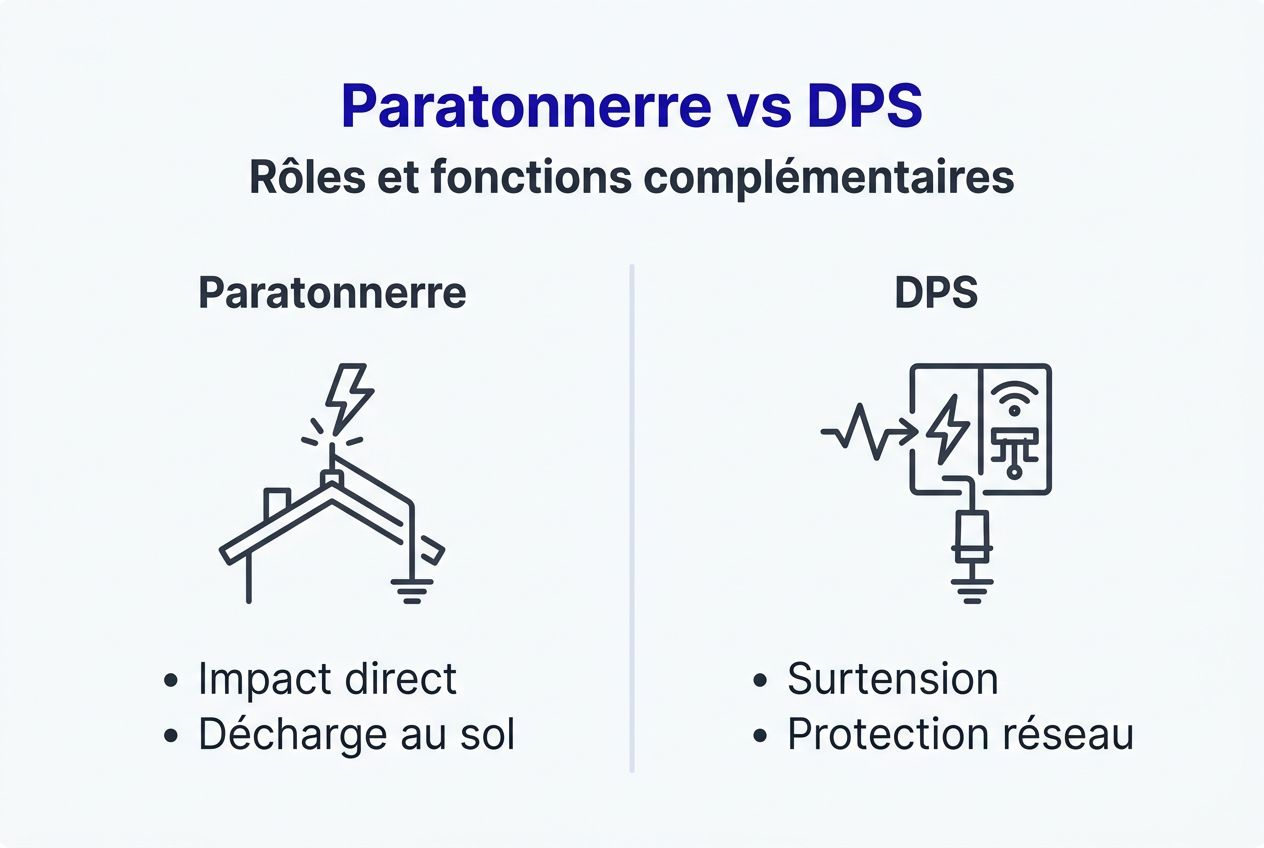
The lightning rod deals with direct external impacts, while the DPS handles indirect internal effects. This fundamental distinction determines their positioning in the protection chain.
| Criteria | Lightning rod | DPS |
|---|---|---|
| Function | Direct discharge capture | Limitation of induced overvoltages |
| Positioning | Exterior (highest point) | Interior (electrical panels) |
| Main standard | NF C 17-102, IEC 62305-3 | IEC 61643, NF C 17-102 |
| Maintenance | Annual + post-impact | Condition check + replacement if defective |
| Protection | Structure and people | Electrical equipment |
In the overall system, the lightning rod dissipates 99% of the energy to the ground. The remaining 1% propagates as surges that only the DPS (Dynamic Power Supply) can block.
Common misconceptions:
- “A lightning rod protects the entire installation” (false: it only protects against direct impact)
- “The DPS replaces the lightning rod” (false: complementary and mandatory)
- “Grounding is sufficient” (false: requires active protection devices)
Selection criteria according to context:
- Isolated exposed sites: ESE lightning rod + DPS type 1
- Commercial buildings: standard lightning rod + DPS cascade type 2 and 3
- Sensitive installations: maximum protection with connected monitoring
Comparing lightning rods and DPS reveals their essential synergy. Neither can compensate for the absence of the other.
LPS France Monitoring, Maintenance and Connected Solutions
Digital technologies are transforming lightning protection maintenance. Communicating systems offer real-time visibility into the status of installations.
LPS France offers three Contact@ir architectures adapted to field constraints:
- Dongl@ir for on-site spot diagnostics (range 80 m)
- Rout@ir for multi-transmitter monitoring with historical data logging (range 300 m)
- Contact@ir MD for autonomous cellular monitoring via eSIM
Contact@ir communication systems enable remote diagnostics with real-time alerts. Autonomous transmitters transmit status and events without human intervention.
Key operational advantages:
- 60% reduction in unnecessary field visits
- Full traceability of impacts and interventions
- Enhanced compliance with time-stamped evidence
- Immediate post-lightning strike response
Integration into industrial maintenance modernizes the traditional approach. Push alerts on smartphones allow for rapid action before the situation worsens.
Tertiary sector example: a multi-site manager receives instant notification after an impact. Targeted verification takes place within 24 hours instead of 3 months during periodic checks.
LPS Manager connected management centralizes data from all sites. A web and mobile interface provides a unified dashboard.
Pro tip: Connected solutions reduce maintenance costs by 40% while improving security. ROI achieved in 18 months thanks to optimized interventions.
Digital monitoring detects defects invisible during visual inspections. Low battery, faulty component or degraded connection generates an alert before an incident.
Practical application: on-site integration of devices and recommendations
The typical architecture in an industrial setting combines ESE lightning rods on the roof, down conductors to ground, and DPS cascade at strategic points of the electrical network.
Tips for implementing effective protection:
- Perform a risk analysis according to IEC 62305-2 to determine the required levels
- Install a lightning rod adapted to the calculated protection radius
- Position DPS type 1 at the head of the installation, then types 2 and 3 in cascade
- Check continuity and grounding resistance (< 10 Ω)
- Document the installation in LPS Manager for traceability
The NF C 17-102 standard mandates annual inspections and verification after each detected impact. Smart meters automate the triggering of these checks.
Recommended maintenance plan:
- Quarterly visual inspection of apparent connections
- Annual functional test with calibrated device
- Post-impact verification within 48 hours maximum
- Preventive replacement according to manufacturer's recommendations
Adapting to the site context requires taking the network environment into account. Isolated sites favor Contact@ir MD cellular, while connected installations use Rout@ir with an internet connection.
The importance of rigorous documentation: traceability proves compliance during audits or claims. Geotagged photos, automated reports, and alert history constitute a complete file.
Gradual modernization is possible on existing installations. Adding smart meters and supervised DPS improves protection without complete replacement.
the right lightning protection system directly influences the level of safety achieved. Undersizing exposes you to risks, while oversizing unnecessarily increases costs.
Conclusion: Choosing the right combination for optimal protection
The complementary nature of lightning rods and DPS (Dynamic Protection System) is the foundation of effective protection. No single device is sufficient to guarantee complete safety.
Lightning rods capture direct impacts, preventing structural damage. DPS blocks induced surges, protecting sensitive equipment. This double barrier reduces risks by 95%.
Direct, measurable benefits:
- Business continuity preserved
- Proven regulatory compliance
- Extended equipment lifespan
- Reduction in insurance premiums
Connected monitoring provides critical responsiveness. Instant alerts enable targeted intervention before deterioration. Automatic traceability simplifies audits and reporting.
Adopting a holistic approach that integrates rigorous design, proactive maintenance, and digital monitoring maximizes return on investment. Lightning protection evolves from a constraint expense to a competitive advantage.
Technological innovation makes systems smarter and more autonomous. Predictive diagnostics anticipates failures, enabling optimized preventive maintenance.
Engineers and technicians now have powerful tools at their disposal to secure installations. The challenge remains to judiciously combine lightning rods, DPS (Device Protection System), and monitoring according to the specific context.
Discover our lightning protection solutions at LPS France
Are you looking to protect your industrial facilities against the risks of lightning? LPS France offers a complete range adapted to all contexts.
Our guyed pylon lightning rod kits offer turnkey solutions for exposed sites. Quick installation and guaranteed compliance with French standards.
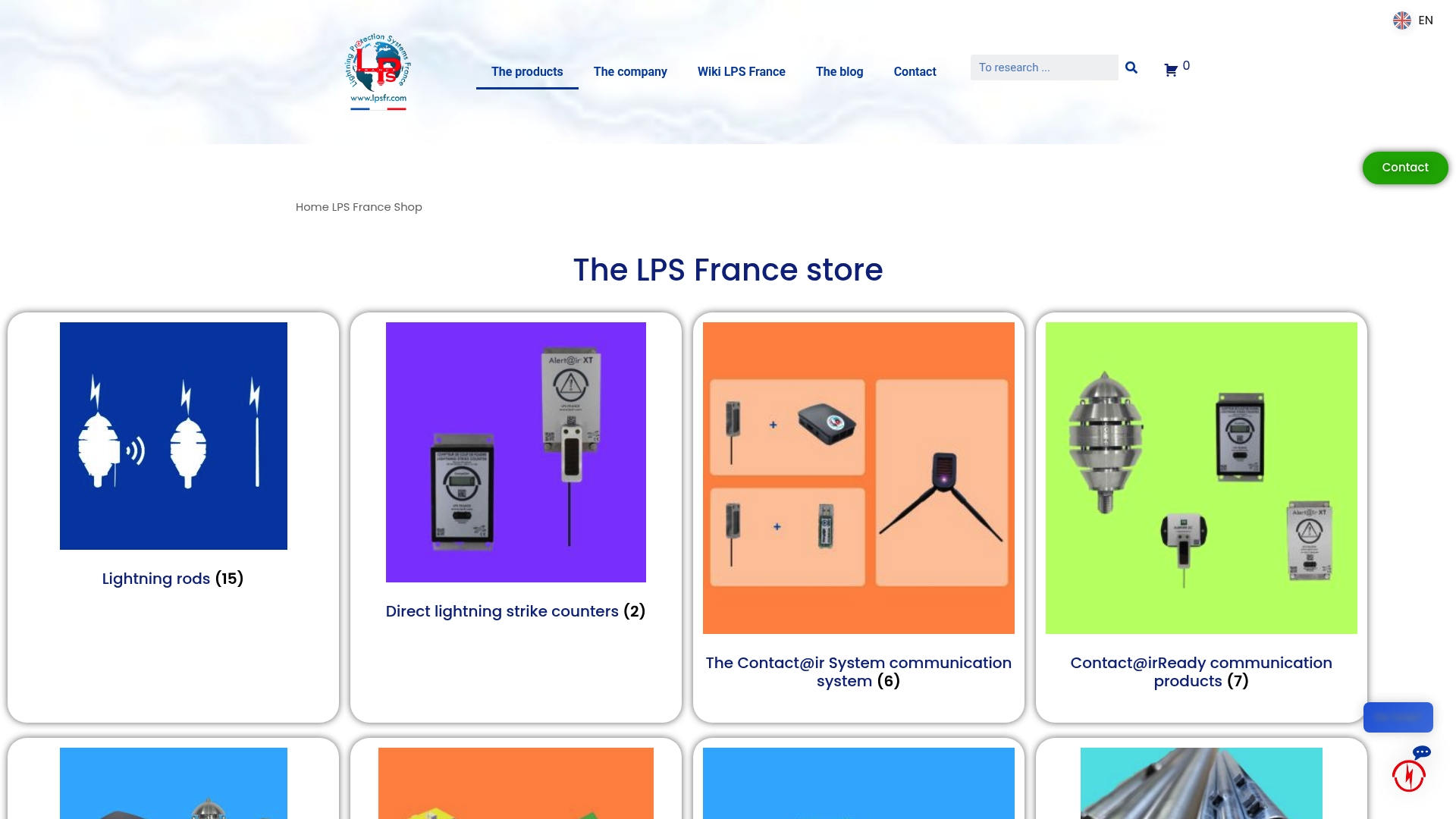
Discover our IEC 61643 certified surge protection devices. Type 1, 2 and 3 surge protection devices for complete cascade from the main switchboard to the terminal equipment.
The Contact@ir communication system revolutionizes maintenance with remote diagnostics and real-time alerts. Reduce your costs while improving safety.
Made in France, recognized expertise since 2010, premium technical support. Benefit from innovative solutions compliant with IEC 62305:2024 and NF C 17-102:2011.
Frequently Asked Questions
What is the main difference between a lightning rod and a DPS?
The lightning rod captures direct lightning strikes and diverts them to the ground via down conductors. The DPS (Dynamic Power Supply) limits induced overvoltages in internal electrical networks. They protect against two distinct and complementary types of threats.
How to ensure effective maintenance of lightning rods and DPS?
The NF C 17-102 standard mandates annual inspection and verification after each lightning strike. Communicating systems reduce manual intervention by automatically alerting users to faults. Remote diagnostics optimize planning and traceability.
See our advice for choosing and maintaining lightning protection adapted to your site.
What advantages do connected monitoring systems like Contact@iroffer?
Real-time alerts enable immediate response after an impact or failure. Complete event traceability simplifies audits and ensures compliance. Maintenance becomes proactive, reducing operational costs by up to 40%.
Discover all the advantages Contact@ir for modernizing your facilities.
Can a DPS be installed without a lightning rod?
Yes, for buildings not exposed to direct lightning strikes according to IEC 62305-2 risk analysis. However, a combination of a lightning rod and a DPS (Direct Protection System) is still strongly recommended for optimal protection. A DPS alone does not protect against direct lightning strikes.
What is the lifespan of a lightning rod and a DPS?
Lightning rods last 15 to 25 years with proper maintenance. DPS (Dynamic Protection System) requires replacement after a significant surge or according to a wear indicator (typically 5 to 10 years). Connected monitoring signals the end of life before critical failure.
Recommendation
- Lightning arrester/surge protector according to IEC 62305 standard – Lightning Protection Systems France – Lightning Protection
- Lightning protection guide 2026: criteria, architectures and recommendations
- Early streamer emission (ESE) lightning rod – Lightning Protection Systems France – Lightning Protection
- Lightning Rod Definition: Everything You Need to Know – LPS France