
Lightning strikes increase globally by 12% per degree Celsius of warming, requiring professionals to rigorously update their practices. Compliance with the 2026 standards ensures the safety of industrial and construction facilities against this growing threat. This guide details the regulatory requirements, practical application methods, and modern monitoring tools to effectively secure your equipment.
Table of Contents
- Evolution and foundations of lightning protection standards
- Detailed comparison of standards NF C 17-102 and IEC 62305
- Practical application of standards in the industrial and construction sectors
- Maintenance, control and innovations in lightning protection
- Discover our complete solutions for compliant lightning protection
- What are the main lightning protection standards applicable in 2026?
Key points
| Point | Details |
|---|---|
| Increasing risks | The intensity of the impacts increases with climate change, requiring enhanced protection. |
| Regulatory framework | NF C 17-102 (France) and IEC 62305 (international) define the protection requirements. |
| Application methods | Risk analysis, the choice of certified devices and regular maintenance ensure compliance. |
| connected tools | The Contact@ir and LPS Manager systems enable remote diagnostics and traceability. |
| Preventive maintenance | Mandatory annual and post-impact checks, facilitated by IoT. |
Evolution and foundations of lightning protection standards
The current climate context reinforces the need for precise standards. Lightning strikes are increasing with climate change, creating unprecedented challenges for safety officials. The two main standards governing lightning protection in 2026 are the French standard NF C 17-102 and the international standard IEC 62305.
These standards share a common goal: to protect people, structures, and electronic equipment from the direct and indirect effects of lightning. Their regular updates incorporate recent data on storm phenomena and available technologies. The IEC 62305:2024 revision, in particular, provides further details on risk assessment and protection levels.
The basic principles revolve around five essential functions:
- Interception of the lightning strike by a capture device placed at the highest points
- Conduction of lightning current to the ground via appropriately sized conductors
- Dispersion of energy in the ground via a network of grounding points
- Effective grounding ensuring sufficiently low resistance
- Surge protection induced by surge arresters on electrical circuits
Understanding these mechanisms allows engineers to design systems tailored to each industrial context. A preliminary site analysis determines the required level of protection based on exposure, geometry, and equipment sensitivity.
Detailed comparison of standards NF C 17-102 and IEC 62305
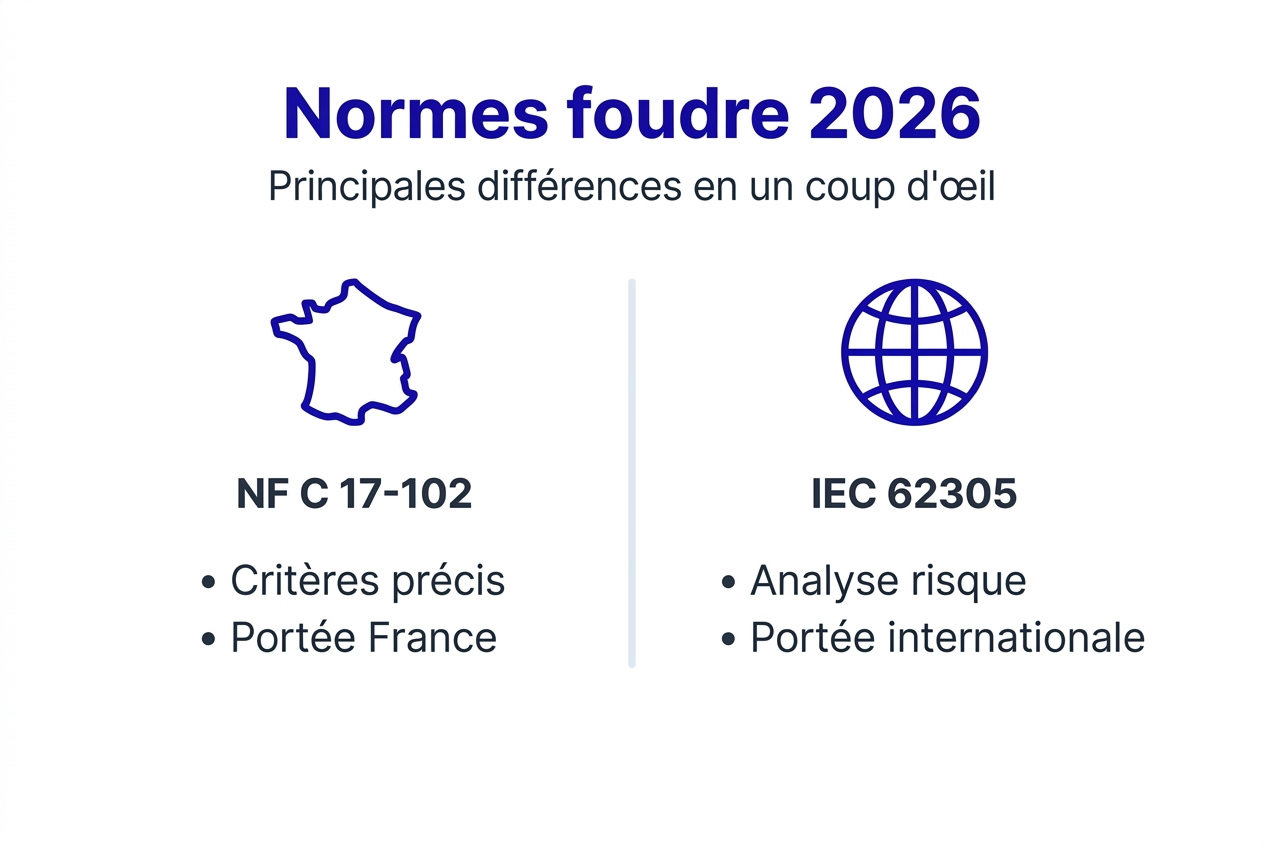
The two standards differ in their methodological approach and geographical scope. Understanding these distinctions guides the choice of the appropriate framework.
| Criteria | NF C 17-102:2011 | IEC 62305:2024 |
|---|---|---|
| Scope | France, a prescriptive approach | International risk management |
| Method | Direct calculation of the protection radius | Probabilistic risk assessment |
| Classification | Types and classes of lightning rods | Protection levels I to IV |
| Earthing system | Imposed resistance values | Context-appropriate resistance |
| Maintenance | Mandatory annual inspections | Inspections as per assessment |
The NF C 17-102 standard sets out precise criteria for sizing and installation. It specifies separation distances, conductor cross-sections, and maximum earth resistance values. This approach ensures consistent application throughout France.
IEC 62305 prioritizes risk analysis to define proportionate measures. It considers the local lightning strike frequency, acceptable losses, and aggravating factors. This method offers a flexibility that is valued in international contexts.
To choose appropriate lightning protection, professionals assess local regulations and insurance requirements. Projects in France generally follow NF C 17-102, while export installations comply with IEC 62305. Surge protection completes the system by protecting sensitive circuits.
Both standards recognize the importance of early streamer emission (ESE) lightning rods and effective grounding systems. They mandate periodic inspections to maintain system effectiveness.
Practical application of standards in the industrial and construction sectors
On-site implementation requires a structured methodology. Here are the key steps to ensure compliance and safety.
- Conduct a detailed risk analysis according to the chosen reference framework, including local lightning strike density, building geometry and equipment sensitivity.
- Select compliant capture devices (ESE lightning rods or simple rods), size down conductors and design the grounding system.
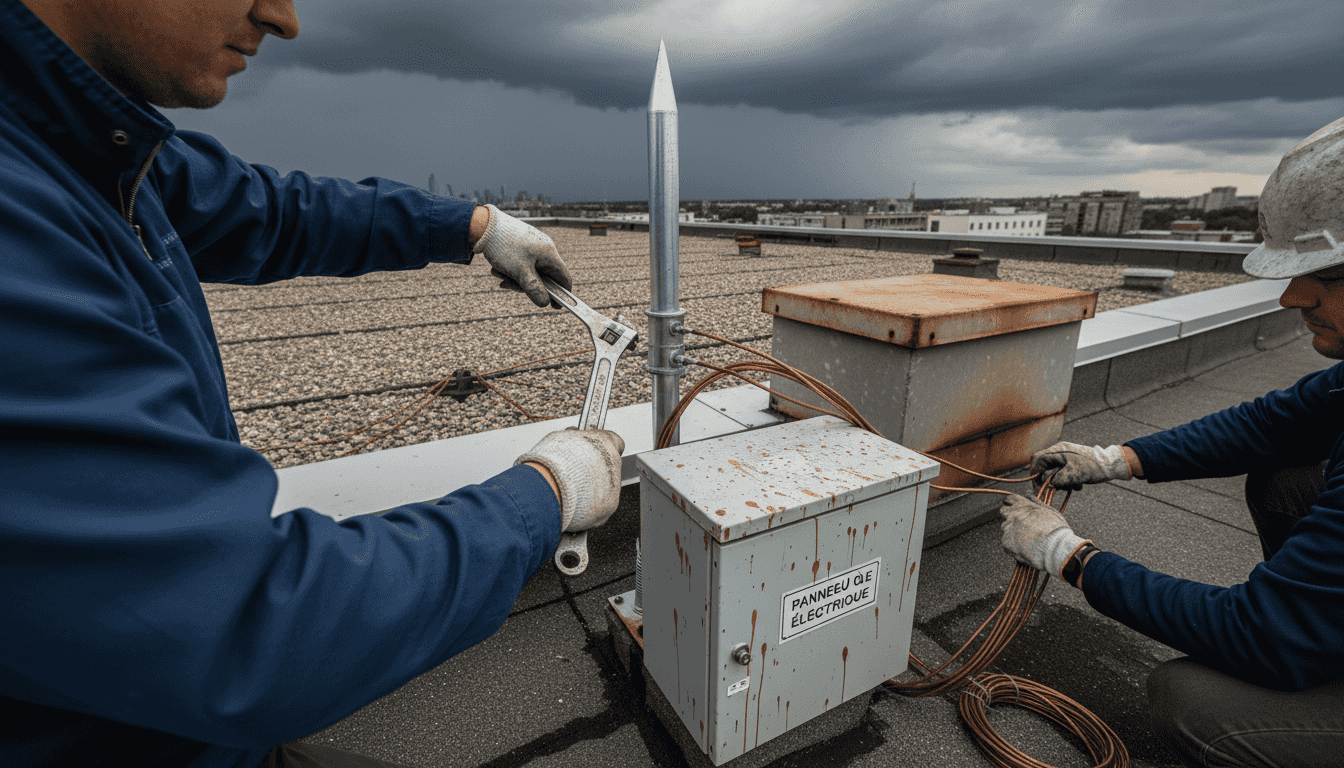
- Install the equipment according to best practices, respecting separation distances and minimum conductor cross-sections.
- Integrate surge protectors on electrical panels and communication lines to limit overvoltages.
- Document the complete installation with plans, certificates of conformity and maintenance procedures.
- Plan annual and post-event checks in accordance with regulatory requirements.
present Industrial sectors specific constraints: the presence of ATEX zones, critical service continuity, and a multitude of sensitive electronic equipment. Risk assessment incorporates these parameters to define an appropriate level of protection.
surges cause nearly half of all lightning-related damage. This fact underscores the importance of effective grounding and properly sized surge protectors. Ground resistance must be measured and documented, then checked periodically.
Pro tip: Integrate connected monitoring systems from the design stage to anticipate failures. Impact counters and condition detectors enable smart maintenance and reduce intervention costs.
Maintenance, control and innovations in lightning protection
The long-term effectiveness of a protection system depends on regular checks and the use of modern technologies. The NF C 17-102 standard mandates an annual and systematic inspection after each impact.
Key checkpoints include:
- Mechanical condition of the capture devices and fixings
- Electrical continuity of down conductors
- Earth resistance value and corrosion of sockets
- Operation of impact counters and surge protectors
- Respect for separation distances and no modification
Connected tools are transforming these operations. Contact@ir systems enable remote diagnostics without physical access to the lightning rod. The Rout@ir receiver centralizes data from multiple transmitters within a 300m radius, with historical data and real-time alerts.
| Tool | Benefits | Boundaries |
|---|---|---|
| Test@ir (wired) | Accurate on-site diagnosis, physical evidence | Requires access to the device |
| Contact@ir + Dongl@ir | Local reading 80 m, without infrastructure | No history or remote alerts |
| Contact@ir + Rout@ir | Multi-sender, history, cloud alerts | Depends on internet connectivity |
| Contact@ir MD (IoT) | Cellular autonomy, immediate alerts | Mobile network coverage required |
The Compt@ir and Alert@ir XT counters record each impact to trigger mandatory checks. This traceability facilitates demonstrating compliance to authorities and insurers.
Pro tip: Anticipate failures with IoT and preventative maintenance. Surge protector fault alerts (Alert@ir DC) enable replacement before a disaster. The LPS Manager application centralizes all events to efficiently manage a multi-site fleet.
Automatic synchronization of data produced every 12 hours with Contact@ir MD ensures continuous monitoring. In the event of an impact, an alert is sent immediately to the cloud, enabling rapid intervention. This responsiveness minimizes service interruptions and preserves security.
Discover our complete solutions for compliant lightning protection
LPS France designs and manufactures certified systems in France that comply with NF C 17-102 and IEC 62305 standards. Our early streamer emission (ESE) lightning rods offer advances of 10 to 60 μs depending on your protection needs. The Paraton@ir connectivity Contact@ir for remote diagnostics.
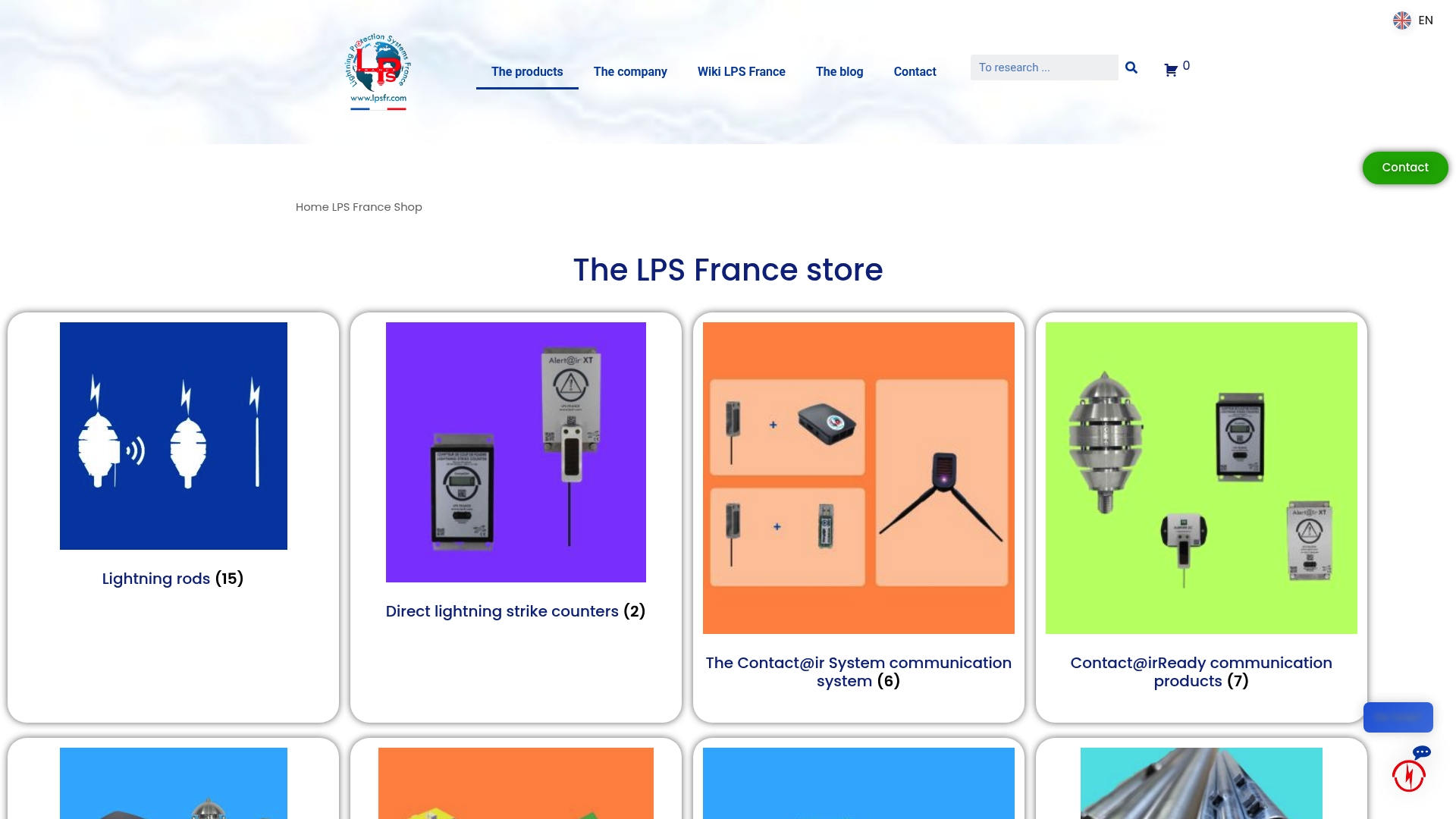
Our connected maintenance services transform the way you manage your facilities. Rout@ir systems centralize up to 999 devices within a 300-meter radius, with cloud updates and real-time alerts. The LPS Manager application provides a complete overview of your fleet, automated reports, and traceability to demonstrate your compliance.
Whether you manage industrial sites, telecom infrastructure, or construction projects, our technical team supports you from risk assessment to preventive maintenance. Our solutions are tailored to all sectors with a personalized approach.
What are the main lightning protection standards applicable in 2026?
What are the major differences between NF C 17-102 and IEC 62305?
NF C 17-102 sets prescriptive values (earth resistance, conductor cross-sections) while IEC 62305 prioritizes probabilistic risk assessment. The former applies in France, the latter internationally.
How often should lightning rods be checked?
Both standards require a minimum annual and systematic inspection after each recorded lightning strike. Critical installations may require semi-annual inspections depending on the risk assessment.
How to choose between a simple lightning rod and a ESE?
Early streamer emission (ESE) lightning rods offer a greater protection radius, reducing the number of devices required. The choice depends on the site's geometry, budget, and architectural constraints.
Are connected systems mandatory?
No standard mandates connectivity, but IoT tools greatly facilitate traceability and preventative maintenance. They reduce intervention costs and improve responsiveness to impacts.
What should you do immediately after a lightning strike?
Visually inspect the installation, test sensitive equipment, and contact a qualified technician for a thorough inspection. Document the event with the date, time, and observations for traceability. Smart meters automatically trigger this procedure.