Real-time alerts via Contact@ir Contact reduce lightning-related risks by 40 to 50%. This advancement is revolutionizing traditional maintenance. The IEC 62305:2024 and NF C 17-102:2011 standards now require communicating monitoring to ensure traceability and compliance. This guide details the technical architectures, suitable devices, and methods for integrating these requirements into your lightning protection systems.
Table of Contents
- Key points to remember
- Introduction to Lightning Protection Standards 2026
- Main regulatory developments and their technical impacts
- Technological solutions compliant with 2026 standards
- Comparison of protection and alert systems
- Communication architectures and system integration
- Intelligent maintenance and regulatory traceability
- Data security and access governance in connected systems
- Conclusion and practical recommendations for 2026 compliance
- Discover LPS France solutions for lightning protection compliant with 2026
- What are the main lightning protection standards in 2026?
Key points to remember
| Point | Details |
|---|---|
| Updated standards 2026 | IEC 62305:2024 and NF C 17-102:2011 strengthen supervision and traceability. |
| Mandatory communication devices | Contact@ir System provides remote diagnostics, real-time alerts and history logging. |
| Predictive maintenance | Targeted interventions after impacts are detected, reduction of unnecessary field visits. |
| Adaptable architectures | Dongl@ir (local diagnostics), Rout@ir (multi-site with internet) and Contact@ir MD (cellular IoT). |
| Centralized LPS Manager | Multi-site management, automated reports, API for BMS/SCADA integration. |
Introduction to Lightning Protection Standards 2026
The IEC 62305:2024 standard replaces and updates the previous version. It strengthens the design and maintenance requirements for lightning protection systems, particularly through the integration of communicating monitoring tools. In France, NF C 17-102:2011 remains a standard reference, specifying design and verification procedures with a strong focus on periodic maintenance.
These standards focus on three main areas. First, enhanced safety for facilities and personnel. Second, digital integration for traceability and document compliance. Finally, optimized maintenance through automated alerts.
For engineers and technicians, these developments require a rethinking of architectures. Traditional, non-communicating systems are no longer sufficient. Installations must now include:
- Impact detection devices with automatic feedback.
- Time-stamped event counters for regulatory traceability.
- A centralized platform for management and report generation.
- Authentication mechanisms and secure access to data.
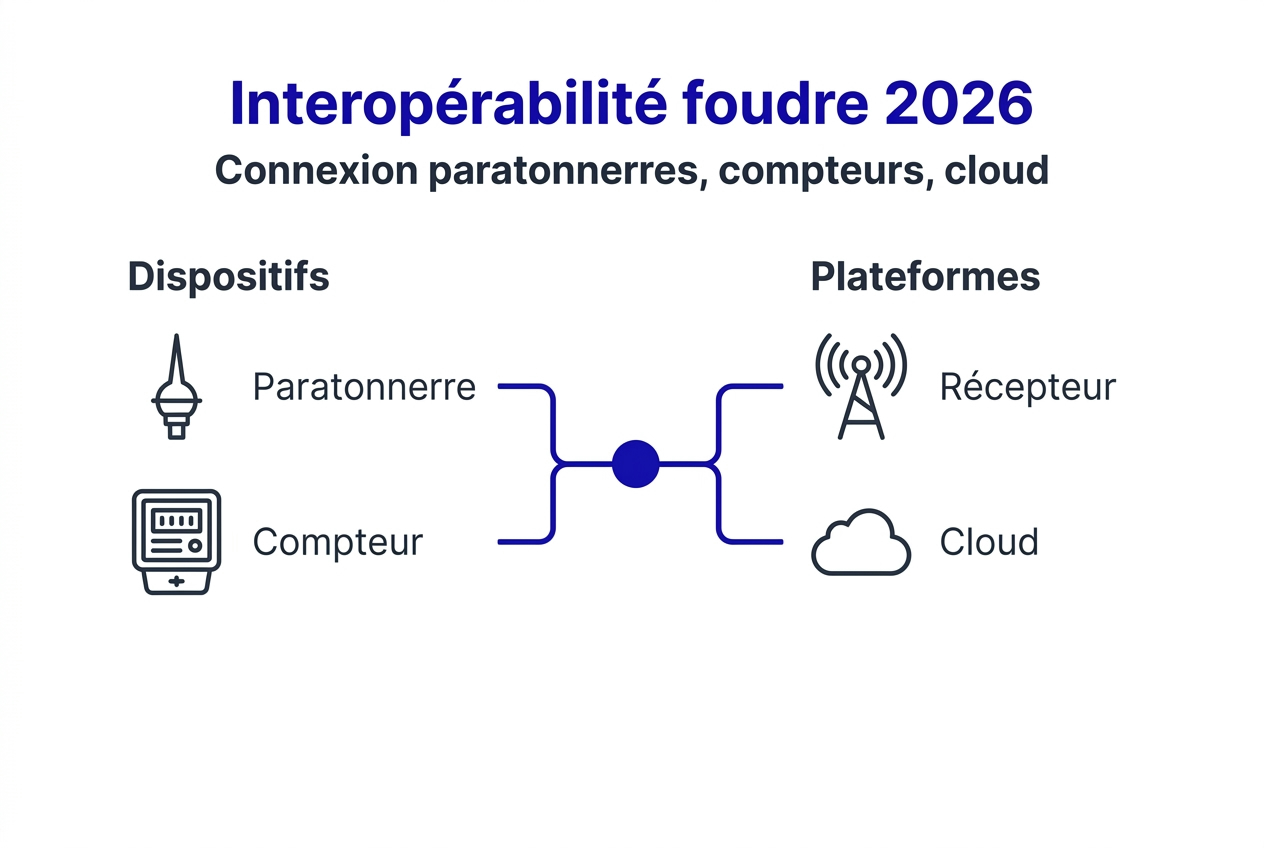
These requirements create a need for interoperability between lightning rods, meters, receivers and cloud platforms.
Main regulatory developments and their technical impacts
The difference between NFC 17-102 and IEC 62305 lies in their scope. IEC 62305 covers overall protection, while NFC 17-102 specifies the French requirements. The IEC 62305:2024 requirements add criteria for digital monitoring.
The main changes include enhanced monitoring. Systems must now continuously monitor their operational status and detect any impacts. Traceability becomes mandatory: every event must be time-stamped and archived for auditing purposes.
The integration of communication devices is no longer optional in standard scenarios. New installations must include Contact@ir or equivalents from the design stage. The differences between lightning rods and surge protectors according to the 2026 standards clarify their respective roles.
Periodic checks are being stepped up. An inspection is required after every detected lightning strike. Annual checks remain mandatory, even without an incident.
In concrete terms, these changes impact several aspects:
- Design: provide locations and power supplies for radio or cellular transmitters.
- Installation: cabling adapted to smart meters, optimal antenna positioning.
- Maintenance: transition from a calendar-based model to an event-based and predictive model.
- Documentation: automated reports replacing paper records.
The steps to achieve lightning protection compliance include initial audit, technical upgrade, and team training.
Technological solutions compliant with 2026 standards
The system Contact@ir offers a modular architecture adapted to the 2026 requirements. Contact@ir receivers Rout@ir or Contact@ir in cellular IoT mode.
The 868 MHz radio architectures offer a range of 80 m (Dongl@ir) to 300 m (Rout@ir) without a wired connection. The Contact@irtransmitter, powered by solar panels, transmits its operating status every 100 seconds. In the event of an impact, an alert is sent immediately.
The cellular IoT architecture (Contact@ir MD) uses an international eSIM. It communicates via 4G/3G/2G/GPRS without requiring a dedicated receiver. Alerts are sent to the cloud in real time, and product data is synchronized every 12 hours.
LPS Manager centralizes information. This web and mobile platform displays alerts, history, and generates automated reports. It manages multi-user access rights and offers an API for BMS/SCADA integration.
Communicating impact counters (Compt@ir, Alert@ir XT) record each lightning strike. When coupled with the Contact@ir System, they automatically trigger verification workflows in LPS Manager.
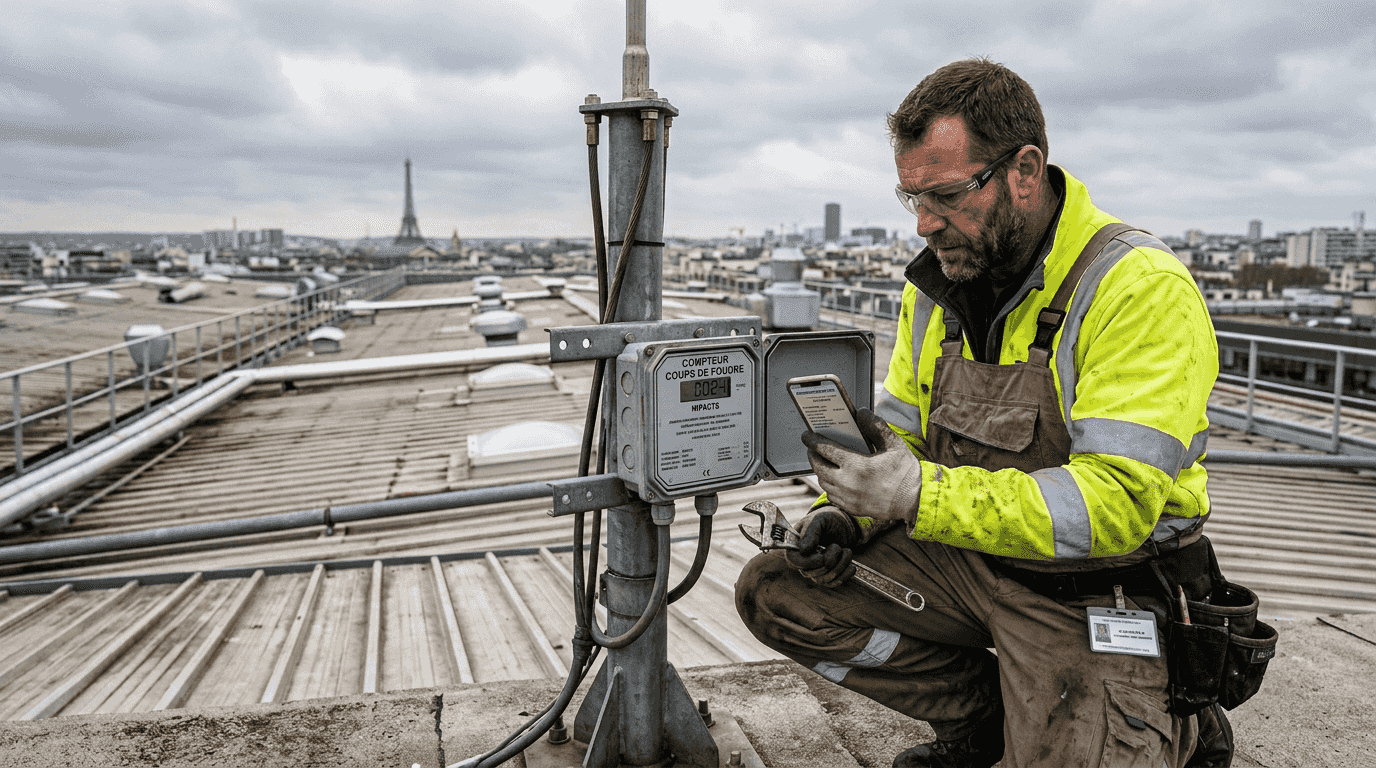
Pro tip: For an industrial site with multiple buildings and an existing Wi-Fi network, choose Rout@ir. For isolated sites without IP infrastructure, Contact@ir MD guarantees autonomous monitoring. Dongl@ir is suitable for spot checks without the need for historical data.
The definition of a lightning rod is evolving: it is no longer just a passive sensor but an active element of a communicating system.
Comparison of protection and alert systems
| Device | Kind | Communicating | Range/Network | Typical use |
|---|---|---|---|---|
| Paraton@ir | Lightning rod ESE | Yes (Contact@ir Ready) | 80 m (Dongl@ir), 300 m (Rout@ir), cellular (MD) | New installations requiring supervision |
| Ellips | Lightning rod ESE | No (modernization option) | Test@ir wired | Existing sites, gradual modernization |
| Compt@ir | Impact counter | Yes (with Contact@ir) | Same as Paraton@ir | Event traceability upgrade |
| Alert@ir XT | Counter without display | Yes (standalone) | Same as Paraton@ir | Retrofit installations of all brands |
| Alert@ir DC | Lightning protection monitoring | Yes | Via Rout@ir or MD | Protection of critical electrical panels |
Paraton@ir communicating lightning rods natively integrate Contact@irmodules. They offer complete monitoring right out of the box. Ellips non-communicating lightning rods require the subsequent addition of a communicating meter to receive alerts.
communicating products Contact@ir Ready share a common interface. This allows lightning rods, meters, and detectors to be combined within the same monitoring architecture.
The added value of smart meters lies in their responsiveness. An impact detected at 3 a.m. immediately generates a smartphone alert. The team can schedule the intervention first thing in the morning, without waiting for the next routine visit.
Operational efficiency versus constraints: communication systems reduce unnecessary travel by 60 to 70%, but require a network infrastructure (radio or cellular) and user account management. Return on investment typically occurs after 18 to 24 months at multi-device sites.
Communication architectures and system integration
Dongl@ir provides spot diagnostics. Connected via USB to an Android smartphone, it reads data from Contact@ir transmitters within a radius of 80 m. Without history or remote alerts, it is suitable for one-off checks.
Rout@ir functions as a multi-transmitter hub. It has a range of 300m, local history storage, and cloud uploads if internet access is available (Wi-Fi, Ethernet, mobile data). Local playback is possible via Bluetooth. Advertised capacity: up to 999 devices.
Contact@ir MD eliminates the need for a dedicated receiver. The transmitter integrates an international eSIM and communicates directly with the cloud via 4G/3G/2G. Alerts are sent without delay, and product data is updated every 12 hours.
On the security side, LPS Manager controls access by user profile. The servers are advertised as secure and redundant. Public documentation does not detail RF encryption or TLS certificates. A corporate specification document should require a security appendix specifying encryption, identity management, and logging.
The data flows are predominantly upward (telemetry). No remote actuator control is documented. The architecture remains telemetry-centric.
Expected latency: a few seconds for an impact alert (standard IP network). The 100-second cycle for periodic emissions introduces a maximum state detection delay.
Pro tip: For sites with strict IT constraints, deploy Rout@ir on a dedicated VLAN with outbound filtering to the LPS France only. This limits the attack surface while maintaining real-time alerts. For sites without a usable IP network, Contact@ir MD offers complete autonomy via mobile network.
The 2026 lightning protection architecture guide details criteria and recommendations. The choice of appropriate lightning protection depends on the technical and budgetary context.
Intelligent maintenance and regulatory traceability
Connected maintenance relies on automatic triggering. As soon as an impact is detected by Compt@ir or Alert@ir XT, an alert is sent to the team via LPS Manager. Time-stamped event logging ensures traceability and compliance.
Automated reports replace manual records. LPS Manager generates PDF documents including dates, times, measured intensities, and field photos. These reports facilitate regulatory audits.
The NF C 17-102:2011 standard requires annual verification and verification after each lightning strike. Contact@ir System provides the event signal to trigger these verifications.
Key steps to successful connected maintenance:
- Register all equipment in LPS Manager with photos and geolocation.
- Configure alerts according to user profiles (site manager, technician, management).
- Define post-impact verification workflows (deadlines, responsible parties, checklist).
- Archive automated reports for the purpose of building the compliance file.
- Conduct an annual review of settings and access rights.
The reduction in unnecessary field visits reaches 60 to 70%. Instead of checking all sites monthly, teams only intervene after an event is detected or at the mandatory annual deadline.
The maintenance of lightning protection systems with Paraton@ir illustrates this approach. The system communicates the operating status, product authenticity, and impact alerts in real time.
Data security and access governance in connected systems
LPS Manager manages user rights on a folder basis. The folder owner grants specific access levels (read-only, edit, administration). This allows information to be shared with installers, engineering firms, or inspection bodies without compromising confidentiality.
LPS Manager servers are advertised as highly secure and redundant. The platform uses access control and authentication mechanisms.
However, the public documents do not specify the encryption protocols (TLS version, cryptographic suites), key management, anti-replay mechanisms, or audit logs. For a critical enterprise deployment, require a contractual appendix detailing:
- End-to-end encryption (RF and IP).
- Identity management (strong authentication, MFA).
- Logging of access and changes.
- GDPR compliance and data localization.
- Backup and incident recovery procedures.
Without rigorous security measures, risks include data interception, unauthorized access to event logs, and compromise of regulatory traceability. Lightning strike data can reveal strategic vulnerabilities (critical equipment, periods of low protection).
Best practices to apply:
- Segment the network: isolate the Rout@ir on a dedicated VLAN.
- Filter outgoing traffic: only allow IPs from the LPS Francecloud.
- Audit accounts regularly: remove obsolete access.
- Train users: raise awareness of the risks of phishing and password sharing.
- Documenting the architecture: maintaining an up-to-date diagram of flows and equipment.
Conclusion and practical recommendations for 2026 compliance
The 2026 standards mandate the adoption of connected solutions to ensure compliance and optimized maintenance. Traditional, unconnected lightning rods no longer meet traceability and responsiveness requirements.
Prioritize the architecture best suited to your technical context. If your site has a stable Wi-Fi or Ethernet network, Rout@ir offers the best compromise (local logging, real-time alerts if internet access is available, Bluetooth readout). For isolated sites without IP infrastructure, Contact@ir MD guarantees autonomous monitoring via mobile network. Dongl@ir remains relevant for ad-hoc diagnostics without the need for historical data.
Use LPS Manager to centralize multi-site management, alerts, and reports. The platform reduces administrative burden and facilitates regulatory audits. API access enables integration with existing BMS, SCADA, or CMMS systems.
Strictly adhere to IT security protocols. Require contractual appendices detailing encryption, identity management, and logging. Segment networks, filter traffic, and regularly audit accounts.
Recommendations for gradual integration:
- Phase 1: Audit of existing facilities and identification of priority sites (high exposure, critical equipment).
- Phase 2: Pilot deployment on a test site with team training.
- Phase 3: Gradual generalization by capitalizing on feedback from experience.
- Phase 4: API integration with existing IS for workflow optimization.
Train your teams on monitoring tools and post-impact verification procedures. The transition to connected maintenance requires organizational adaptation and skills development.
Lightning protection best practices for 2026 include adaptive design, communicating monitoring, and automated documentation.
Discover LPS France solutions for lightning protection compliant with 2026
LPS France offers Paraton@ir and Ellips lightning rods compliant with the 2026 standard. The Paraton@ir range natively integrates Contact@ir Ready communication modules. Ellips offers a proven solution with the possibility of gradual modernization through the addition of smart meters.
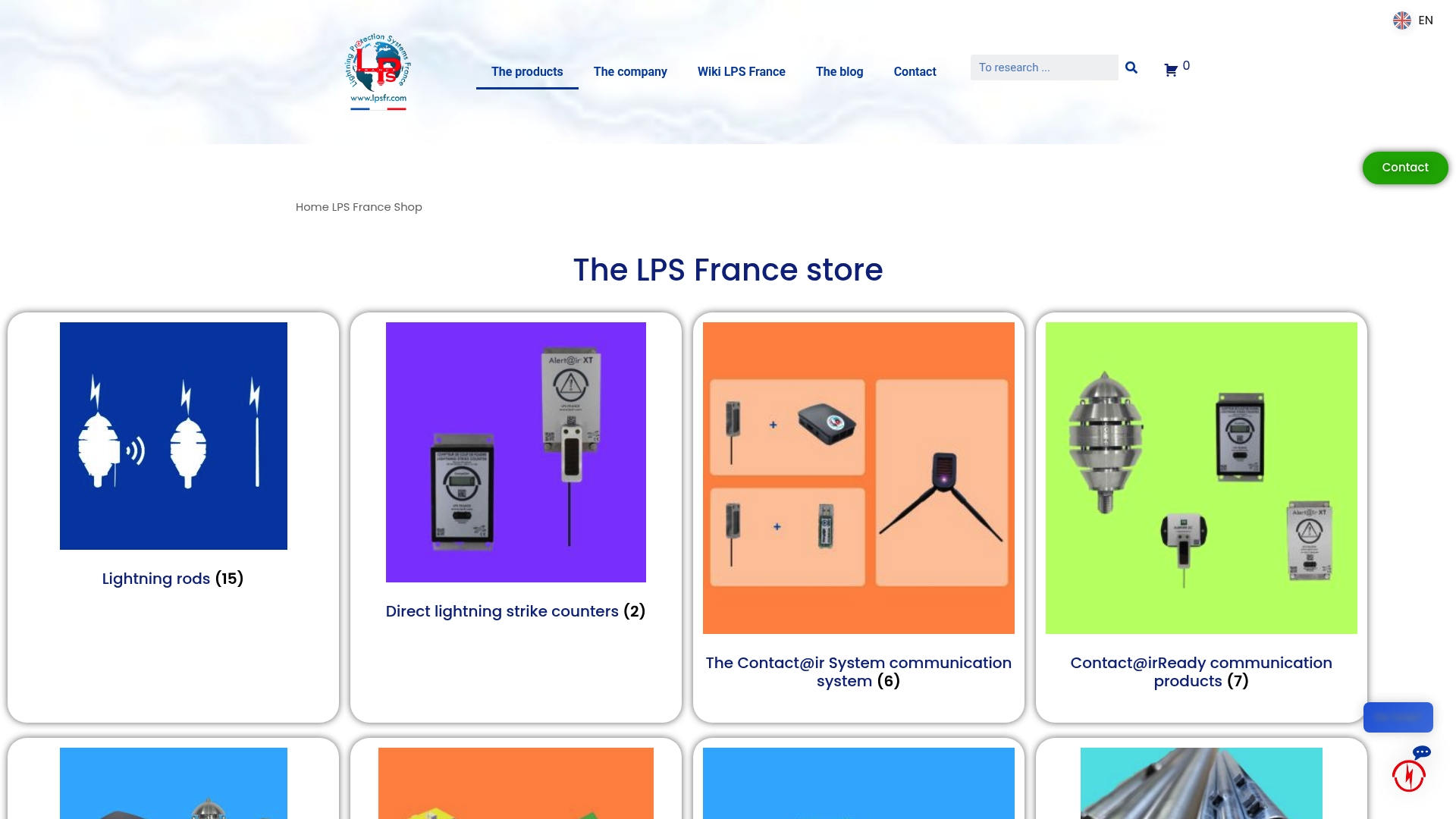
The Contact@ir system provides real-time monitoring and alerts. Three architectures are available to suit your needs: Dongl@ir for local diagnostics, Rout@ir for multi-device sites with internet access, Contact@ir MD for complete autonomy via mobile network.
Maintaining installations with Paraton@ir illustrates the advantages of predictive maintenance: reduced unnecessary visits, automated traceability, and guaranteed regulatory compliance. LPS France supports your projects from design to operation, with technical support and team training. To learn more about the solutions tailored to your needs, consult our comprehensive definition of a lightning rod and discover how to optimize your 2026 compliance.
What are the main lightning protection standards in 2026?
The main standards are IEC 62305:2024 and NF C 17-102:2011. IEC 62305:2024 covers overall protection and mandates communicating supervision. NF C 17-102:2011 specifies the French design and verification procedures with mandatory periodic maintenance.
How do communicating devices improve maintenance?
They detect lightning strikes in real time and automatically trigger verification workflows. Time-stamped logging ensures regulatory traceability. Teams no longer intervene systematically but only after an event or at the annual deadline, reducing unnecessary visits by 60 to 70%.
Which communication architecture should be chosen depending on the type of installation?
Contact@ir MD is suitable for remote sites without a local network thanks to its standalone cellular connection. Rout@ir is suitable for sites equipped with Wi-Fi or Ethernet that require real-time logging and alerts. Dongl@ir meets the needs of ad-hoc diagnostics without a permanent infrastructure.
How can we guarantee data security in connected systems?
Control access based on user profiles to limit the visibility of sensitive data. Use secure and redundant servers. Require contractual appendices detailing end-to-end encryption, identity management, audit logs, and GDPR compliance. Segment networks and filter outbound traffic.