
Indeed, do you think a simple lightning rod guarantees the safety of your commercial building? The reality is far more complex. The IEC 62305:2024 standard introduces comprehensive risk management that goes beyond simply installing lightning rods. This integrated approach, combining physical devices, connected monitoring, and intelligent maintenance, reduces risks by 47% while ensuring regulatory compliance. Discover how to optimize your lightning protection in 2026.
Table of Contents
- Introduction to lightning protection in the service sector
- Applicable standards: IEC 62305:2024 vs NF C 17-102:2011
- Physical protection devices adapted to commercial buildings
- Connected monitoring and intelligent maintenance with lps france
- Maintenance procedures, verification and regulatory compliance
- Case studies and integration into multi-site office buildings
- Conclusion and best practices for optimizing tertiary lightning protection
- Discover lps france solutions for optimal lightning protection
- Frequently Asked Questions
Key points to remember
| Point | Details |
|---|---|
| Regulatory compliance is crucial | The IEC 62305:2024 and NF C 17-102:2011 standards structure the overall approach to protection. |
| Essential connected monitoring | Contact@ir System and LPS Manager enable remote diagnostics and real-time alerts. |
| Proactive intelligent maintenance | Automated traceability reduces operating costs and ensures continuous compliance. |
| BMS/SCADA integration possible | The LPS Manager API facilitates multi-site and multi-building centralization. |
| Rigorous mandatory checks | Annual and post-impact checks are mandatory according to NF C 17-102 for legal validity. |
Introduction to lightning protection in the service sector
Commercial buildings face specific risks related to lightning. Lightning strikes can cause fires, business interruptions, and significant material damage in the commercial sector. Public access buildings (ERP) bear a heightened legal responsibility regarding occupant safety. Business continuity is also a major economic concern.
Furthermore, the economic consequences of inadequate protection amount to tens of thousands of euros per incident. Destruction of IT equipment, service interruptions, data loss, and civil liability accumulate rapidly. Regulatory compliance is no longer optional since the entry into force of the IEC 62305:2024 standard.
Furthermore, “Effective lightning protection in the service sector requires a systemic approach integrating risk analysis, standardized physical devices and connected monitoring to guarantee safety and compliance.”
Furthermore, the risks associated with lightning in the service sector extend far beyond a direct strike. Surges induced on electrical and communication networks often cause more damage than the strike itself. Therefore, comprehensive protection must cover multiple levels.
It should be noted that the regulatory importance has increased with the 2024 update of international standards. Insurers now require documented proof of compliance and maintenance. The absence of a compliant system can lead to denial of compensation and liability claims.
In general, a comprehensive approach is necessary given the complexity of modern commercial and industrial infrastructure. The installation of lightning rods, surge protectors, grounding systems, connected monitoring, and preventive maintenance form a coherent whole. Each element plays a specific role in the protection chain.
- Personal safety and ERP compliance
- Business continuity and equipment protection
- Legal liability and insurance coverage
- Compliance with IEC 62305:2024 standards
Applicable standards: IEC 62305:2024 vs NF C 17-102:2011
In practice, the IEC 62305 standard is structured in four main parts covering the entire protection cycle. The IEC 62305:2024 standard structures risk analysis by integrating loss of life, property damage, and business continuity under the National Safety Level (NSG). Part 1 defines the general principles. Part 2 details risk management and the evaluation of the NSG. Part 3 concerns physical damage to structures. Part 4 deals with electrical and electronic systems.
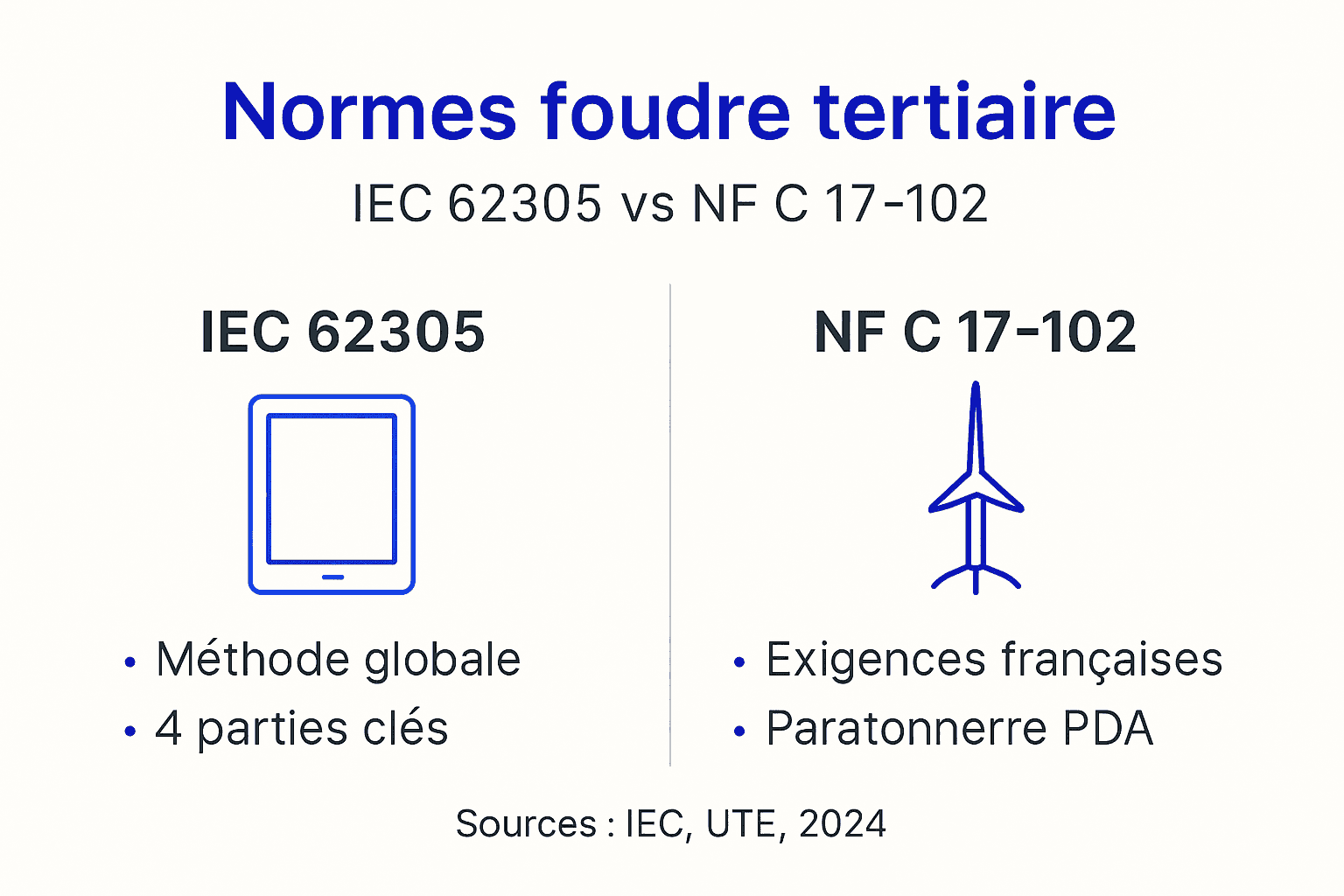
In concrete terms, the 2024 updates introduce a more refined approach to risk analysis. The NSG calculation now incorporates additional parameters related to economic losses and business continuity. This development recognizes the critical importance of modern tertiary infrastructure.
It should be noted that NF C 17-102:2011 specifies the French requirements for the sizing and testing of PDA lightning rods. This national standard complements IEC 62305 by establishing rules specific to the French context. It defines acceptable early-flash advances, test methods, and verification procedures.
Pro tip: Always combine the requirements of IEC 62305:2024 and NF C 17-102:2011 for optimal compliance. The international standard provides the overall methodological framework, while the French standard specifies the technical aspects of installing and testing PDA lightning rods.
| Standard | Main perimeter | Update |
|---|---|---|
| IEC 62305 | Comprehensive lightning risk management | 2024 |
| NF C 17-102 | Lightning rods, ESEs, and controls | 2011 |
In reality, the risk analysis methodology according to IEC 62305-2 follows a structured six-step process: identification of structures to be protected, assessment of local lightning strike density, calculation of risks by type of loss, comparison to the acceptable risk, selection of protection measures, and final validation of the National Safety Guarantee (NSG).
Indeed, the importance of combining these standards becomes clear during compliance audits. The differences in lightning protection standards require specialized technical expertise. A properly conducted risk analysis according to IEC 62305 determines the required protection levels and optimizes investments.
- NSG calculation based on site parameters
- Determining the level of protection (I to IV)
- Selection of devices compliant with NF C 17-102
- Sizing of surge protectors and grounding systems
- Maintenance and inspection planning
- Complete documentation for compliance and insurance
Physical protection devices adapted to commercial buildings
However, early streamer emission (ESE) lightning rods constitute the first line of defense. Paraton@ir lightning rods use a multi-eared emission device compliant with NF C 17-102, ensuring early lightning capture. Four models offer emission advances of 10, 25, 45, or 60 microseconds. These advances determine the protection radius and adapt to different tertiary configurations.
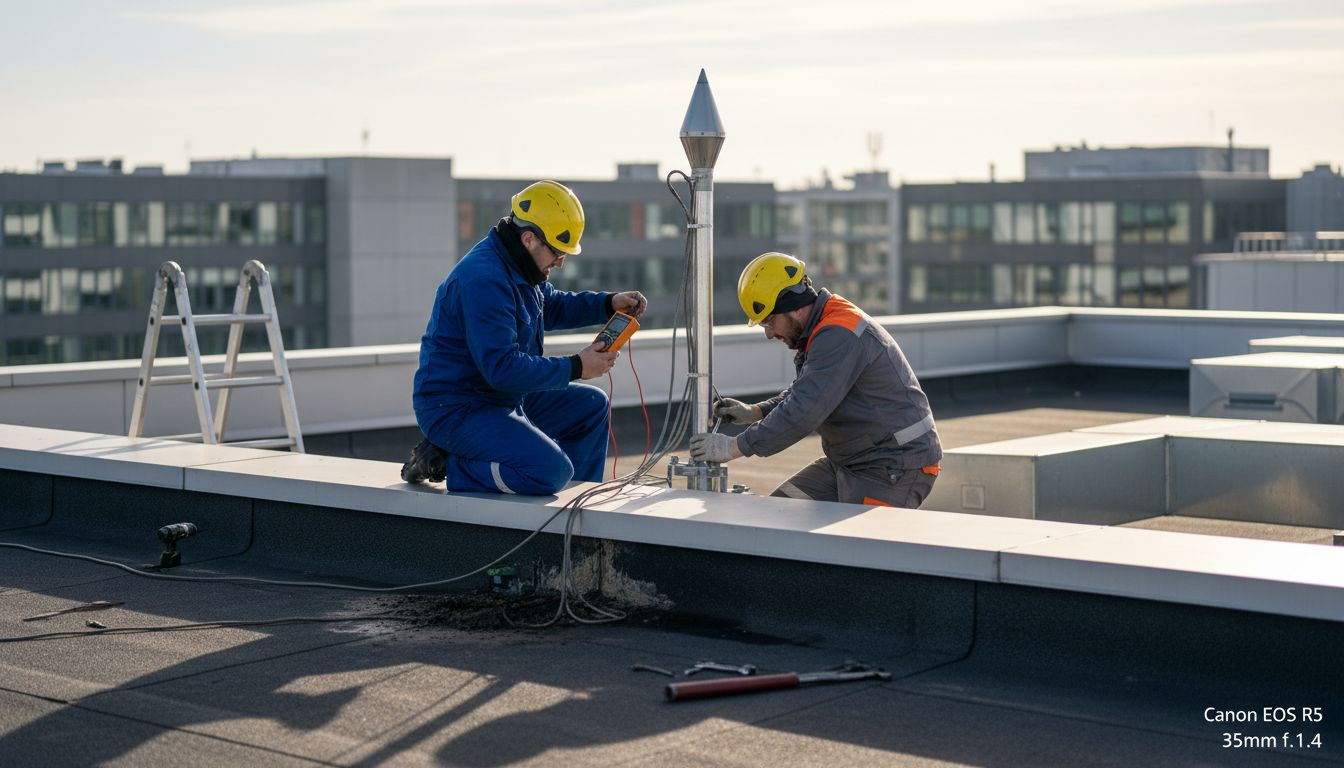
However, the operation of ESEs relies on the creation of an upward leader before impact. This early initiation allows the lightning to be captured over a wide radius, reducing the number of lightning rods required. The Paraton@ir communicating models also incorporate remote diagnostic capabilities.
However, properly sized surge protectors and grounding systems effectively dissipate induced overvoltages. Surge protectors protect electrical and communication circuits from voltage spikes. Installed in the main distribution board and sub-distribution boards, they divert overvoltages to ground.
Nevertheless, grounding systems ensure the effective dissipation of lightning currents. Ground resistance must comply with the standard values according to the chosen level of protection. Regular measurement guarantees consistent performance over time.
For example, Pro tip: Favor a phased protection zone approach. External zone (lightning rod), intermediate zone (type 1 and 2 surge arresters) and internal zone (type 3 surge arresters) create optimal cascading protection for complex commercial buildings.
Specifically, the selection criteria depend on several technical parameters: building height, presence of sensitive equipment, local lightning strike density, and the level of protection required according to the risk analysis. Early streamer emission (ESE) lightning rods are adaptable to each configuration.
- Evaluation of the protection radius based on the installation height
- Selection of the primer advance adapted to the level of protection
- Selection of surge protectors based on expected lightning currents
- Grounding system sizing based on soil resistivity
In particular, the installation steps follow a rigorous protocol. This includes a preliminary study and sizing calculations, installation of the lightning rod and connection to the down conductor network, installation of surge arresters and compliant grounding systems, compliance checks and measurements, and then documented commissioning.
- NSG Site Audit and Risk Analysis
- Design of the multi-layer protection system
- Installation of physical devices by a qualified company
- Testing and compliance measurements
- Complete documentation and traceability
Connected monitoring and intelligent maintenance with LPS France
In fact, LPS France offers three monitoring architectures adapted to the constraints of each site. Contact@ir tri-modal architecture adapts to network constraints for lightning protection monitoring. Contact@ir with Dongl@ir provides on-site spot diagnostics within an 80-meter radius. Contact@ir with Rout@ir ensures continuous multi-transmitter monitoring up to 300 meters with historical data logging. Contact@ir MD uses the cellular IoT network for complete autonomy without local infrastructure.
In this respect, key features transform traditional maintenance. LPS Manager guarantees traceability, real-time alerts, and document organization for proactive maintenance. Real-time alerts immediately signal any impact or defect. Automatic event logging provides evidence for insurance and audits. Remote diagnostics eliminate the need for routine site visits.
In this context, Pro Tip: Choose Rout@ir for multi-building office sites with existing network infrastructure. Its ability to manage up to 999 transmitters within a 300-meter radius centralizes monitoring while maintaining local autonomy via Bluetooth in case of network failure.
In other words, the benefits of preventive maintenance quickly become apparent. Unnecessary travel is reduced by 60% thanks to remote diagnostics. Intervention planning is optimized based on the actual condition of equipment. Complete traceability of checks ensures regulatory compliance. Failures can be anticipated before they become critical.
In other words, integration with BMS/SCADA systems facilitates centralized management. LPS Manager offers a key-based API to connect lightning protection to existing monitoring platforms. This convergence improves overall visibility and enables correlations with other security systems. Teams can manage similarly to other critical systems.
- Selection of the Contact@ir architecture according to site constraints
- Deployment of transmitters on Contact@ir Ready equipment
- Connected Monitoring Configuration Contact@ir
- Configuring alerts and notifications in LPS Manager
- API integration with intelligent maintenance systems using LPS Manager
- Training of teams and operating procedures
Maintenance procedures, verification and regulatory compliance
First, the NF C 17-102 standard mandates annual and post-event inspections to ensure the system's validity. These inspections are a legal requirement for public access buildings (ERP) and commercial buildings. They include a visual inspection of the overall condition, electrical measurements of continuity and earth resistance, functional testing of communication devices, and complete photographic documentation.
Next, the Compt@ir counters and Alert@ir XT detectors automatically trigger intervention procedures. Each recorded impact activates an alert in LPS Manager. The maintenance team receives an immediate notification with the event details. A complete post-impact verification then becomes mandatory according to NF C 17-102.
Finally, the organization of files via LPS Manager structures document management and regulatory compliance. Each site has a centralized digital file. Certificates of conformity, verification reports, impact histories, and intervention records are automatically archived. Geolocation facilitates multi-site tracking.
It is important to note that reducing legal risks relies on this rigorous traceability. In the event of a claim, documented evidence of compliance and regular maintenance protects against liability claims. Insurers require this documentation to validate coverage and compensation.
- Annual visual inspections of lightning rods and conductors
- Earth resistance and electrical continuity measurements
- Systematic post-impact verification after each recorded lightning strike
- Photographic documentation and time-stamped reports
- Digital archiving in LPS Manager
Indeed, it should be noted that lightning protection maintenance procedures follow a strict schedule. Annual checks are planned, post-impact interventions are triggered automatically, and there are post-construction inspections and periodic compliance audits for certification renewal.
- Real-time alert reception via LPS Manager
- Remote history review and diagnosis
- Triggering intervention if necessary
- On-site verification with Test@ir
- Compliance report and updated file
- Automatic validation and archiving
Case studies and integration into multi-site office buildings
Indeed, a 15,000 m² shopping center with covered parking illustrates the use of Contact@ir with Dongl@ir. Contact@ir solutions adapt to access and network constraints, enabling monitoring of isolated sites or multi-building systems. Lightning rods installed on rooftops require checks without a permanent network infrastructure. The technician performs spot checks via smartphone during scheduled annual inspections.
Thus, a university campus with eight buildings demonstrates the advantages of Contact@ir with Rout@ir. Each building has several communicating lightning rods. Three Rout@ir receivers connected to the campus Ethernet network centralize monitoring. The maintenance team consults LPS Manager to monitor all installations from the central technical office.
Furthermore, a chain of stores with 25 outlets spread across three regions operates Contact@ir MD. The lack of local IT infrastructure and the geographical dispersion make a wired architecture impossible. Each lightning rod communicates directly via a 4G cellular network. The group security manager oversees the entire system from LPS Manager with push alerts sent to smartphones.
| Architecture | Scope | Historical | Real time | Use Cases |
|---|---|---|---|---|
| Dongl@ir | 80 m | No | No | Monitoring of isolated sites, ad-hoc diagnostics |
| Rout@ir | 300 m | Yes | Yes, if internet | Multi-building management with centralized supervision |
| Contact@ir MD | Unlimited | Yes | Yes | Dispersed sites without a local network |
Furthermore, a 400-bed hospital is integrating lightning protection into its existing Building Management System (BMS). The LPS Manager API connects lightning alerts to the centralized technical management system. Alarms are then reported along with other security events. This centralized management integration improves the responsiveness of the technical teams.
- Shopping centers: one-off assessment Dongl@ir
- Campus and business parks: multi-point Rout@ir monitoring
- Distributed networks: autonomy Contact@ir MD cellular
- Critical sites: API integration in BMS/SCADA
Conclusion and best practices for optimizing tertiary lightning protection
Furthermore, strict compliance with IEC 62305:2024 and NF C 17-102:2011 standards entails your legal responsibility. Insurers make their coverage conditional upon documented compliance. Regular audits validate the maintenance of performance. A compliant installation protects against claims in the event of a loss.
Note that connected maintenance and real-time alerts drastically reduce operational risks. Targeted interventions replace costly routine checks. Automatic traceability simplifies regulatory compliance. Operating costs decrease by 40% over three years.
In general, opt for an integrated solution combining standardized physical devices and digital monitoring. NF C 17-102 compliant ESE lightning rods, multilayer surge arresters, properly sized grounding systems, and Contact@ir System form a coherent whole. LPS Manager centralizes monitoring, alerts, and documentation.
In practice, plan multi-site management with tools tailored for efficiency and traceability. The Contact@ir adapts to your network constraints. The API enables BMS/SCADA integration. Monitoring best practices for tertiary lightning protection becomes simple and effective.
- NSG risk analysis compliant with IEC 62305-2:2024
- Installation of devices compliant with NF C 17-102
- Deployment of adapted connected monitoring
- Rigorous maintenance procedures and checks
- Documentation and traceability via LPS Manager
Discover LPS France solutions for optimal lightning protection
In practical terms, LPS France offers comprehensive solutions to protect your commercial buildings. From risk analysis and installation to connected monitoring, follow the lightning protection compliance steps with expert guidance. Our lightning rods, manufactured in France, and our Contact@ir systems guarantee safety and compliance.
Remember that LPS Manager connects to your maintenance management system, allowing you to optimize your operations. Real-time alerts, automatic history logging, and compliance reports simplify your operations. API integration facilitates centralized multi-site monitoring. Our teams provide training and technical support to assist your teams.
We emphasize that you can develop your engineers' expertise with our lightning protection training courses LPS France . Understand the standards, master sizing calculations, and optimize your installations. This professional certification is recognized to enhance your technical skills.
Frequently Asked Questions
What is the main difference between the IEC 62305 standard and the NF C 17-102 standard?
In reality, IEC 62305:2024 provides the overall methodological framework for lightning risk management, including NSG calculation and protection level selection. NF C 17-102:2011 specifies the French technical requirements for ESE lightning rods, notably acceptable early streamer emission (ESE) times and control procedures. The different lightning protection standards necessitate combining both frameworks for full compliance.
How do I choose the right monitoring system for my commercial site?
Indeed, evaluate three main criteria. Available network connectivity: Ethernet/Wi-Fi suggests Rout@ir, no network suggests Contact@ir MD cellular. Number of points to monitor: fewer than 5 accepts Dongl@ir, complex installations require Rout@ir. Need for history and real-time alerts: essential for ERPs and critical sites, necessitates Rout@ir or MD. Budgetary and operational constraints refine the final choice.
What are the frequencies and procedures for regulatory checks?
However, NF C 17-102 mandates a comprehensive annual inspection, including visual inspection, electrical measurements, and functional tests. A complete verification is required after each lightning strike recorded by a meter or detector. The Compt@ir and Alert@ir XT meters automatically trigger these interventions via LPS Manager alerts. Photographic documentation and time-stamped reports constitute proof of compliance for insurance and regulatory audits.
How does connected maintenance reduce costs and risks?
However, connected lightning protection management eliminates 60% of call-outs thanks to remote diagnostics. Interventions become targeted based on the actual condition of the equipment. Real-time alerts enable immediate post-impact response. Automatic traceability simplifies compliance and reduces legal risks. Return on investment is achieved within 18 months for multi-site installations.
Can lightning protection be integrated into existing BMS or SCADA systems?
However, yes, LPS Manager offers a USB-based API enabling full integration with your technical management systems. The Enterprise edition includes API access, technical support, and Fleet service for multi-rodholder coordination. Lightning alerts are sent to your monitoring platform along with other security events. This convergence improves overall visibility and the responsiveness of technical teams while maintaining specific lightning protection traceability.