
Lightning protection installations in France frequently fail due to non-compliance with regulations and the lack of connected diagnostics. Without strict adherence to standards NFC 17-102:2011 and IEC 62305, lightning protection systems become vulnerable. This guide presents each step of a reliable installation, from regulatory preparation to connected maintenance, enabling a drastic reduction in failures and a 25% increase in planned interventions thanks to connected diagnostics .
Table of Contents
- Key points to remember
- Prerequisites and regulations
- Choosing the device and preparation
- Physical Installation Steps
- Integration of the connected monitoring system
- Verification and quality control
- Common mirods and practical solutions
- Maintenance and post-installation follow-up
- LPS France solutions for a successful lightning protection installation
- Frequently asked questions about lightning rod installation
Key points to remember
| Point | Details |
|---|---|
| Mandatory regulatory compliance | The NFC 17-102:2011 and IEC 62305 standards define design, installation and maintenance to ensure efficiency. |
| Recommended connected architecture | Contact@ir System (Dongl@ir, Rout@ir, MD) offers remote diagnostics, real-time alerts and fault reduction. |
| Six steps of physical installation | Fixing, conductors, grounding, Test@irwire tests, continuity validation and LPS Manager documentation. |
| Common, avoidable mirods | Incorrect conductor sizing, non-compliant distances and omission of grounding compromise protection. |
| Proactive maintenance is essential | Using Compt@ir and Alert@ir XT with LPS Manager tracking reduces unplanned visits and associated costs. |
Prerequisites and regulations
Compliance with French and international standards is the foundation of any professional installation. The NFC 17-102 standard imposes precise requirements on the design, installation, and maintenance of lightning rods in France. The IEC 62305 standard provides a complementary international framework. Understanding the distinctions between lightning rods and surge protectors according to IEC 62305 avoids technical confusion.
Before any intervention, check the necessary equipment and safety conditions:
- Professional tools, calibrated and compliant with French electrical standards
- Equipment certified to NFC 17-102 and IEC 62305 with manufacturer traceability
- Secure access to the site with harnesses, compliant ladders and a marked perimeter
- Complete personal protective equipment suitable for working at height
The list of required materials includes the selected lightning rod, copper or aluminum down conductors, corrosion-resistant mounting brackets, earthing rods or copper plates, Equipotential Spark Gap, and exothermic welding equipment. An LPS Manager account must be created beforehand to register the installation and activate connected monitoring upon commissioning. This documentation facilitates traceability and guarantees.
Choosing the device and preparation
Selecting the appropriate lightning rod depends on several technical and organizational criteria. Paraton@ir is a communicating device offering periodic diagnostics, while Ellips requires wired testing . Lightning rod selection criteria include the environment (urban, industrial, rural), lightning risk level, access constraints, and maintenance strategy.
The Paraton@ir and Ellips devices are available in four models, differentiated in advance at startup (10, 25, 45, 60 µs). Paraton@ir natively integrates Contact@ir Ready for connected monitoring. Ellips is suitable for sites favoring traditional wired diagnostics, with the option to add communicating meters later.
Site preparation:
- Preliminary inspection of the roof or load-bearing structure to verify mechanical resistance
- Securing the work area and installing signage
- Weather conditions checked (no storm forecast, moderate wind)
- Preparation of fixing surfaces according to roof type (concrete, steel, tiles)
Checklist of equipment to be installed includes lightning rod, mast if necessary, conductors with appropriate cross-section, standard spacing clamps, earthing rods of appropriate diameter, Equipotential Spark Gap, Test@ir device for validation and Contact@ir System option according to the architecture chosen.
Physical Installation Steps
The mechanical installation follows six rigorous steps ensuring regulatory compliance and operational safety:
- The lightning rod should be fixed at the highest point of the building, respecting a minimum distance of 2 meters from metal elements and antennas
- Check verticality using a level, then tighten to the specified torque to avoid deformation
- Laying down conductors along the structure, prioritizing the shortest and most direct path to ground
- The conductors are secured with clamps every 80 cm on the vertical face, ensuring rigid support without excessive stress
- Grounding connection via grounding rods or copper plates, with exothermic welding for optimal electrical continuity
- Installation of Equipotential Spark Gap connecting all metallic parts of the building to the earthing network
Incorrect conductor sizing compromises protection . The minimum cross-section depends on the material: 50 mm² for copper, 70 mm² for aluminum. Standard distances require a minimum separation of 1 meter between conductors and unconnected metallic elements. Grounding according to standards requires a resistance of less than 10 ohms, verifiable by earth resistance measurement.
| Stage | Applicable standard | Validation criteria |
|---|---|---|
| Lightning rod mounting | NFC 17-102 §5.2 | Distance ≥ 2 m metallic elements |
| Drivers descending | IEC 62305-3 | Copper cross-section ≥ 50 mm² |
| Earthing system | NFC 17-102 §6 | Resistance ≤ 10 Ω |
| Continuity tests | IEC 62305-3 | Resistance < 0.2 Ω between points |
Mandatory wired tests with Test@ir validate proper operation before commissioning. Physical installation of the lightning rod requires verification of complete electrical continuity of the circuit, from the lightning rod head to the ground connection.
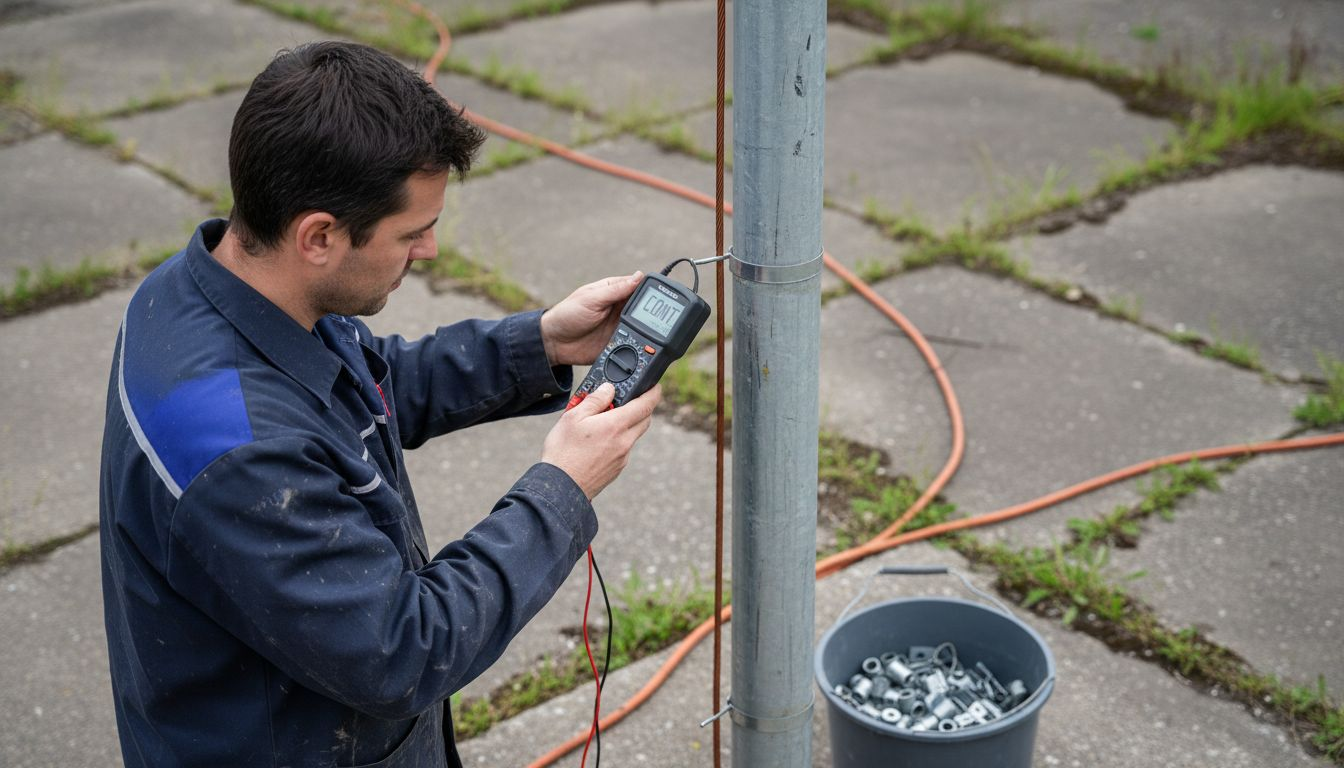
Pro tip: During installation, check electrical continuity after each major connection with a calibrated multimeter. A resistance greater than 0.2 ohms between two points indicates a faulty connection requiring immediate rewiring. Document each measurement in LPS Manager for complete traceability.
Integration of the connected monitoring system
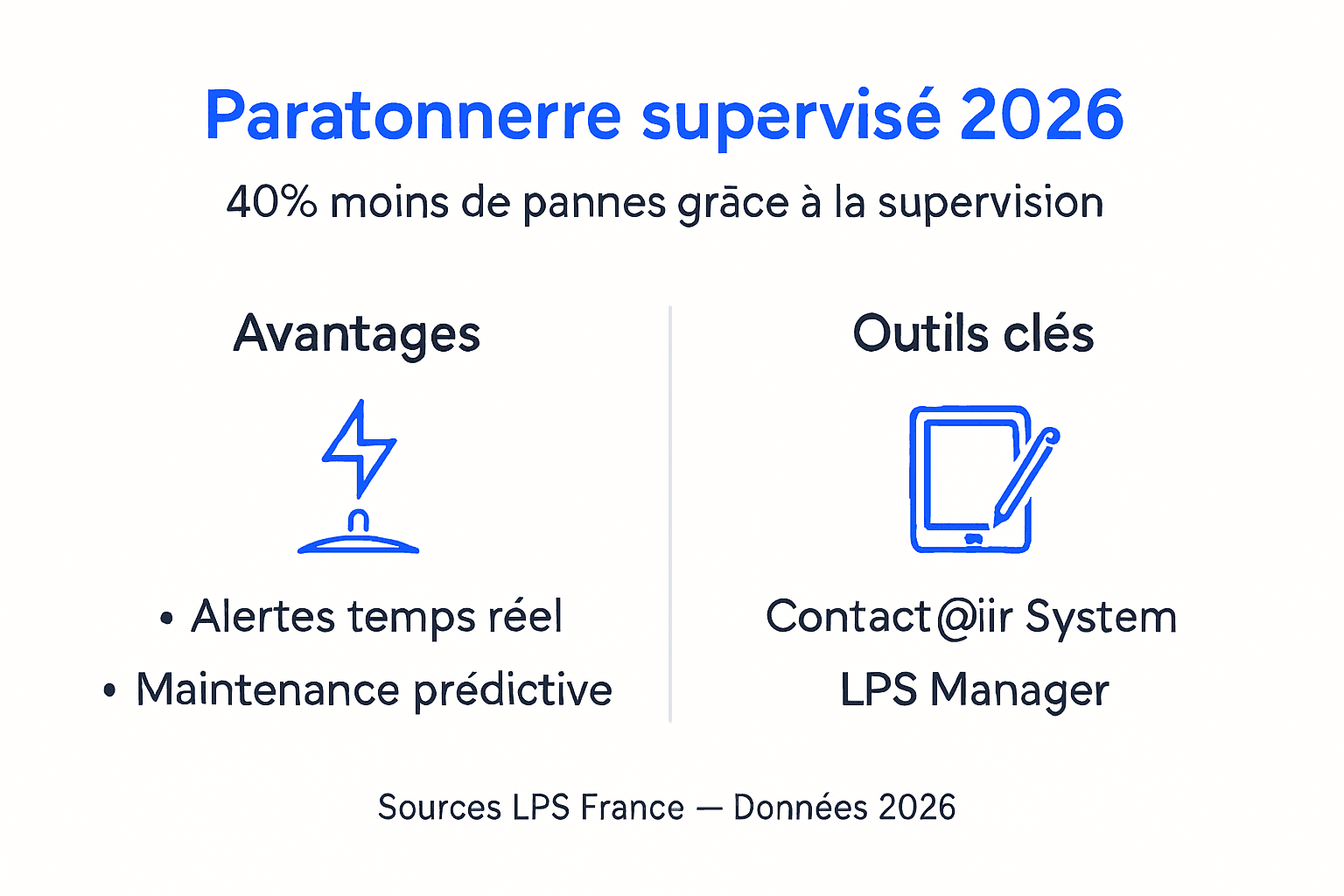
Contact@ir integration transforms a traditional installation into a real-time monitored system. Connected integration via Contact@ir reduces downtime by 40% through proactive maintenance . Three architectures are available to installers, depending on site constraints and maintenance strategy.
Contact@ir with Dongl@ir is suitable for remote sites without internet connectivity. On-demand diagnostics are performed on an Android smartphone via USB receiver, with a range of up to 80 meters. This mobile solution is ideal for scheduled annual checks without a permanent infrastructure.
Contact@ir with Rout@ir provides a multi-transmitter, stationary solution. Rout@ir options for local monitoring include on-site Bluetooth reading and cloud uploading if internet access is available (Wi-Fi, Ethernet, mobile data). A range of 300 meters allows for industrial site coverage with local data logging.
Contact@ir MD operates completely autonomously via a 4G/3G/2G mobile network with an integrated international eSIM. It sends alerts instantly to the cloud and performs product diagnostics every 12 hours. This architecture is ideal for distributed sites without a usable IP network.
LPS Manager configuration:
- Create a professional account with installer contact details
- Product registration via serial numbers and certificates of authenticity
- Site folder assignment with Google Maps geolocation
- Setting up alerts (email, push notifications, trigger thresholds)
Benefits of connected monitoring include real-time impact alerts, periodic self-testing, predictive maintenance based on historical data, and complete traceability for regulatory compliance. Practical examples show that a multi-building industrial site benefits from centralized Rout@ir , while isolated sites prefer Contact@ir MD.
Pro tip: To optimize alerts, configure intervention time slots and escalation levels according to severity in LPS Manager. A lightning strike detected outside of business hours can trigger on-call duty, while a routine self-diagnostic generates a simple email notification to the maintenance team.
Verification and quality control
Final tests guarantee installation compliance before official commissioning. Tests with Test@ir ensure compliance before commissioning . The procedure includes functional verification of the Contact@ir Ready product, a complete electrical continuity test, and measurement of earth resistance.
Test@ir enables complete wired diagnostics:
- Tester connection to the lightning rod via dedicated terminal block
- Launching automatic test sequence validating internal circuits
- Verification of displayed results conforms to manufacturer specifications
- Documentation of results with photos and screenshots in LPS Manager
Checking electrical connections requires a calibrated professional multimeter. Resistance measurement between the sensor head and ground should show a value less than 0.5 ohms. Resistance between the ground connection alone must remain below 10 ohms. Equipotential Spark Gap requires perfect continuity with no measurable resistance.
Quality control practices require a complete visual inspection: tightening of clamps, absence of corrosion on connections, secure mechanical fixings, and adherence to safety distances. Post-installation verification tests include simulated alerts via Contact@ir System to validate cloud reporting and LPS Manager notification receipt.
Comprehensive documentation in LPS Manager includes installation photos, test results, material certificates, conductor layout plans, and scheduled maintenance plans. This traceability facilitates compliance audits and warranty renewals.
Common mirods and practical solutions
Field feedback identifies recurring errors that compromise the effectiveness of lightning protection. Insufficient down conductors affect 20-30% of installations posing a major risk. Undersized conductor cross-sections cause overheating during lightning current passage, with a risk of partial melting.
Common mirods and corrections:
- Incorrect conductor sizing : Check minimum cross-section 50 mm² copper or 70 mm² aluminium according to NFC 17-102. Replace non-compliant conductors before commissioning.
- Failure to comply with standard distances : Measure the actual distance between the conductor and metallic elements. A distance of less than 1 meter requires additional equipotential bonding or a modification of the wiring.
- Failure to provide effective grounding : Perform a professional earthing measurement. Resistance exceeding 10 ohms requires the addition of ground rods or copper plates until compliance is achieved.
- Connected diagnostic configuration failures : Test Contact@ir Rout@ir reception before leaving the site. Validate the received test alert in LPS Manager with the correct timestamp.
Common errors require prompt intervention. Insufficient grounding can be corrected by adding earthing rods spaced at least 3 meters apart, interconnected with conductors of the same cross-section. Non-compliant distances sometimes necessitate a complete architectural overhaul with a new conductor layout.
Error prevention on construction sites relies on a systematic pre-installation checklist, team training on current standards, and intermediate quality audits. Photographic documentation of each step in LPS Manager facilitates anomaly detection and compliance verification.
Maintenance and post-installation follow-up
Regular maintenance preserves the effectiveness of protection over the installation's lifespan. NFC 17-102 mandates a complete annual verification and systematic inspection after each detected lightning strike. Using connected systems reduces unplanned emergency visits by 25%.
The standardized maintenance protocol includes six interventions:
- Complete visual inspection: corrosion, loosening, mechanical damage
- Electrical continuity test with Test@ir and earth resistance measurement
- Checking the condition of the down conductors and Equipotential Spark Gap
- Check mechanical fixings and retighten if necessary
- Validation of connected system functionality Contact@ir
- Complete documentation in LPS Manager with photos and measurements
Alert@ir XT for lightning strike monitoring automatically detects lightning strikes captured by the installation. Compt@ir displays the cumulative number of strikes on a six-digit digital counter. This equipment triggers real-time alerts in LPS Manager during events, enabling targeted post-storm intervention.
LPS Manager's alert and history management centralizes telemetry data: periodic self-diagnostics, detected impacts, reported defects, and completed interventions. Automated reports facilitate regulatory compliance justification during audits. Multi-site geolocation optimizes maintenance route planning.
Post-installation maintenance practices show that proactive connected monitoring reduces operating costs by anticipating breakdowns and optimizing travel. Measurable impact includes a 40% decrease in unplanned breakdowns, a 25% reduction in emergency visits, and a 30% improvement in regulatory audit compliance rates.
LPS France solutions for a successful lightning protection installation
LPS France supports professional installers with a complete range of lightning protection solutions manufactured in France. Discover Paraton@ir and Ellips to select the appropriate device based on your environment and maintenance strategy. Paraton@ir offers native connected monitoring, whileEllips is suitable for traditional installations with the option of gradual upgrades.
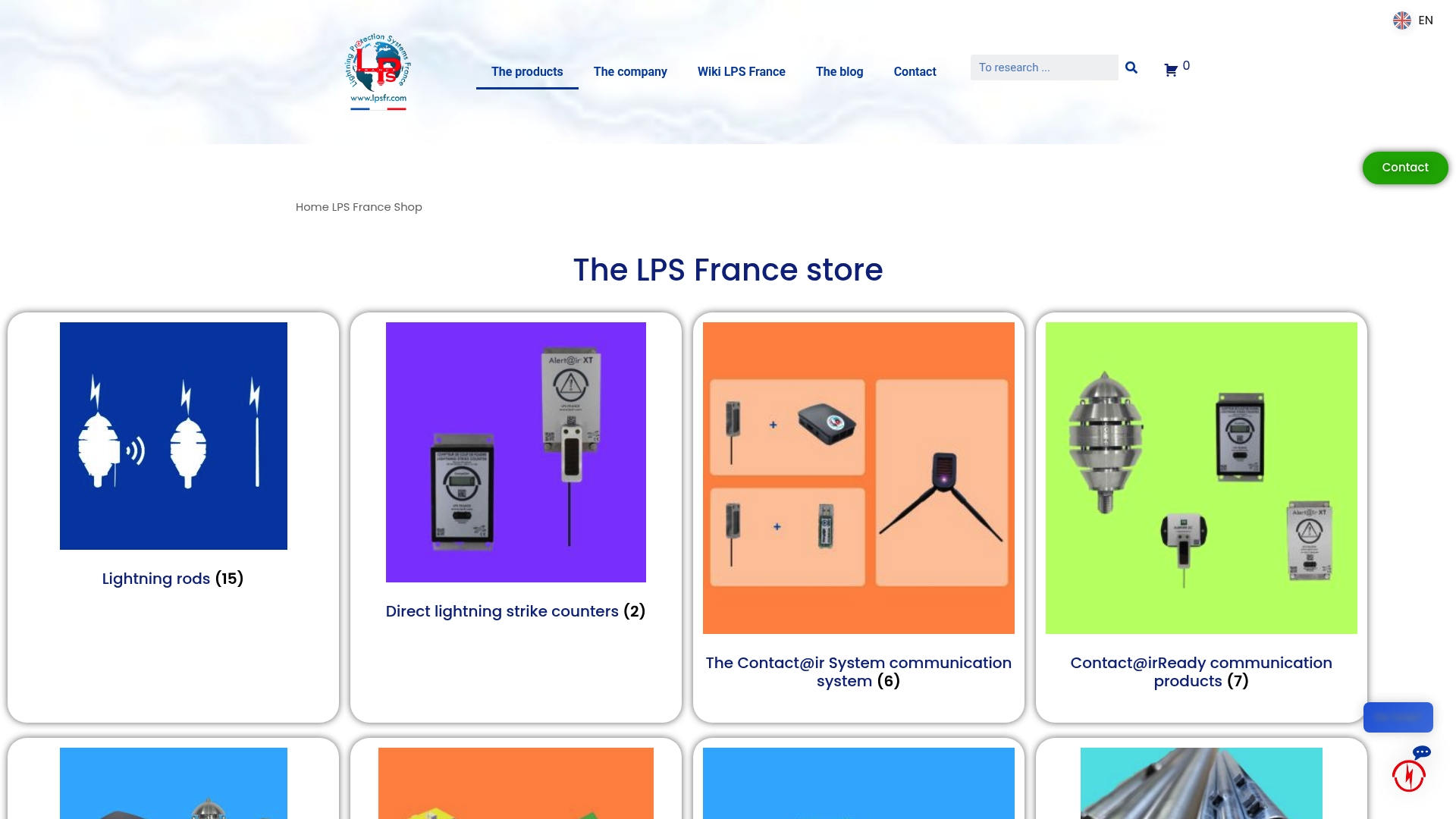
Contact@ir connected solutions transform traditional lightning protection into an intelligent system with remote diagnostics, real-time alerts, and predictive maintenance. A tri-modal architecture (Dongl@ir, Rout@ir, Contact@ir MD) adapts to the constraints of each site. The LPS Manager application centralizes multi-site monitoring with automated compliance reports.
LPS France maintenance services include installer training, premium technical support, and NFC 17-102 certification assistance. An extended warranty, obtained through LPS Manager registration, covers parts and labor. Permanent stock in France ensures immediate availability and fast 24-48 hour delivery.
Frequently asked questions about lightning rod installation
What standards will govern the installation of lightning rods in France in 2026?
The French standard NFC 17-102:2011 defines requirements for design, installation, and maintenance. The IEC 62305:2024 standard provides a complementary international framework. These standards mandate conductor sizing, safety distances, and annual verification protocols.
What is the difference between Paraton@ir and Ellips for my project?
Paraton@ir integrates Contact@ir Ready system, enabling remote diagnostics and real-time alerts via LPS Manager. Ellips requires wired Test Test@ir during checks. Paraton@ir is suitable for sites prioritizing proactive connected maintenance, while Ellips is better suited to traditional installations with periodic on-site inspections.
How to correctly size down conductors
Minimum cross-section depends on the material: 50 mm² for copper, 70 mm² for aluminum according to NFC 17-102. Verify sufficient mechanical strength and secure with clamps every 80 cm maximum. Incorrect sizing can cause dangerous overheating during lightning currents.
What is the maximum permissible earth resistance?
NFC 17-102 mandates a grounding resistance of less than 10 ohms. A professional telluric measurement confirms compliance. Excessive resistance requires the addition of copper rods spaced at least 3 meters apart or grounding plates, depending on the soil type.
Is Contact@ir System mandatory for regulatory compliance?
No, compliance with NFC 17-102 and IEC 62305 is based on the physical installation design. Contact@ir System offers a modernization option that facilitates maintenance with remote diagnostics, real-time impact alerts, and a 40% reduction in breakdowns thanks to connected LPS Manager monitoring.
How often is maintenance required after installation?
NFC 17-102 mandates a complete annual verification and systematic inspection after each detected lightning strike. Compt@ir and Alert@ir XT connected systems automatically trigger alerts requiring targeted intervention, optimizing maintenance planning.